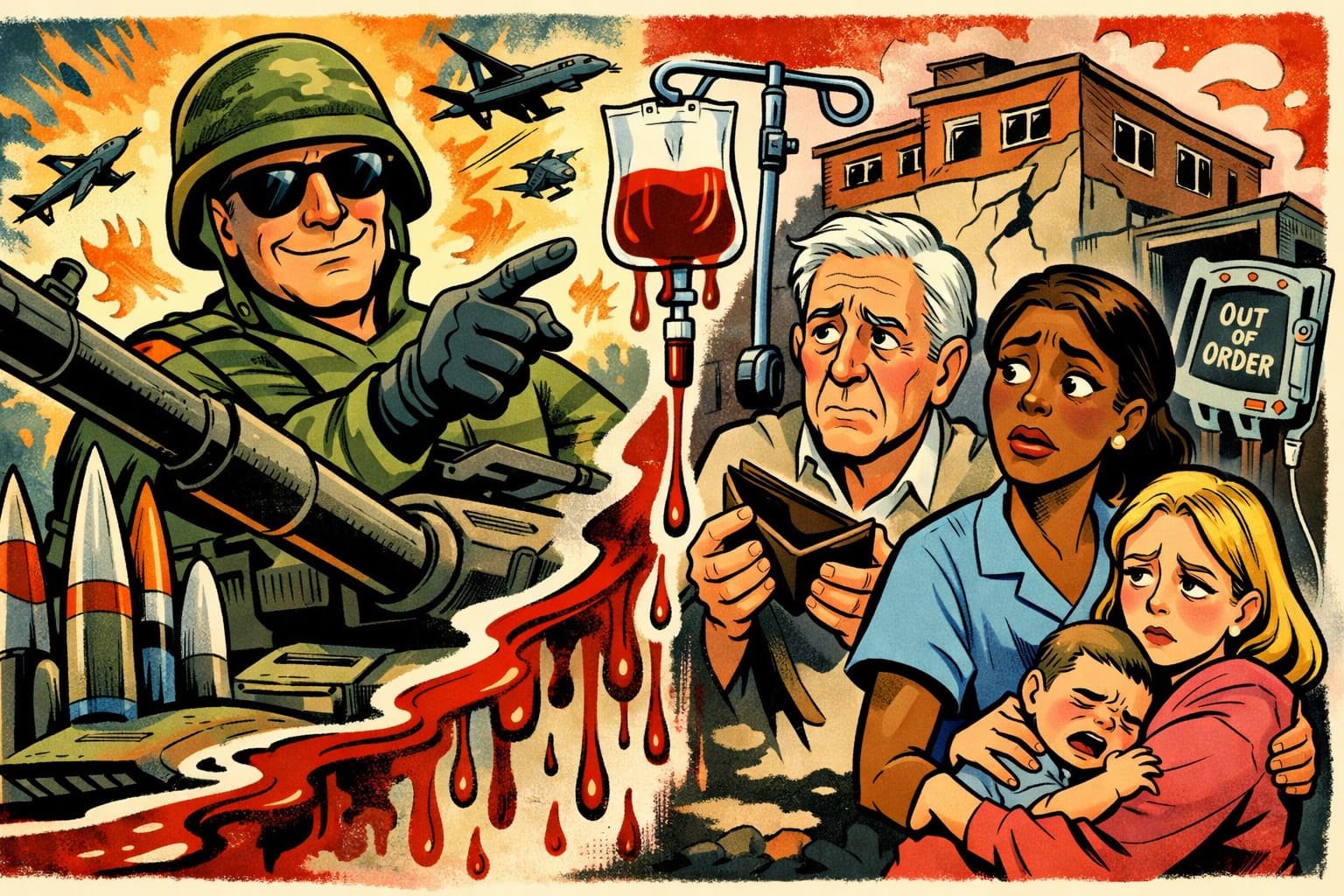
The old peace dividend now feels like a relic from a museum gift shop, tasteful, optimistic, and no longer priced for the world outside. Across many countries, defense has moved from peripheral line item to urgent headline. Tanks, air defense, ammunition, cyber capability, resilience, and strategic stockpiles now speak with a volume that housing, schools, clinics, and local transit struggle to match. Security has returned to budget politics with a stern face and a hand already inside the public wallet. Once that happens, the question is no longer whether defense matters. It is what must quietly bleed to make room for it.
That trade-off is emotionally brutal because defense spending has a unique moral charge. It is not just another claim on the treasury. It is tied to sovereignty, deterrence, fear, and survival. Cutting it can sound naive. Expanding it can sound patriotic. Yet budgets still obey arithmetic. New military commitments do not float above domestic priorities in some noble separate sky. They land in the same ledger as welfare, education, transport, pensions, and health. The IMF’s recent work on fiscal advice and military spending, along with ECB analysis on higher defense plans, reflects how central this tension has become.
That is why defense first budgets often create a peculiar kind of political silence. Leaders speak clearly about threats, but less clearly about substitution. The public hears that more security is needed. It hears less about which hospital expansion may wait, which rail line may slip, which benefit reform may harden, or which tax increase may creep in through the side door. National security is framed as an imperative. Social trade-offs are framed as unfortunate technicalities. That communication gap matters because democratic consent weakens when sacrifice is hidden behind strategic language.
Europe has been living through this recalibration in real time. The war on the continent changed the mood, and not without reason. States that had spent years treating defense as manageable background noise were suddenly forced to confront ammunition shortages, procurement delays, and industrial weakness. The mistake would be to conclude that higher defense spending is automatically wasteful. It is not. The sharper mistake is pretending that urgency excuses bad procurement, poor oversight, and vague financing. Security can be essential and still be inefficiently bought. Patriotism does not audit contracts.
A nurse in a provincial town can feel this shift more quickly than a bond trader. Her hospital postpones upgrades. Her rota tightens. Her pay settlement becomes politically awkward. At the same time national leaders talk about deterrence with righteous gravity. She may agree with them and still feel bruised by the budget. That is the human shape of guns-versus-butter debates. People often understand the strategic case long before they accept the distributive one. Their objection is not always to defense itself. It is to being asked to absorb invisible trade-offs while being told the nation has simply chosen seriousness.
There is also a nasty temptation hidden inside the defense revival: using military urgency as fiscal cover. Once the public accepts that threats are real, governments may discover room to loosen discipline more broadly. A flexibility clause for defense can become a backdoor for general softness if institutions are weak and scrutiny gets sentimental. That is why fiscal credibility matters even more in hard times. A serious security posture should be paired with serious budget honesty. Otherwise the politics of danger becomes a blank cheque written in a trembling hand.
The best case for stronger defense budgets is not martial theater. It is clear-eyed realism. Deterrence is a public good. Freedom is not maintained by slogans. Supply chains for defense equipment cannot be wished into existence during a crisis. Those are adult facts. Yet another adult fact follows. If states want more military capability, they need better prioritization, not just bigger appropriation. Procurement reform, joint purchasing where sensible, industrial coordination, maintenance discipline, and transparent long-term planning can do more for national safety than a noisy spending spike built on panic.
A shipyard manager in northern Europe once put it neatly. “Everyone loves rearmament until the invoice meets the labor shortage.” He was not making a joke, at least not entirely. Defense is not bought in abstract patriotic units. It competes for engineers, steel, energy, factory space, and public borrowing capacity. The same state that wants more shells may also want more social homes, more green infrastructure, and more healthcare workers. These demands do not politely line up. They elbow one another in the dark. That is why simple rhetoric fails once the budget season gets real.
There can be spillovers from defense spending. Some technologies diffuse. Some production networks strengthen. Some resilience benefits reach civilian systems. But those gains are not automatic, and romanticizing them can become another excuse for lazy policy. A missile plant is not a childcare system. A drone contract is not a pension reform. A radar upgrade does not fix a housing shortage. Societies get into trouble when every form of spending is forced to wear the mask of growth or national renewal. Sometimes a line item is simply costly and necessary. Mature budgeting begins there.
The deeper political risk is that defense crowds out not only spending, but imagination. Once public debate is organized around threat, softer priorities become easier to dismiss as indulgence. Local services start to sound small. Community repair sounds soft. Cultural spending sounds unserious. Yet social fragility is also a national vulnerability. A country that buys hardware while letting civic trust rot is not becoming strong. It is becoming armored and brittle, which is not the same thing at all. A stable republic needs deterrence at the border and legitimacy at the bus stop.
No budget reveals a government’s values more starkly than one written under fear. Fear clarifies and distorts at the same time. It shows what leaders believe must be protected. It also tempts them to hide the true price of protection. The task is not to choose between safety and society. It is to refuse the lazy politics that treats that balance as someone else’s problem. The current fiscal debate on defense makes one thing plain: security can be vital, and still demand sharper honesty than governments usually offer.
In the end, a defense first budget is a portrait of a nation under pressure, one hand on the shield, the other digging through its own pockets for what it can no longer postpone. The tragedy is not that trade-offs exist. The tragedy is how often they are hidden until the cut is felt in the places where everyday life actually lives. A country may indeed need more armor. The harder question is whether it still remembers that a nation is not only what it can defend, but what it chooses not to let quietly bleed while doing so.
