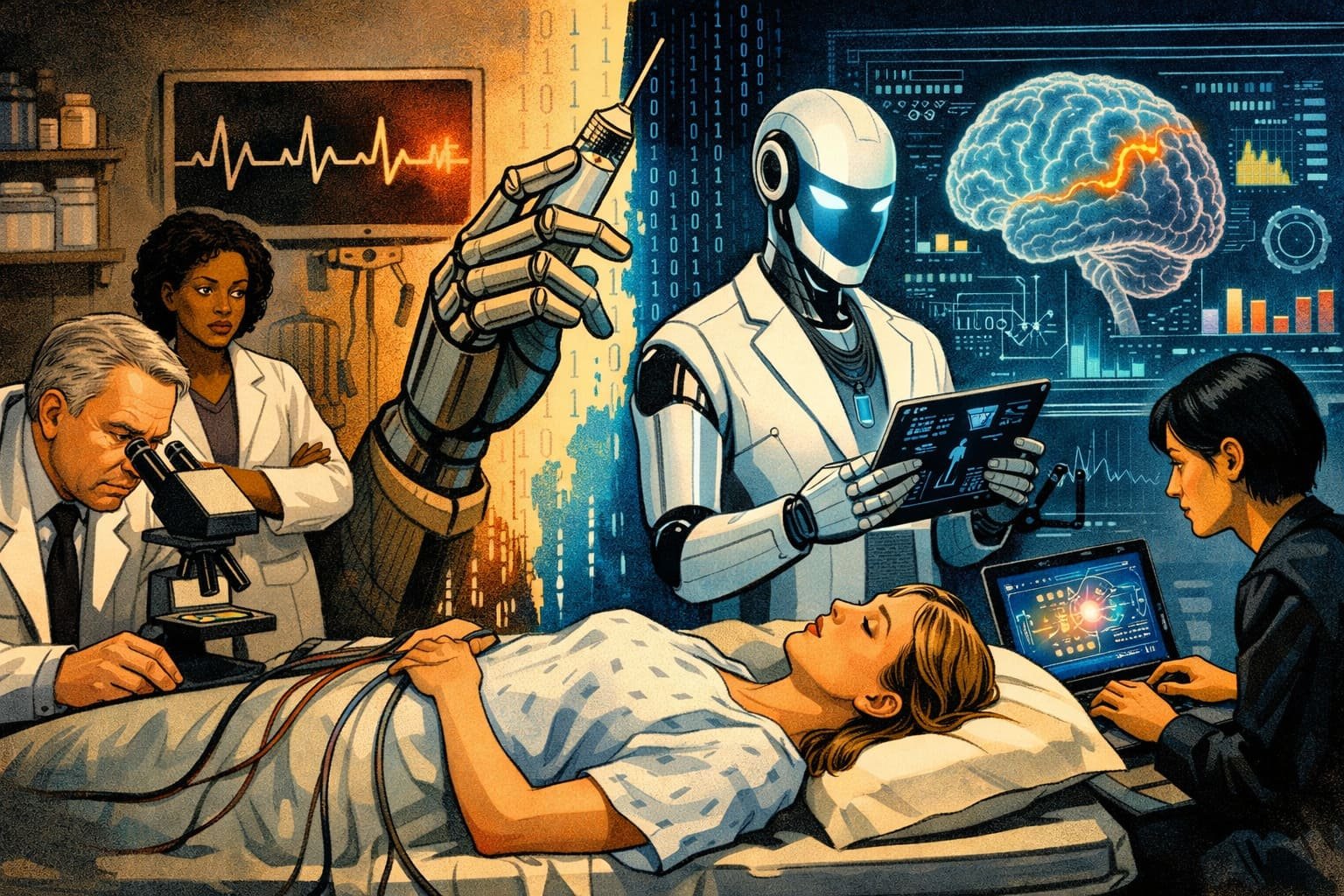
Hospitals once sold a comforting fiction. White coats, clean lights, clipped voices, charts, machines that beeped with sterile certainty. The setting implied that medicine, for all its flaws, was at least recognizably human in its chain of judgment. A patient described pain. A clinician interpreted. Experience met uncertainty and made a call. That story is still partly true, but the exam room has gained a new, quieter participant. It does not wear a badge. It does not shake hands. It parses images, flags risk, drafts notes, predicts deterioration, suggests diagnoses, and increasingly shapes the tempo of care. Artificial intelligence in healthcare has moved from side tool to embedded influence, and with that move medicine has lost a little innocence. The World Health Organization and the FDA both now frame AI in health as promising and risky, a combination that deserves more suspicion than marketing usually permits.
The enchantment is obvious. Healthcare is drowning in data, administrative drag, clinician burnout, imaging backlogs, staffing pressure, and the ancient misery of too many patients chasing too little time. AI arrives offering relief. Faster reads. Better triage. Cleaner documentation. Earlier signals. More personalized care. In that context, adopting algorithms can look less like recklessness and more like mercy. A radiologist buried under scans does not need a lecture on purity. A hospital leader facing queues and exhausted staff does not need a sonnet about tradition. They need help. That urgency is real, which is exactly why the conversation gets dangerous. When desperation meets shiny tools, scrutiny often gets treated like sabotage.
And the tools are spreading. The FDA now maintains a public list of AI-enabled medical devices authorized for marketing in the United States, framing the list as a transparency resource for patients, providers, and developers. That matters because AI in medicine is no longer a pilot project whispered about at innovation panels. It is becoming infrastructure, especially in image-heavy specialties and software-mediated workflows. Once a technology becomes infrastructure, it stops feeling optional. That is where innocence disappears. A stethoscope assists the clinician. An algorithm can quietly reshape what the clinician notices, ignores, trusts, and clicks past. Influence becomes ambient. Responsibility gets harder to map.
The old moral comfort of medicine rested on a human face attached to a hard choice. If something went wrong, blame, grief, accountability, and apology at least had somewhere to land. AI muddies that geography. If a decision support tool nudges the wrong diagnosis, who failed? The doctor who trusted it. The hospital that bought it. The company that trained it. The regulator that cleared it. The data ecosystem that baked bias into its performance. Legal and ethical commentators have warned that AI can make fault harder to establish because the chain of influence is long, opaque, and commercially protected. Patients may suffer inside a maze where everybody can point at somebody else’s dashboard.
That opacity would be tolerable only if performance were pristine, and it is not. Real-world medicine is noisy. Devices trained in one setting can stumble in another. Populations differ. Workflows drift. Image quality changes. Staff behavior shifts under pressure. Even when the model is technically sound, clinical adoption can be sloppy. A Reuters investigation published in February 2026 reported rising safety concerns around some AI-assisted surgical and medical systems, including complaints and recalls tied to misidentification and device problems. One investigation does not indict the whole field, but it destroys the fantasy that healthcare AI will fail in clean, cinematic ways. In medicine, bad outputs can turn into injured bodies with alarming speed.
There is another loss hidden beneath the headlines: the loss of moral simplicity. Patients do not merely want accurate treatment. They want to feel held inside a human encounter. They want someone to notice the tremor in the voice, the fear behind the joke, the fact that the pain started after the funeral, not before it. Algorithms can classify signals. They do not carry the same burden of witnessing. A clinician who becomes overly dependent on machine summaries risks becoming a technician of plausible outputs rather than a reader of messy lives. Medicine has always needed science. It has also needed attention that cannot be reduced to prediction. That tension will define the next decade of care more than any product demo.
A junior doctor in a crowded emergency department once described the eerie comfort of an early warning system that flagged deterioration before anyone else on the ward sensed it. The alert was right. It helped save time, maybe more. A month later, the same doctor watched staff ignore their own unease because the system remained calm. The patient worsened. No one intended harm. The algorithm had become a kind of weather, not decisive, but mood-setting. That is how power often works in institutions. It does not always command. Sometimes it merely bends confidence. In healthcare, even that can be enough to change outcomes.
The smartest path forward is not anti-AI nostalgia. It is disciplined suspicion paired with practical adoption. Use the tool where evidence is strong. Keep humans accountable. Demand monitoring after deployment, not just before approval. Build systems that record where the model influenced a choice. Test for bias in real populations, not polished demos. Train clinicians not only in how to use AI, but how to resist it when context says no. The FDA’s recent guidance on AI supporting regulatory decision-making for drugs and biologics emphasizes risk-based credibility assessment. That bureaucratic phrase matters because it points to a basic adult truth: if AI is going to help decide matters of life and death, credibility cannot be a vibe.
The WHO has also stressed ethics, governance, transparency, and public benefit in AI for health, including more recent guidance focused on generative systems in healthcare and research. That should be read not as bureaucratic caution tape, but as a survival document for trust. Health systems run on trust more than they admit. A patient swallows a pill, signs a consent form, removes a shirt for an exam, or lies down on an operating table because trust makes vulnerability bearable. Once patients suspect that decisions are being shaped by black boxes nobody can fully explain or audit, the emotional contract frays. Innovation people often underestimate how expensive broken trust can become.
There is a contrarian point worth making here. Medicine may not lose innocence because algorithms are cold. It may lose innocence because they expose how industrial medicine had already become. The rushed appointments, templated notes, throughput targets, billing codes, fragmented care, and bureaucratic layers were already teaching patients that the system valued process over presence. AI did not invent that wound. It simply makes the trade-off harder to ignore. In some clinics, automation may actually return time to clinicians and create more human space. In others, it will become a management excuse to squeeze even harder. The same tool can deepen care or bleach it out. Governance decides which story becomes ordinary.
That is why the debate is larger than technology. It is about what medicine believes it is for. If healthcare is mainly a production system for managing risk at scale, then algorithms fit naturally. If medicine is also a moral practice grounded in judgment, dignity, and relationship, then AI must remain servant, not atmosphere. The answer cannot be found in marketing copy or panic headlines. It will be decided in procurement meetings, regulatory frameworks, training programs, malpractice cases, ward routines, and quiet clinical moments where someone chooses whether to trust the screen or the patient in front of them.
Somewhere tonight, in a room washed with fluorescent patience, a patient will wait for a verdict partly shaped by code. A clinician will glance at a risk score, then at a face that does not fit the neat contours of the model. In that split second, medicine’s future will feel painfully intimate. Not a war between humans and machines, but a test of whether care can remain humane while intelligence becomes distributed across software, devices, institutions, and tired people trying to do right under pressure. The future of medicine will belong to the systems that use algorithms to sharpen judgment, not replace the fragile human courage it takes to truly see another person.