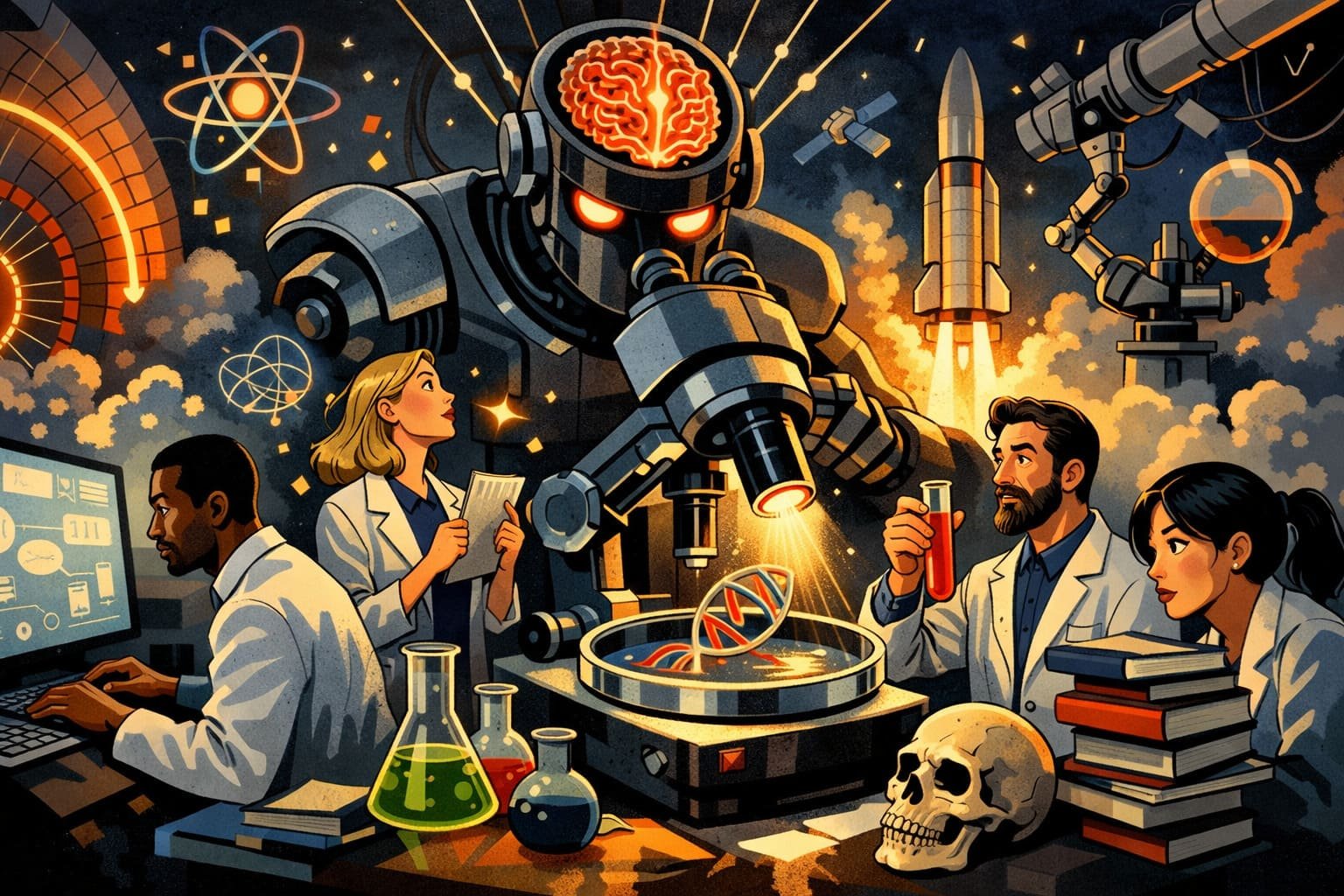
The lab no longer feels like a quiet temple of patience. It feels like a control room after someone spilled lightning on the keyboards. Screens glow with protein folds, molecular guesses, failed simulations, rescued hypotheses, and a strange new confidence that the machine might see a pattern before the Nobel hopeful in the wrinkled shirt sees it. The old myth cast science as a slow march powered by careful humans and long nights. That myth is cracking. Artificial intelligence in scientific discovery is not just speeding up research. It is changing what counts as intuition, what counts as expertise, and what counts as a good question in the first place. AlphaFold’s protein structure work helped push that shift into public view, turning a stubborn biology puzzle into a solvable computational problem and resetting expectations across research culture.
For years, science loved the romance of the heroic lone thinker. A researcher in a cluttered office noticed the one odd result everyone else ignored, then history bent around that hunch. That story still has charm, but charm is not a method. AI arrived like an unsentimental colleague who does not sleep, does not care about prestige, and does not need to defend a pet theory at conferences. That has made many scientists uneasy for good reason. When a model can scan literature, predict structures, rank candidates, and suggest pathways faster than a whole department, the lab starts to resemble a casting call where half the humans are being quietly asked whether they still belong in the next season.
That fear hides a more useful truth. The real contest is not human versus machine. It is slow science versus augmented science. Researchers using tools like AlphaFold and newer molecular prediction systems are not handing over the soul of inquiry. They are trading drudgery for reach. A cancer biologist who once spent months chasing one molecular lead can now test several plausible routes before lunch. A materials scientist can screen possibilities that would have buried a graduate student under years of dead ends. DeepMind’s own description of AlphaFold now frames it not as a neat software trick, but as infrastructure for understanding how molecules interact. That is the key shift. AI is becoming part microscope, part map, part provocation.
There is a delicious irony here. Science trained machines on human knowledge, then those machines began finding paths through that knowledge that humans had missed. It is a little like building a library robot and watching it come back with a secret passage hidden behind the philosophy shelf. Researchers in protein design, gene editing, and drug discovery now use models not only to organize known information, but to imagine candidate structures and tools that nature itself never quite produced. A 2025 Nature paper on AI-enabled design of genome editors captured that mood well: AI can help bypass evolutionary constraints and produce editors with more useful properties in human cells. That line should make every researcher sit up straighter. Nature is no longer the only designer at the table.
Consider the researcher staring at a screen at midnight, coffee gone cold, trying to decide whether the model’s strange suggestion is brilliant or deranged. That moment is becoming the real scene of modern science. Not a robot replacing discovery, but a person learning when to trust an alien pattern generator. This is where the job gets harder, not easier. AI can flood the lab with plausible answers, and plausibility is a dangerous drug. It feels like progress even when it is only noise dressed in confidence. The new scientific skill is judgment under abundance. The winners will not be the people who collect the most outputs. They will be the ones who know which output deserves the next wet-lab test, the next grant proposal, the next risky bet.
History keeps offering small warnings. Every powerful tool arrives dressed as salvation before showing its appetite for chaos. Statistical software once promised clean truth and instead helped produce generations of badly interpreted significance. Social media promised connection and built an empire out of distraction. AI could do something similar to science if research culture starts confusing acceleration with understanding. A thousand model-generated hypotheses do not equal one well-framed biological insight. A dazzling simulation is still a guess until reality, rude and unimpressed, says otherwise. That is why the most serious scientists keep repeating a line the hype merchants hate: prediction is not explanation. It is a clue, not a coronation.
Even so, the upside is too big to dismiss. Drug discovery, protein engineering, climate modeling, battery chemistry, and genomics all gain from systems that can sift hidden relationships faster than any mortal team. That is not just efficiency. It changes ambition. Questions once considered too messy, too expensive, or too slow become newly approachable. Labs can chase bolder ideas because the cost of early exploration drops. A small team with the right computational backbone can punch above its weight in a way that once belonged only to giant institutions. Science becomes less like digging with spoons and more like switching on floodlights in a cave nobody had time to map.
That shift also rearranges status. The old hierarchy rewarded people who guarded scarce knowledge. The new one rewards people who can frame sharp problems, stress-test outputs, and connect disciplines without getting drunk on novelty. A chemist who can talk to a machine learning engineer now carries a different kind of power. A biologist who understands model limits may be more dangerous, in the best sense, than a pure coder with ten thousand lines of elegant confidence and no feel for living systems. Research careers will be built not only on publishing papers, but on becoming interpreters between worlds, part scientist, part editor, part translator of machine weirdness into human meaning.
One small story captures the mood. A team working on enzyme discovery at a young biotech firm had spent months arguing over which protein family deserved attention. The senior researcher backed the familiar path. The junior computational lead trusted a model that ranked an odd candidate higher than expected. The room split. The test moved ahead. The strange candidate turned out to be the better starting point, not because the machine was magical, but because it noticed a relationship the team’s habits had trained them to ignore. That is the deeper gift here. AI does not just save time. It embarrasses routine. It exposes how often expertise becomes a polite way of defending the obvious.
Plenty of scientists still resist that lesson. Some of that resistance is noble. Science should be suspicious. It should make flashy claims sweat under bright lights. Yet some of it is plain territorial grief. If the machine can draft hypotheses, rank mechanisms, and suggest designs, the researcher must give up a flattering fantasy: that brilliance always arrives wearing a human face. The next era of scientific prestige may belong less to the oracle and more to the conductor, the person who can make humans, models, instruments, and evidence move together without turning the whole enterprise into theater.
This is why AI in research feels bigger than a productivity story. It is a cultural revolt inside science itself. It pushes inquiry away from reverence and toward orchestration. It makes curiosity more industrial and, oddly enough, more democratic. With the right tools, smaller labs can ask richer questions. With the wrong habits, wealthy institutions can simply produce errors at terrifying speed. The machine does not decide which future arrives. People do. Funding systems do. Journals do. Lab leaders do. The ethics of AI in science are not abstract. They live in who gets to build, who gets to verify, who gets ignored, and who gets harmed when confidence outruns evidence.
Somewhere tonight, a researcher will stare at a model output that looks almost offensive in its audacity. The idea will feel too neat, too fast, too unlike the miserable pace science taught them to expect. Across the hall, another researcher will distrust it on instinct and be partly right. In another building, a patient waiting for a treatment that does not exist yet will not care whether the breakthrough came from a bench, a cloud server, or a collaboration between the two. That is the uncomfortable beauty of this moment. Discovery has become less romantic and more alive. The frontier now hums with code, doubt, hunger, and a very old human desire to know what the world is hiding. The real question is whether the next great discovery will belong to the lab that protects its pride, or the one brave enough to let a machine ruin its favorite assumptions.