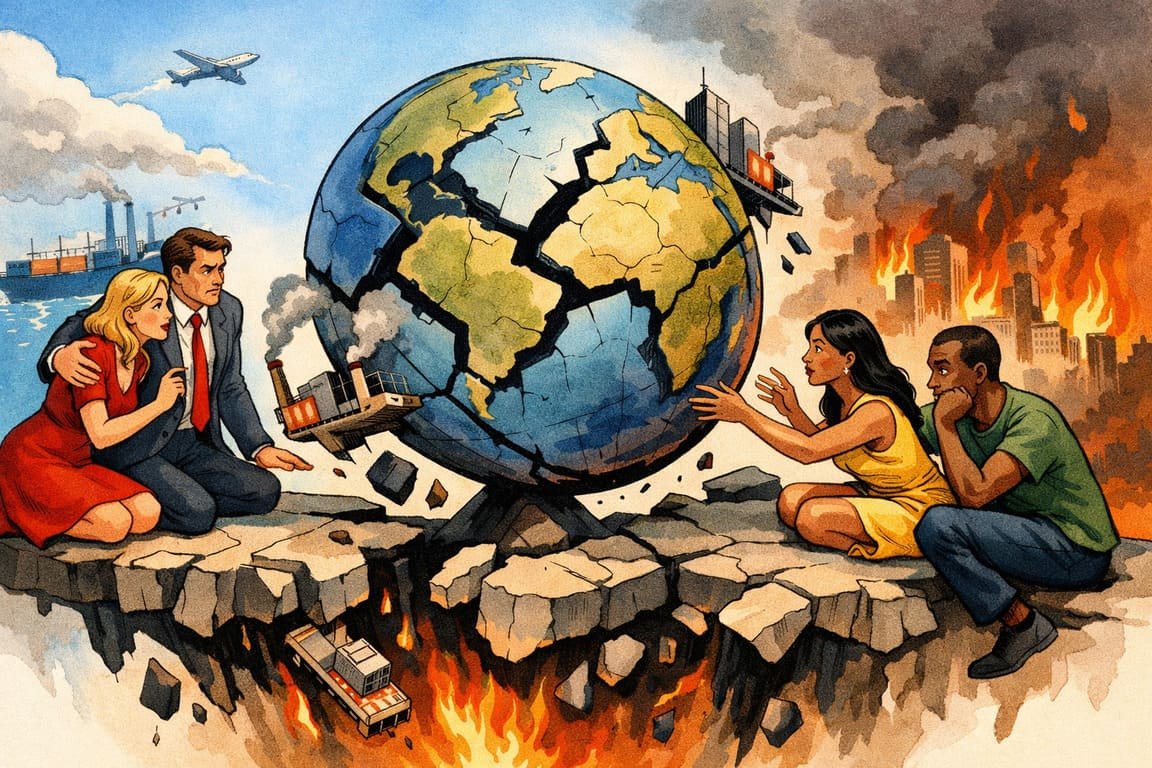
The factory hums with precision. Robots glide across spotless floors. Screens blink with efficiency metrics that rarely miss their targets. From the outside, this place looks like progress perfected. Outside its gates, the town feels paused, as if time took a wrong turn years ago and never corrected itself. Shops closed quietly. Skills aged out. Pride thinned. Globalization arrived here with speeches about opportunity and growth. What it left behind was harder to quantify and easier to ignore.
The idea behind globalization was seductively simple. Open markets. Move capital freely. Let efficiency decide winners. Growth would lift everyone eventually. The language sounded neutral, almost scientific. What it failed to account for was how unevenly people experience change. Systems adjusted faster than communities could. Jobs moved across borders more easily than workers could move across careers. Markets adapted. Lives fractured.
Efficiency became the highest virtue. Supply chains stretched across continents to shave costs. Corporations celebrated optimization. Governments applauded lower prices. Consumers enjoyed abundance. What disappeared was resilience. When production scattered, communities lost anchors. When shocks arrived, there were no buffers. A delayed shipment became a crisis. A factory closure became generational damage. The system functioned perfectly until it didn’t.
Work absorbed the shock first. Skilled labor was reclassified as expendable. Retraining programs lagged behind reality. A machinist in the Midwest once described watching his craft lose value overnight, not because it stopped working, but because value relocated. The work still existed. It simply lived somewhere else. Globalization called this progress. Those left behind felt something closer to erasure.
Culture followed economics out the door. Local businesses vanished, replaced by brands that looked the same everywhere. Cities blurred together. Convenience traveled well. Identity did not. When work disappears, meaning often follows. Community spaces hollow out. Social trust thins. Globalization measured success through output and ignored belonging, assuming one would follow the other. It rarely did.
Political backlash was not accidental. It was predictable. People displaced by global forces searched for explanations. Leaders offered simple villains. Foreign competitors. Trade partners. Migrants. The system that promised unity delivered division. Integration without protection bred resentment rather than cooperation. Nationalism filled the void left by absent strategy.
Developing nations faced a different contradiction. Some gained manufacturing footholds and export growth. Others remained trapped exporting raw materials and importing dependency. The ladder existed, but not everyone could reach it. Rules favored those already climbing. Globalization spoke of opportunity while enforcing hierarchy. Growth arrived without sovereignty.
Environmental costs were treated as someone else’s problem. Goods traveled vast distances because fuel felt cheap and consequences felt abstract. Pollution clustered near production sites. Consumption flourished elsewhere. Responsibility blurred. The planet absorbed the cost of a system that separated cause from effect. Climate stress exposed the flaw brutally and publicly.
Finance completed the transformation. Capital moved freely. Risk flowed downward. Profits detached from place. When crises hit, losses spread outward while gains remained concentrated. Trust eroded quietly. People sensed the game was rigged even when they couldn’t explain how. That intuition proved accurate enough to reshape politics.
Globalization was not a mistake. It connected ideas, accelerated innovation, and lifted millions from poverty. Its blunder was assuming markets could replace governance, that efficiency could substitute for ethics. Integration raced ahead of the institutions meant to cushion its impact. The imbalance grew until legitimacy cracked.
Repair does not require retreat into isolation. It demands recalibration. Trade with guardrails. Growth with distribution. Efficiency paired with redundancy. Global cooperation grounded in local resilience. None of this sounds inevitable. That is the point. It requires choice rather than momentum.
Picture a world map not defined by shipping lanes alone, but by accountability, where prosperity no longer depends on distance from consequence. The tools exist. The knowledge exists. What remains uncertain is resolve.
Globalization did not fail because the world connected, it failed because connection forgot responsibility, and the question waiting quietly for you is whether progress still counts when too many people no longer recognize themselves in the future it built.
