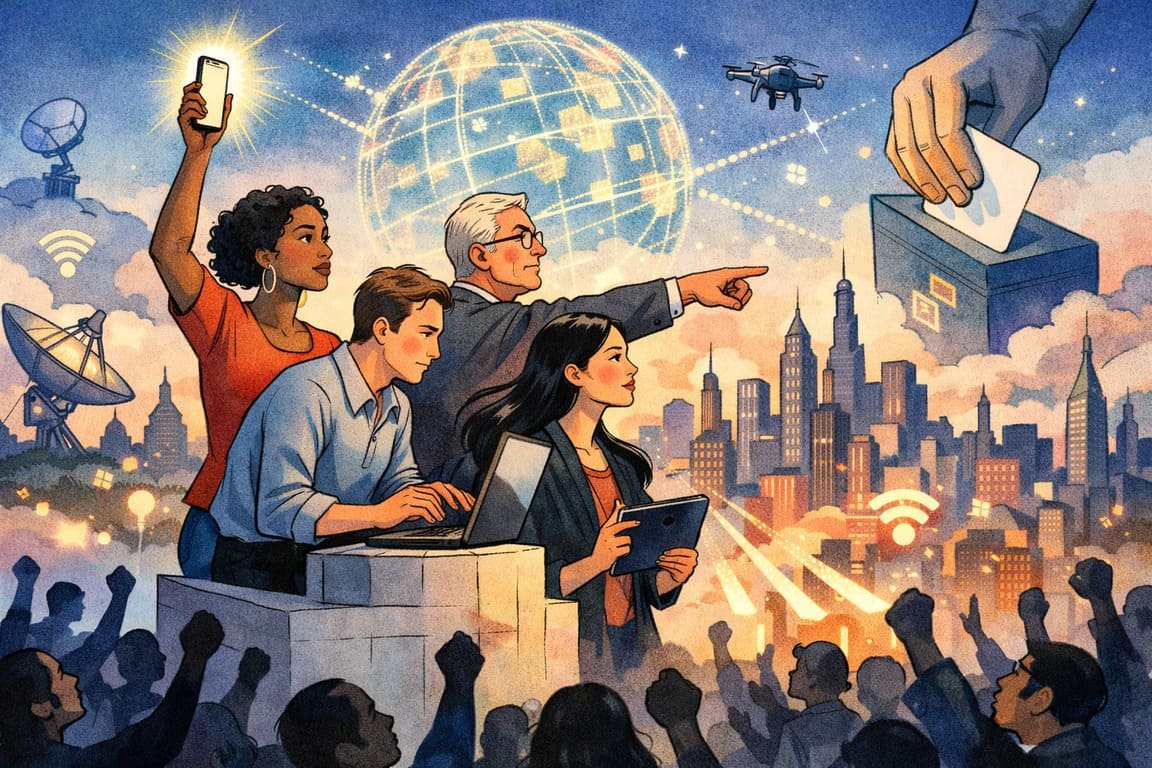
The meeting no longer needs a room. No microphones squeal. No chairs scrape the floor. It begins quietly, scattered across screens, fingers hovering, opinions forming in real time. Votes appear instantly. Petitions circulate faster than rumors once did. Power feels closer, lighter, almost casual. Digital democracy does not arrive with revolution. It slips into daily habits, disguised as convenience, promising participation without friction. The promise feels intoxicating. Finally, a system that listens. Finally, a voice without intermediaries. Yet beneath the glow of access, a deeper transformation unfolds, one that rewires how authority is claimed, shared, and contested.
Democracy traditionally moved at human speed. Debate took time. Deliberation required presence. Delay forced reflection. Technology accelerates everything. Platforms invite instant opinion. Algorithms amplify engagement. Decisions compress into moments. Participation expands while patience shrinks. A civic technologist once described online voting forums as emotional accelerators, brilliant at surfacing sentiment, terrible at cultivating wisdom. Speed democratizes access. It also flattens complexity. The question shifts quietly from who gets to speak to how quickly outcomes must appear.
The appeal feels obvious. Digital tools lower barriers. Marginalized voices bypass gatekeepers. Grassroots movements organize without permission. A neighborhood group once halted a zoning decision through coordinated online pressure before officials finished drafting statements. Power responded because it had to. Visibility forced accountability. Technology did what institutions would not. Moments like these fuel belief that digital democracy represents progress rather than disruption. It feels fairer. It feels modern. It feels inevitable.
Yet platforms are not neutral town squares. They are engineered environments with incentives. Visibility depends on algorithms. Reach favors emotional intensity. Calm deliberation rarely trends. A policy proposal framed carefully struggles beside a viral accusation. Engagement becomes currency. Influence shifts toward those who master platform dynamics rather than democratic norms. A former community organizer admitted learning to provoke outrage strategically just to keep attention long enough for serious points to land. The system rewarded tactics, not truth.
Power migrates accordingly. Tech companies become arbiters of speech without electoral mandate. Moderation policies shape debate. Platform rules determine which movements grow and which fade. Appeals feel opaque. Decisions feel sudden. Accountability feels distant. A digital rights lawyer once compared platform governance to constitutional law written in private, enforced instantly, revised without notice. Democracy adapts unevenly when its infrastructure belongs to entities optimized for profit rather than public deliberation.
Culturally, digital democracy reshapes identity. Political belonging forms online first. Community emerges through shared feeds rather than shared spaces. Solidarity feels constant yet fragile. Movements surge rapidly and dissipate just as quickly. Attention moves on. A volunteer described burnout after weeks of nonstop digital organizing that produced viral momentum but little structural change. Participation increased. Impact felt thin. The emotional toll accumulated quietly. Technology amplifies engagement without guaranteeing endurance.
Philosophically, digital democracy tests assumptions about participation. Does expression equal influence. Does visibility equal legitimacy. Clicking feels empowering. It also feels insufficient. A philosopher once warned that democracy risks becoming performative when participation substitutes for responsibility. Expression without consequence breeds cynicism. People speak often. They feel unheard anyway. The paradox deepens. More voices fill the space. Fewer feel satisfied with outcomes.
Security complicates optimism. Digital systems attract manipulation. Bots distort discourse. Foreign interference scales cheaply. Deepfakes blur reality. Trust erodes. A cybersecurity analyst once described watching public opinion shift during coordinated campaigns invisible to most users. Democracy depends on shared reality. Technology fragments it. Verification lags innovation. Doubt spreads faster than correction. Participation feels risky when authenticity cannot be assumed.
Economic inequality persists digitally. Access varies. Literacy varies. Attention favors those with time, resources, and fluency. Digital democracy risks amplifying existing gaps while claiming inclusivity. A rural advocate once noted that online consultations excluded communities with poor connectivity, turning participation into performance rather than representation. Technology expands reach unevenly. Inclusion requires design, not assumption.
Governments experiment cautiously. Some adopt digital consultations. Others trial online voting. Results remain mixed. Engagement rises initially. Trust fluctuates. A municipal pilot program discovered that online participation skewed younger and angrier than in person forums, reshaping priorities unexpectedly. Digital tools did not replace institutions. They reshaped them. Governance became more reactive. Strategic planning suffered. Speed clashed with stewardship.
Still, dismissing digital democracy misses its potential. When designed thoughtfully, technology strengthens transparency, coordination, and accountability. Open data empowers oversight. Digital platforms connect local issues globally. Collective intelligence emerges under the right conditions. The challenge lies in architecture. Democracy does not fail because people speak. It fails when systems reward noise over judgment.
The future likely blends forms. Digital participation complements rather than replaces deliberative institutions. Technology becomes a tool rather than a stage. That requires restraint rarely rewarded. It demands slowing down inside systems built to accelerate. A civic designer once argued that the most democratic feature a platform could offer is friction, moments that encourage pause before action. Slowing feels radical in a culture trained to equate speed with progress.
Somewhere between a tap and a law, democracy recalibrates quietly. Power feels closer. It also feels slipperier. Technology opens doors long sealed while quietly rearranging the room behind them. The rise of digital democracy asks a simple question with complicated consequences. Will societies shape these tools around democratic values, or will values adapt themselves around tools already optimized for attention, speed, and control, leaving participation louder than ever yet influence strangely out of reach?
