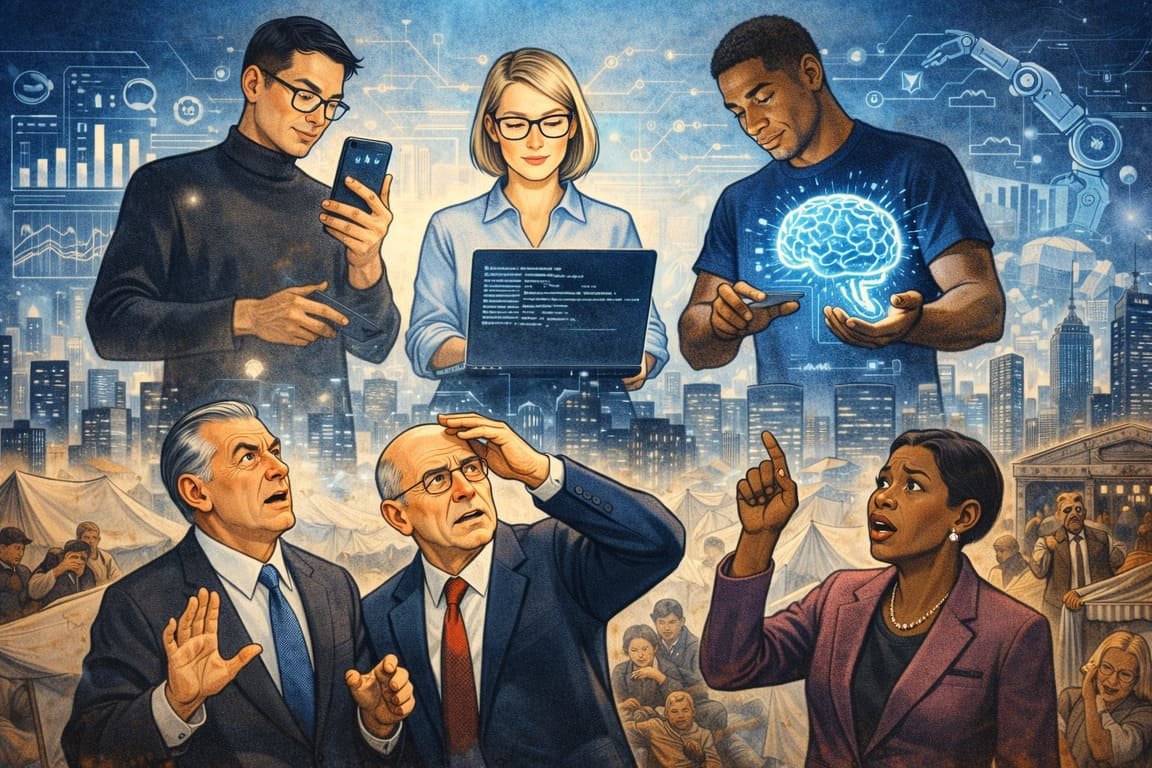
The room is quiet in a way that feels deliberate. Laptops glow. Charts align neatly. No one raises their voice. Decisions arrive already dressed as conclusions. Outside this space, people argue loudly about cost of living, safety, and fairness. Inside, those arguments are translated into metrics and risk thresholds. The contrast captures a shift that has been building for years. Governance is becoming technical, and democracy is starting to feel like a secondary consideration rather than the central one.
Technocrats tend to rise when trust collapses. Financial instability, pandemics, infrastructure failures, and climate pressure all create moments where politics looks chaotic and expertise feels reassuring. Engineers fix bridges. Economists stabilize currencies. Epidemiologists map outbreaks. The appeal is obvious. Data appears calm where rhetoric feels reckless. Expertise promises order without noise.
Many citizens quietly welcome this arrangement. After years of gridlock, watching specialists act decisively can feel like relief. There are fewer slogans and more spreadsheets. Policy sounds less ideological and more procedural. Governance becomes maintenance rather than debate. In that framing, democracy starts to feel inefficient, even irresponsible.
The danger lies not in expertise itself, but in how power attaches to it. Technocrats wield authority without elections. Their legitimacy rests on credentials rather than consent. Decisions are justified through models most people cannot access or challenge. When outcomes hurt, explanations arrive wrapped in technical language that sounds final. Distance grows between those who decide and those who live with the consequences.
Political leaders often enable this shift willingly. Deferring to experts reduces personal risk. Hard choices can be framed as unavoidable rather than value driven. Austerity becomes arithmetic. Trade offs become technical necessities. Accountability blurs. If results disappoint, responsibility dissolves into the logic of systems rather than the judgment of people.
Institutions like the World Bank illustrate the tension clearly. Staffed by highly trained professionals, they shape development paths across nations through lending conditions and policy guidance. Their work can stabilize economies or constrain democratic choice, depending on perspective. For communities affected, the experience often feels distant and predetermined, even when intentions are sincere.
A city level example makes the issue tangible. Faced with a housing shortage, local officials appointed a panel of urban planning experts. The proposal optimized density, transit access, and cost efficiency perfectly on paper. Residents pushed back, citing social ties, informal economies, and daily routines the model ignored. The plan was rational. It was also incomplete. Lived knowledge collided with calculated efficiency.
Philosophically, technocracy raises a fundamental question about legitimacy. Is being right enough, or does being chosen matter more. Democracy values consent even when outcomes are messy. Expertise values accuracy even when it feels detached. Treating governance as a technical puzzle erases the moral dimension of deciding whose interests come first.
Culturally, technocracy often reflects the worldview of a narrow professional class. Education, language, and networks shape priorities subtly. What appears neutral can carry embedded values. When those values diverge from public experience, resentment grows. Anti expert backlash thrives in that gap, rejecting evidence not because it lacks merit, but because it arrives without respect.
The pandemic revealed both the strength and fragility of expert led governance. Clear guidance saved lives. Shifting recommendations eroded trust. Communication mattered as much as competence. Where experts spoke plainly and acknowledged uncertainty, credibility held. Where they sounded dismissive or absolute, skepticism hardened quickly.
Politics cannot be reduced to problem solving alone. It is also about identity, fairness, and collective meaning. Experts can inform these debates, but they cannot resolve them by calculation alone. Deciding acceptable risk, equitable sacrifice, and shared priorities requires values, not just data.
Hybrid models offer cautious promise. Citizen assemblies, participatory budgeting, and transparent advisory panels blend expertise with public voice. These approaches slow decision making slightly, but they deepen legitimacy. People accept hard choices more readily when they feel included, even imperfectly.
The deeper risk is not a hostile takeover by technocrats. It is a quiet abdication by democratic systems relieved to hand complexity to specialists. Governance becomes efficient but brittle, optimized for stability rather than trust. When trust breaks, backlash arrives fast and indiscriminate.
The future does not demand choosing between expertise and democracy. It demands renegotiating their relationship. Expertise should guide, not govern. Democracy should decide, not pretend complexity absolves it. When the quiet conference room opens and the noise rushes back in, the challenge will be resisting the urge to close the door again, remembering that the disorder outside is not a flaw in democracy, but the evidence that it still belongs to the people it serves.
