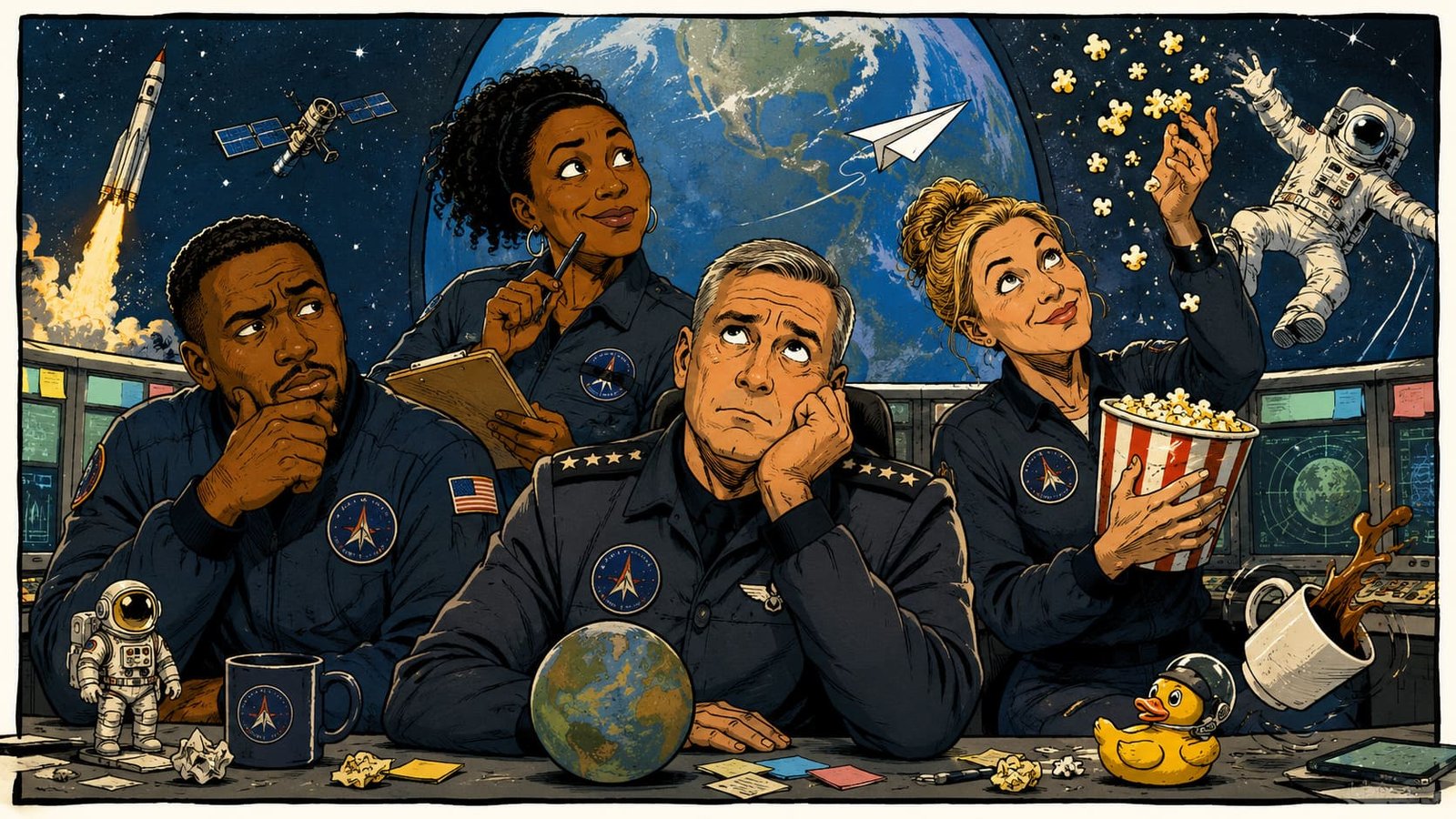
The war room smelled faintly of burnt coffee and expensive panic. Monitors glowed like sleepless eyes. Men with medals debated orbital dominance while struggling to organize a coherent lunch order. Somewhere between bureaucratic theater and national ambition, Space Force discovered one of the great hidden truths of modern institutions: the people steering civilization are often improvising with terrifying confidence. The series arrived during an era when governments, corporations, and technology giants increasingly resembled exhausted stage productions pretending to be immortal systems. That timing mattered. Beneath the comedy sits a sharp autopsy of power, ego, organizational dysfunction, and the fragile emotional machinery holding massive institutions together. The jokes land because the fear underneath them feels recognizable.
General Mark Naird walks through the series carrying the haunted stiffness of a man promoted beyond emotional preparation. Steve Carell plays him not as a cartoon patriot but as someone trapped between loyalty and absurdity. That distinction gives the show its strange emotional gravity. Naird believes in service. He also understands, often too late, that modern institutions reward optics as aggressively as competence. The character spends much of the series trying to preserve dignity inside systems increasingly addicted to spectacle. Anyone who has survived corporate politics recognizes the rhythm instantly. Public meetings become performance rituals. Strategic priorities mutate according to executive moods. Entire departments chase visibility rather than usefulness because attention has become the real organizational currency.
The brilliance of Space Force lies in how casually it exposes bureaucratic irrationality. Orders descend from invisible political ceilings with surreal urgency. Scientists clash with military hierarchy. Public relations crises erupt over nonsense while larger structural failures quietly expand in the background. It feels ridiculous until remembered against real history. Large organizations often collapse not because people lack intelligence, but because incentives become warped by ego, fear, and image management. During the collapse of several once-dominant startups, former employees described meetings where executives obsessed over branding slogans while operational systems quietly rotted underneath. Space Force weaponizes that same contradiction for comedy. The laughter arrives quickly, then curdles slightly in the throat.
Dr. Adrian Mallory becomes the philosophical center of the series precisely because he recognizes the madness while remaining trapped inside it. John Malkovich delivers every line like a man who has seen civilization’s group project and deeply regrets participating. His frustration mirrors the exhaustion of countless experts forced to translate reality into language executives can emotionally tolerate. Priya, an aerospace engineer in Bangalore, once described pitching safety concerns to leadership teams who responded with phrases like “optics,” “momentum,” and “narrative alignment.” She later joked that technical expertise inside modern organizations sometimes feels like bringing a library card to a knife fight. Space Force understands that despair intimately.
What makes the series more than satire is its understanding of loneliness inside leadership. Naird constantly performs confidence for subordinates while privately unraveling under impossible expectations. The emotional contradiction feels painfully modern. Many leaders now operate inside systems where vulnerability threatens authority, yet emotional suppression quietly corrodes judgment. Corporate culture celebrates resilience while ignoring psychological exhaustion until breakdown becomes unavoidable. One scene captures this dynamic beautifully: a tense strategy discussion spirals into emotional chaos while everyone pretends professionalism remains intact. The room resembles a collapsing dinner party where guests continue complimenting the wine while smoke rises from the kitchen.
The show also delivers a surprisingly sharp critique of performative patriotism and capitalist spectacle. National pride becomes branding exercise. Military ambition merges with media manipulation. Public image outranks practical wisdom. It would be easy to dismiss the series as exaggerated if modern reality had not already drifted into similar territory. Billionaires livestream rocket launches while workers burn out in fulfillment warehouses. Politicians announce technological revolutions before ethical frameworks exist to contain consequences. Companies sell “changing the world” as marketing copy while quietly optimizing addiction metrics behind polished glass walls. Space Force captures the emotional absurdity of civilizations trying to innovate their way out of existential confusion.
Yet the series refuses pure cynicism. That restraint gives it emotional depth. Beneath the incompetence and institutional chaos lives a strange tenderness between characters trying, imperfectly, to preserve meaning. Scientists still care about discovery. Soldiers still believe sacrifice should matter. Even the awkward humor carries traces of longing for integrity inside systems drifting toward parody. A small storyline involving a chimpanzee astronaut somehow becomes one of the most emotionally revealing arcs in the series because it exposes how easily institutions treat living beings as expendable symbols when ambition outruns conscience. That theme stretches far beyond comedy. History repeatedly shows what happens when organizations value achievement more than humanity.
Near the end of its emotional orbit, Space Force leaves behind an unsettling realization. Modern civilization increasingly rewards people who can perform certainty rather than practice wisdom. Loudness masquerades as vision. Branding disguises confusion. Institutions become addicted to spectacle because spectacle temporarily hides fragility. The series laughs at that condition while quietly mourning it. Somewhere inside glowing command centers and absurd policy meetings sits a deeply human question about whether ambition without emotional maturity inevitably becomes self-destruction wearing expensive uniforms. The satellites keep spinning. The cameras keep broadcasting. The slogans grow shinier. Still, beneath all the noise, a quieter truth waits like static beneath a radio signal: a civilization obsessed with conquering space may still fail to understand the fragile emotional gravity keeping human beings connected to one another on Earth.
Editorial Disclaimer: Whether a TV Show is rooted in fiction or inspired by real events, the actions, decisions, and behaviors portrayed within are not intended to be encouraged, replicated, or endorsed in real-world settings. This review exists solely to analyze the storytelling, characters, themes, and business dynamics presented in the TV Show for educational, analytical, and entertainment purposes. Any ethical or unethical conduct depicted in the TV Show does not reflect the views, values, or endorsements of ESYRITE.
