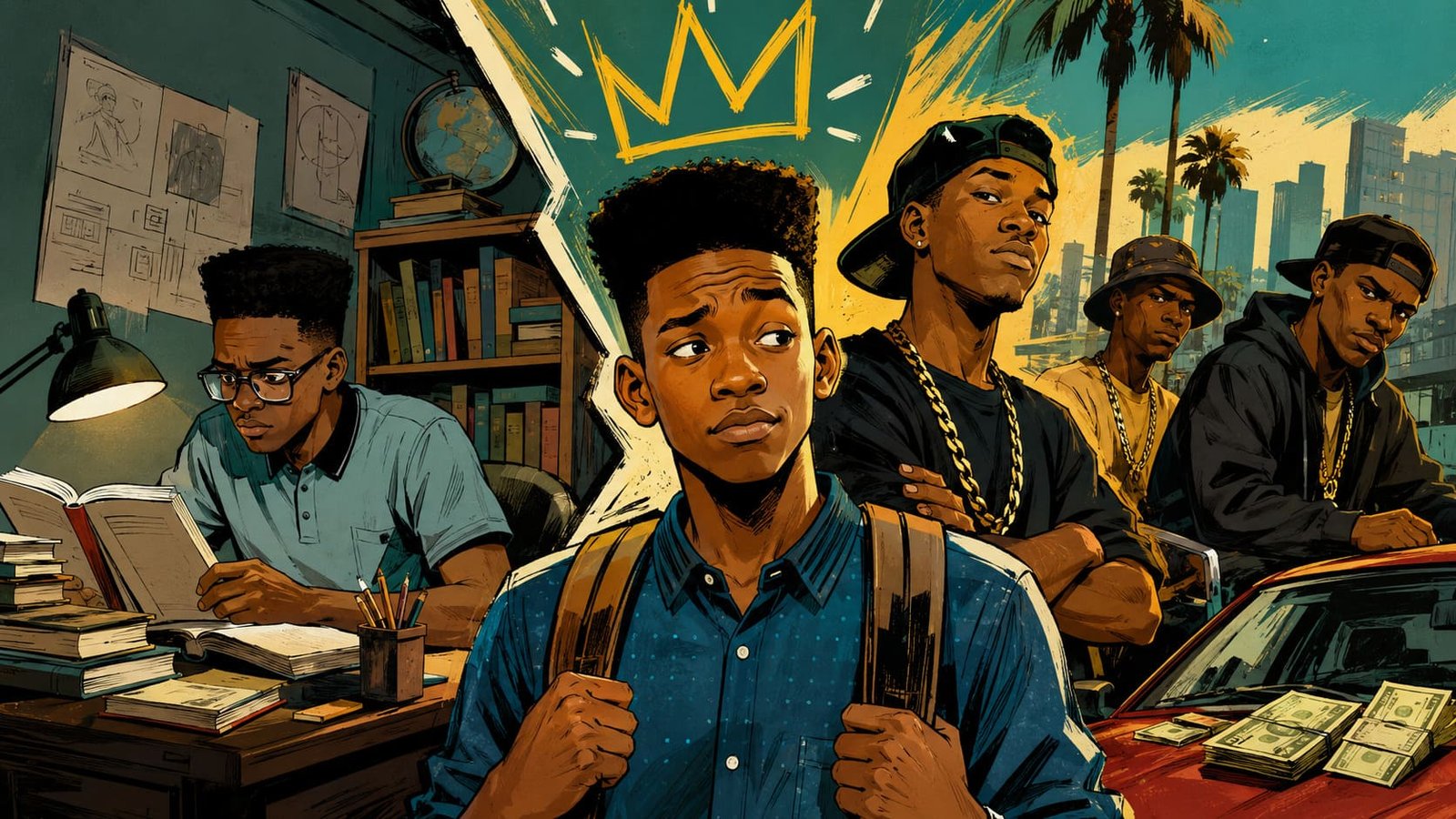
Inglewood pulsed with contradictions sharp enough to cut through skin. Sneaker stores blasted old-school hip-hop beside luxury apartment developments rising like polished spaceships above neighborhoods still carrying the scent of hot asphalt, weed smoke, and survival. Teenagers moved through crowded streets balancing SAT dreams against gang politics with the reflexes of chess players trapped inside action films. Somewhere behind every school hallway joke and late-night bike ride sat a quieter fear: intelligence alone might not be enough to escape the gravity of where they came from.
Dope slides into that tension with swagger, humor, and startling emotional intelligence. Directed by Rick Famuyiwa, the film follows Malcolm Adekanbi, played brilliantly by Shameik Moore, a geeky high school student obsessed with 1990s hip-hop culture, vintage style, and Harvard dreams while navigating an environment constantly trying to reduce him into stereotype. Most coming-of-age stories celebrate individuality politely. This film weaponizes individuality like survival gear. That difference gives the movie its pulse.
Malcolm’s greatest challenge is not lack of intelligence. It is cultural perception. Society loves inspirational narratives about talented young people overcoming adversity, but only when those young people remain emotionally convenient. Malcolm confuses people because he refuses expected categories. He likes punk music, vintage technology, and anime while living in a neighborhood outsiders associate mainly with danger. The film understands a brutal modern truth: institutions often punish complexity because stereotypes make systems easier to manage. Malcolm’s existence becomes quietly revolutionary simply because he refuses reduction.
A scholarship advisor in Birmingham named Yasmin once mentored a student named Omari who built custom gaming computers from discarded electronics while secretly writing poetry about urban loneliness. Admissions officers interviewing him seemed more fascinated by his postcode than his ideas. One interviewer actually asked whether he felt “lucky” to escape his environment. Omari later admitted the question irritated him more than outright discrimination would have. “People wanted a redemption story,” he said while adjusting cracked headphones during a campus visit. “Not an actual person.” Dope thrives inside that exact frustration.
The movie also dissects modern identity performance with rare sharpness. Malcolm understands that social mobility often requires strategic code-switching. Dress differently here. Speak differently there. Sound ambitious but not threatening. Intelligent but not arrogant. Authentic but still marketable. Entire professional industries operate this way quietly. Young employees entering elite spaces frequently perform sanitized versions of themselves to reduce discomfort for gatekeepers. Malcolm navigates those invisible expectations with exhausting precision. The comedy lands because the emotional reality beneath it feels painfully accurate.
One of the film’s smartest insights involves technology and entrepreneurship. Malcolm accidentally stumbles into a dangerous drug operation yet responds using digital intelligence, creativity, and adaptive thinking rather than brute force. The story subtly reframes modern power itself. Previous generations associated influence mainly with physical dominance or institutional status. Malcolm’s generation understands networks, information, and perception. That shift matters enormously. A teenager with coding skills and cultural awareness can now disrupt systems older generations barely understand. The movie captures that transformation beautifully.
A young designer in Toronto named Celeste launched a resale fashion platform during university after noticing classmates turning vintage clothing into online status symbols. Investors initially dismissed the idea as niche internet behavior. Celeste ignored them and focused on community instead of scale. Users began posting styling videos filmed in cramped bedrooms lit by cheap ring lights and stubborn ambition. Within months, major retailers started imitating the platform’s aesthetic language. Celeste later joked that corporations spent years studying “youth engagement” while missing the obvious truth sitting right in front of them. “People want identity more than products,” she explained during a warehouse photoshoot surrounded by thrifted denim and tangled extension cords. Malcolm would have understood instantly.
Dope also attacks the mythology of meritocracy with refreshing honesty. Malcolm works hard. He studies relentlessly. Yet opportunities still depend heavily on perception, geography, race, and luck. The film refuses fantasy solutions. Intelligence helps, but systems remain uneven. That realism gives the story emotional weight. Too many narratives treat success as purely individual achievement while ignoring structural barriers shaping outcomes long before effort enters the equation. Malcolm’s journey feels compelling precisely because victory never feels guaranteed.
One unforgettable sequence involving college admissions radiates quiet psychological violence. Malcolm presents himself carefully while understanding his audience already carries assumptions before he speaks. Countless professionals recognize that emotional choreography immediately. The pressure to become legible inside elite institutions can feel spiritually exhausting. Smile correctly. Frame struggle attractively. Transform pain into inspirational branding. The film exposes that performance with satirical brilliance while still allowing Malcolm dignity and humor.
The soundtrack deserves attention too because music here functions almost like cultural memory. Old-school hip-hop anchors Malcolm emotionally while surrounding environments shift unpredictably around him. That detail deepens the film’s identity themes. People often cling to style, music, fashion, and subculture not because trends matter superficially, but because those things create psychological continuity inside unstable worlds. Malcolm’s vintage obsession becomes less nostalgia and more resistance against erasure.
As the story races toward its final moments, Los Angeles still vibrates with contradiction, aspiration, danger, and reinvention. Somewhere another brilliant teenager sits beneath flickering bedroom light building futures invisible to the institutions judging them. Dope leaves behind a realization sharper than its comedy initially suggests: society often underestimates people who refuse familiar narratives because unfamiliar intelligence threatens comfortable assumptions. And once someone learns how to weaponize authenticity inside systems addicted to categorization, even limitation starts looking strangely temporary.
Editorial Disclaimer: Whether a film is rooted in fiction or inspired by real events, the actions, decisions, and behaviors portrayed within are not intended to be encouraged, replicated, or endorsed in real-world settings. This review exists solely to analyze the storytelling, characters, themes, and business dynamics presented in the film for educational, analytical, and entertainment purposes. Any ethical or unethical conduct depicted in the film does not reflect the views, values, or endorsements of ESYRITE.
