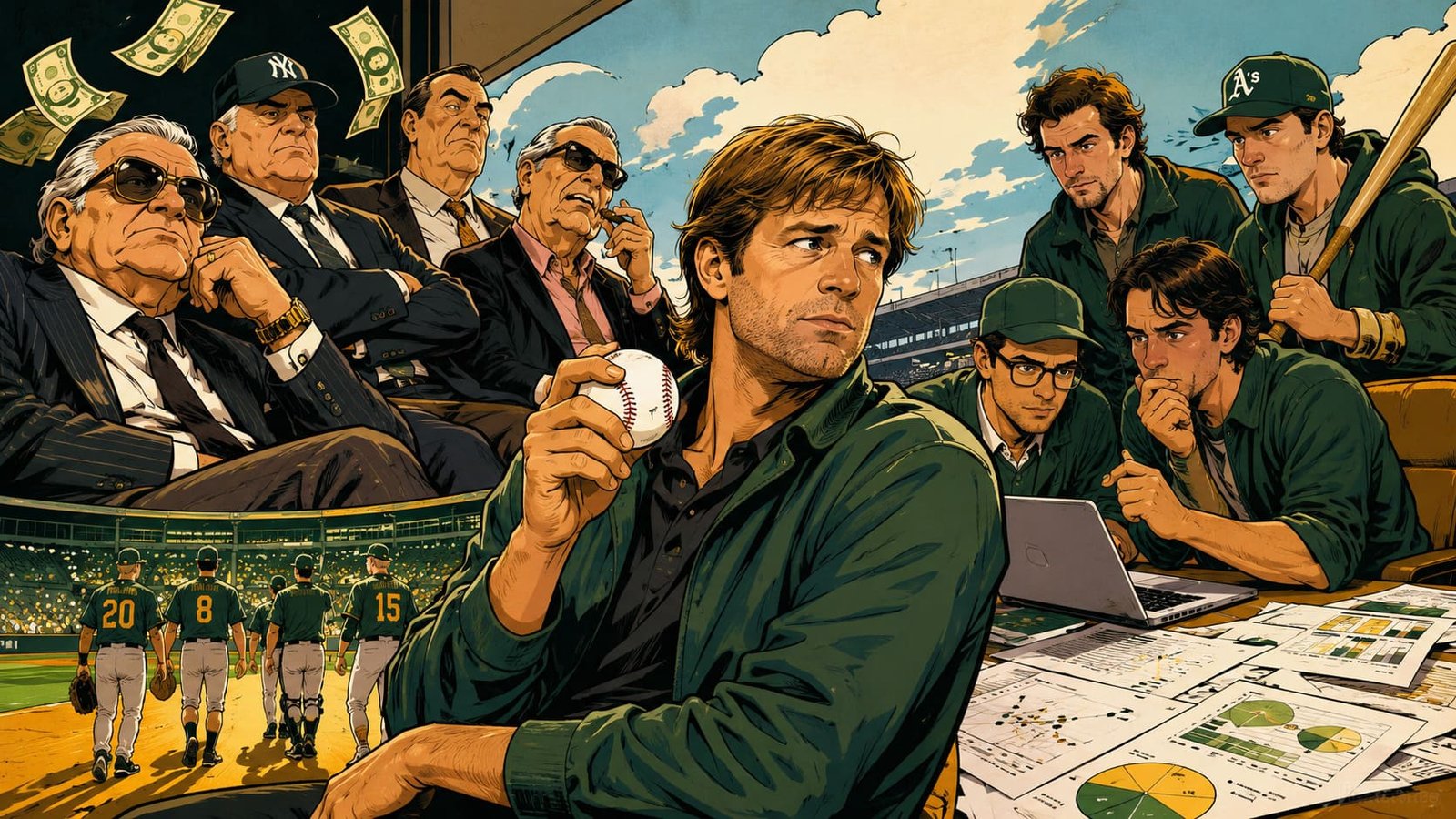
The stadium smelled faintly of stale beer, grass, and exhausted hope. Scouts sat in cramped rooms chewing sunflower seeds while discussing athletes with the confidence of medieval priests interpreting divine signs from smoke. Somewhere inside this machinery of ritual and nostalgia, a general manager stared at a spreadsheet and quietly declared war on intuition itself. Moneyball is not really about baseball. Bennett Miller crafts something sharper and far more unsettling: a story about institutions defending emotional tradition long after evidence begins exposing its weaknesses. The film studies how power protects familiar systems even when those systems repeatedly fail. Beneath the statistics and locker-room tension sits a universal conflict modern organizations still struggle to resolve. Human beings say they value innovation. Most actually value emotional comfort disguised as wisdom.
Brad Pitt’s Billy Beane moves through the film with the restless frustration of someone trapped inside a machine allergic to self-awareness. He understands the rules of baseball deeply enough to recognize that much of its mythology survives through repetition rather than accuracy. That tension exists everywhere. Corporations cling to outdated hiring rituals because they feel prestigious. Universities worship credentials while overlooking competence. Investors chase charisma because spreadsheets cannot satisfy emotional instincts on their own. A retail executive named Naomi Keller once proposed using customer-behavior analytics to redesign a luxury brand’s sales strategy. Senior leadership dismissed the idea because one director insisted “real retail is about gut feeling.” Months later a competitor implemented similar systems and dominated the market. Moneyball understands that institutions often reject innovation not because the evidence looks weak, but because the evidence threatens identity.
Jonah Hill’s Peter Brand becomes the film’s quiet revolutionary. His awkwardness matters because modern power structures frequently underestimate people who lack theatrical confidence. Brand speaks carefully, dresses plainly, and avoids performative masculinity. In another world he would be ignored completely. Yet he sees patterns others miss because he is emotionally detached from the mythology surrounding the game. That distinction feels increasingly relevant in contemporary business culture. Organizations often reward certainty over accuracy. Meetings become competitions for dominance rather than clarity. A cybersecurity analyst named Elias Venn once warned his company about vulnerabilities hidden inside a legacy payment system. Executives brushed aside the concerns because the presentation lacked “executive energy.” After a major breach months later, internal emails revealed his analysis had been correct almost line by line. Moneyball repeatedly exposes the dangerous relationship between ego and decision-making.
The film’s dialogue feels surgical because it strips away sentimental nonsense with brutal efficiency. One scene involving scouts arguing over players based on appearance and personality lands like an autopsy of corporate hiring culture. People still judge competence through emotional shortcuts dressed up as expertise. Height becomes leadership potential. Confidence becomes intelligence. Familiarity becomes trustworthiness. Billy Beane challenges those assumptions with near-religious intensity because he knows outdated systems survive through emotional storytelling rather than measurable truth. There is humor buried inside these exchanges, though it tastes bitter. Institutions frequently defend irrational behavior while claiming objectivity. That contradiction powers entire industries.
Baseball itself becomes symbolic terrain for larger societal questions about class and access. Wealthier teams operate like monopolistic empires capable of buying certainty through resources. Smaller organizations must rely on creativity because conventional competition remains structurally impossible. That imbalance mirrors broader economic realities. Startups disrupt industries not because disruption feels romantic, but because entrenched power leaves them few alternatives. A founder named Lucia Moretto once built a small logistics platform using unconventional pricing models after larger competitors locked her company out of traditional partnerships. Rivals mocked the strategy publicly. Two years later those same competitors quietly copied her approach while pretending it had always been obvious. Moneyball captures the emotional loneliness of challenging dominant systems before validation arrives.
The movie also explores masculinity in fascinating ways. Baseball culture inside the film feels deeply ritualistic, almost tribal. Men perform toughness constantly. Vulnerability becomes weakness. Billy Beane himself struggles emotionally despite understanding systems with remarkable clarity. His inability to watch games reveals something painful about ambition. High achievers often develop strange relationships with uncertainty because failure stops feeling temporary and starts feeling existential. A venture capitalist named Trevor Sloan reportedly spent acquisition negotiations pacing hotel hallways instead of entering conference rooms because he physically could not tolerate moments where outcomes remained beyond his control. That emotional tension pulses quietly through Moneyball. Success does not eliminate fear. Sometimes it sharpens it.
Visually, Bennett Miller avoids turning baseball into glossy fantasy. Clubhouses feel cramped and worn. Offices look tired beneath fluorescent lighting. Conversations unfold over cheap coffee and budget anxiety rather than cinematic grandeur. That grounded atmosphere strengthens the story enormously. Innovation rarely looks glamorous during its early stages. Real transformation often begins in overlooked rooms populated by skeptical people and fragile ideas. The film resists the temptation to romanticize genius. Instead it portrays strategic thinking as lonely, repetitive, and emotionally exhausting. Billy Beane does not change baseball through inspiration speeches. He changes it through relentless pattern recognition while enduring constant ridicule.
Near the emotional center of the film sits a devastating realization about human behavior. Most systems continue operating long after they stop making sense because too many identities depend on preserving the illusion. Billy Beane threatens not merely baseball strategy but baseball mythology itself. That is why resistance becomes emotional rather than rational. Moneyball leaves behind more than lessons about analytics or sports management. It reveals how power protects familiar narratives even when evidence quietly begs for reinvention. Somewhere between locker-room silence and glowing spreadsheets, the film exposes a truth modern culture still struggles to accept: progress rarely begins when institutions become smarter, but when somebody stubborn enough finally stops worshipping the stories those institutions tell about themselves. And once that illusion cracks, entire worlds suddenly look negotiable.
Editorial Disclaimer: Whether a film is rooted in fiction or inspired by real events, the actions, decisions, and behaviors portrayed within are not intended to be encouraged, replicated, or endorsed in real-world settings. This review exists solely to analyze the storytelling, characters, themes, and business dynamics presented in the film for educational, analytical, and entertainment purposes. Any ethical or unethical conduct depicted in the film does not reflect the views, values, or endorsements of ESYRITE.
