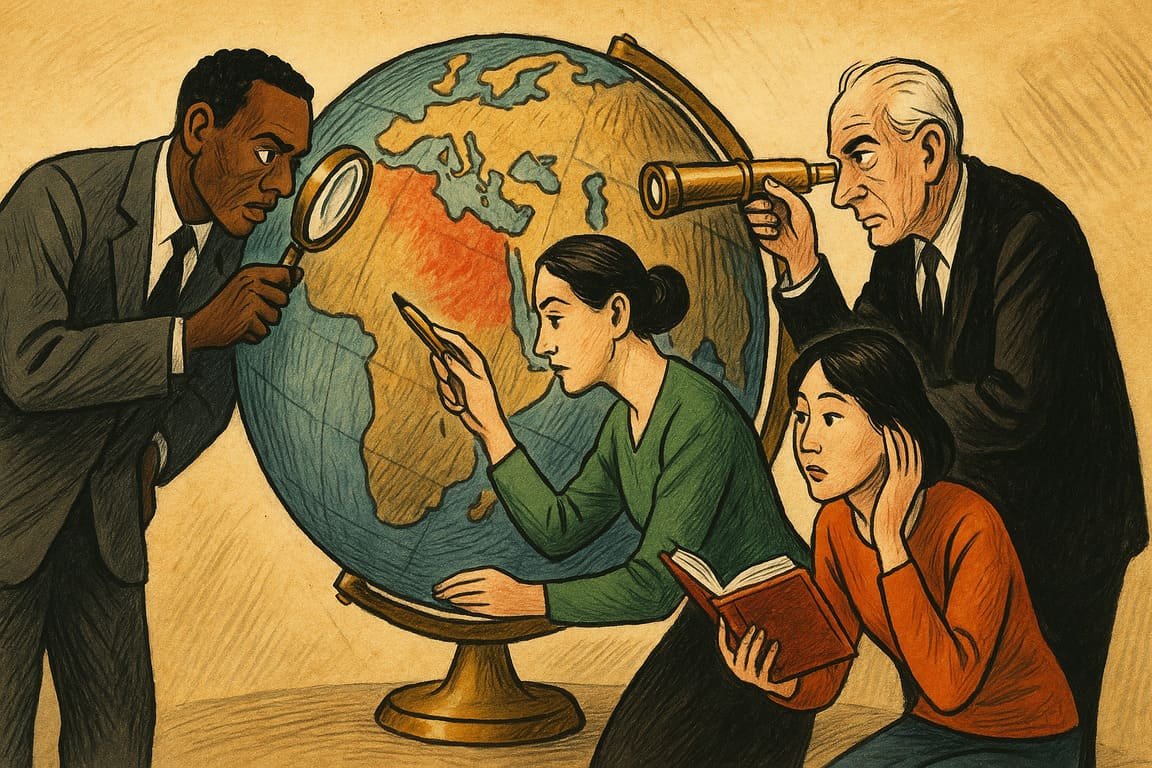
A battered metro car rattles beneath the city, fluorescent lights flickering as strangers clutch briefcases, textbooks, and unanswered questions. At the far end, a student scribbles in a well-worn notebook, eyes darting between commuters and the passing blur outside. Curiosity simmers in every glance—a silent current pulling them deeper into the maze of human experience. The city above may move on autopilot, but underground, minds are at work, restlessly mapping the world’s puzzles. In this tunnel of uncertainty, research is not a fixed destination. It’s a journey, a quest for meaning stitched together by the courage to ask and the humility to learn.
Every culture has its own myths about knowledge: some claim answers live with the elders, others hide them in the stars, but only the art of inquiry invites anyone to pull back the curtain and see what’s really there. At its heart, research is not about collecting facts, but about cultivating the habits of a questioner. The world rewards those who can navigate its ambiguity with steady curiosity and a readiness to follow wherever the answers lead.
You don’t need a PhD or a lab coat to master this art. Inquiry begins the moment you choose to ask why. A barista tests new recipes, a teacher redesigns a lesson after a tough week, a designer tweaks an interface to match user feedback. The art lies in noticing patterns, documenting your hunches, and daring to experiment. Research is less about the perfect method and more about resilience: the willingness to get lost, double back, and try a new path when the old one runs out.
Real progress starts with uncomfortable questions. Apple’s early team famously argued over fonts and pixels, risking delays and drama in search of products that felt intuitive and alive. Their willingness to keep asking “what if?” changed not just design, but how millions interact with technology every day. Inquiry refuses to accept “good enough” when better is possible.
You might find your own life nudged by this restless spirit. Maybe you question your company’s hiring process, or the way your team communicates. Instead of settling, you launch a survey or try a new workflow. Sometimes it works, sometimes it flops, but every result is a lesson. This is the messy beauty of inquiry: the process is as important as the answer. Each attempt builds your intuition and sharpens your judgment for the next challenge.
The world is packed with information but starved for insight. Inquiry helps you sift the meaningful from the trivial. Think about how journalists follow leads, check sources, and keep digging when the facts don’t add up. Their success isn’t in the first tip, but in the relentless follow-up. You can borrow this mindset. When a client’s project falters, or a friend’s startup stalls, the instinct to investigate can be a game changer.
Inquiry thrives in teams where dissent is encouraged and failure is seen as a teacher. Netflix’s internal culture famously rewards those who challenge assumptions, inviting employees to poke holes in ideas and propose wild experiments. This trust in inquiry has fueled their evolution from DVD rental to streaming empire, outpacing competitors afraid to question their own playbook.
If you’re feeling stuck, remember: every discovery started with someone who refused to accept the status quo. Case in point: when the city of Medellín, Colombia, was plagued by traffic gridlock, local engineers and researchers tested dozens of interventions, from bike lanes to cable cars. Not every idea stuck, but the willingness to keep asking, measuring, and pivoting transformed the city into a global model of urban renewal.
Learning to navigate research is less about memorizing steps and more about embracing uncertainty. No two projects are the same, and no guidebook will save you from wrong turns. What matters is the discipline to reflect, adjust, and keep moving. The path may zigzag, but over time, your questions get sharper, your failures sting less, and your wins stack up.
The best researchers—whether in science, business, or everyday life—don’t hoard knowledge. They share, debate, and invite critique. By teaching others to ask, they build resilient communities where innovation can thrive. The art of inquiry multiplies when shared, turning lone explorers into collective trailblazers.
Your life is a series of unfinished questions. The biggest breakthroughs come when you invite others to join your search, pooling curiosity and insight to solve problems that once felt impossible. This spirit doesn’t just power organizations; it can revive relationships, heal communities, and ignite movements.
Research is not an elite club. It’s an open invitation to see the world as a living question—messy, demanding, and full of possibility. The only requirement is the nerve to follow where curiosity leads.
On a rain-slick rooftop at midnight, a researcher tilts their head to the sky, rain tracing lines across a field notebook. The city below pulses with unanswered mysteries, every window a flickering question mark. In the hush, a new thought surfaces, surprising even its author—a puzzle piece clicking into place, a story turning on a single, brilliant question.
For a moment, the world holds its breath. Progress belongs not to those with all the answers, but to those willing to ask the questions that nobody else dares. So, if discovery is a journey, will you settle for the map, or dare to carve your own path with questions only you can see?
