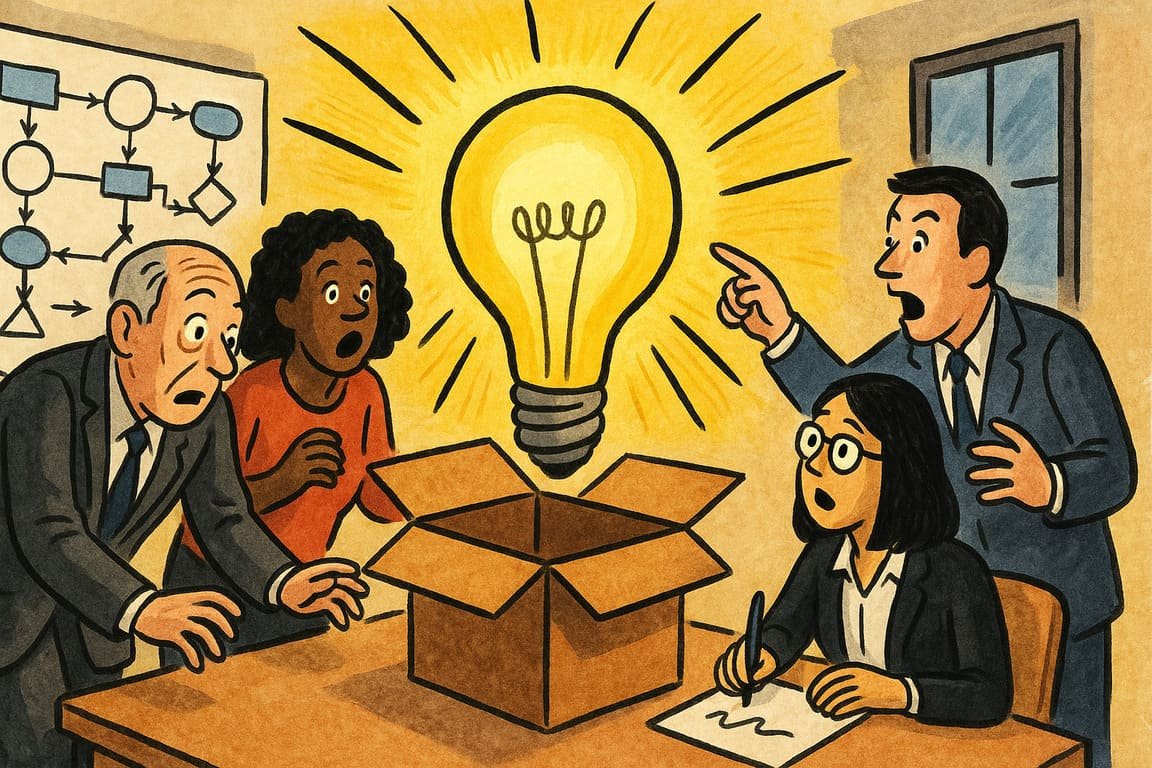
Rain gathers on the cracked pavement outside an old warehouse turned startup hub, where a cluster of mismatched chairs surrounds a table covered in sticky notes and half-finished sketches. A small team leans in, eyes sharp, breaths steady, studying a problem that refuses to behave. Above them, a single bulb flickers like a heartbeat. This is not a boardroom, not a lab, not even a studio in the traditional sense. It is a pressure chamber where ideas collide, collide again, then bloom into something nobody expected. Design thinking is not whispered here. It crackles in the air.
Inside this room, the difference between slow progress and sudden breakthrough is almost physical. When someone throws out a wild suggestion, the others do not flinch. It sits in the center like a mysterious object waiting to be opened. People talk, gesture, laugh, frown, and rearrange fragments of insight until the shape of a solution takes form. Nothing about it looks linear. Nothing about it looks rational. Yet the rhythm feels real and urgent, like musicians improvising in a basement club. Every choice adds a note that brings the idea closer to clarity.
Stories from teams across the world echo this same rhythm. A crowded clinic in Manila solved its patient overflow by rearranging its waiting spaces based on community sketches. A small grocery chain in Oslo redesigned its checkout experience after a cashier suggested organizing the lines like a festival queue. A hardware startup in Nairobi fixed a long standing defect by letting users doodle what they wished the product could do. These small examples reveal a truth that should feel obvious: solutions grow faster when ordinary people shape them.
You already know what happens when design thinking enters your own work. Problems that once felt heavy begin to loosen. You stop staring at the ceiling, and instead listen, prototype, test, rebuild, and test again. Each cycle sharpens your intuition. You discover that rethinking a clumsy layout or a confusing form is not guesswork. It is a dance with users who guide your hand, even when they do not realize they are leading the way.
It is tempting to believe that brilliant ideas appear from gifted minds. You know better. They emerge from conversations that spark fresh angles. When a teammate says something imperfect, you catch the hidden gem inside their words. You grab it, polish it, and hand it back. Design thinking is not a magic trick. It is cooperation in its rawest form. The secret is not intelligence, but humility. You stop needing to be right. You start needing to be useful.
Fear melts when people feel free to make mistakes. That freedom is the oxygen of design thinking. A team from a Dutch ed tech firm once admitted that their best breakthrough began with a drawing that resembled a lopsided potato. Everyone laughed, then realized the shape suggested a simpler interface for young learners. Without that clumsy sketch, the idea would have stayed buried. The lesson is simple: goofy thoughts save more time than polished ones.
You recognize this in your own creative moments. The times you scribbled nonsense only to uncover a real possibility beneath it. The times a customer said something unexpected that rearranged your assumptions. The times you prototyped with cardboard or napkins because waiting for the perfect tool would kill the momentum. Design thinking rewards motion, not perfection. The faster you move, the clearer the path becomes.
Speed does not mean chaos. It means stripping away anything that slows understanding. Instead of arguing over hypotheticals, you test. Instead of planning for weeks, you build something by lunchtime. Instead of guessing what people want, you ask them. Then you listen, really listen, to the frustration in their tone or the excitement in their eyes. People reveal the truth long before data catches up.
The business world often treats complexity like a badge of honor. Yet design thinking thrives on the opposite. It takes a tangled process and untangles it until a child could explain it. You see this in companies like Patagonia, which turned product repairs into a joyful user experience after gathering stories from customers who stitched torn jackets at home. The insight came not from an executive memo but from listening sessions filled with laughter, nostalgia, and questions that most brands never bother to ask.
Every time a team chooses design thinking over rigid planning, something unexpected happens. Leaders stop pretending they have all the answers. Juniors speak up with ideas that reshape entire strategies. Departments that rarely talk begin to collaborate. Meetings shift from deadlock to discovery. The atmosphere changes, and with it, the trajectory of the project. Businesses often chase innovation, but design thinking shows them where it hides.
You have felt these shifts too. When you move from planning to experimenting, fear loosens its grip. When you stop defending your first idea, you recognize better ones waiting behind it. When you treat constraints as creative prompts, obstacles transform into clues. Every challenge becomes a kind of doorway, and once you walk through it, you see options you never noticed before.
The proof appears in the results. Faster decisions. Clearer direction. Solutions that feel surprisingly human. Things that once took months shrink into days. Teams that struggled now thrive. Even skeptics soften when they see how much smoother life becomes. The method works because it mirrors how people naturally solve problems in daily life: try, observe, refine, try again.
Design thinking does not promise perfection. It promises momentum. It gives you the courage to act before everything is certain. Once that shift happens, the world opens. Problems that looked solid crumble under your touch, revealing the solution already hiding inside them, waiting to be discovered.
A low hallway stretches beneath an old train station where peeling posters cling to the damp walls. A small group gathers around a sketch pinned beside a flickering vending machine. They study it, each person seeing something different, yet slowly arriving at the same conclusion: the first attempt is rough, but it points toward something worth chasing. A distant rumble travels through the floor as a train prepares to depart. No one rushes. The moment holds a calm certainty, as if the next idea is already forming in the air.
A single sheet of paper, smudged with fingerprints and charcoal, becomes the turning point. The team steps back, then forward again, drawn to the imperfect strokes that hint at a path forward. In that stillness, the power of design thinking reveals itself, not through grand speeches or perfect plans, but through a fragile sketch that invites possibility.
What you choose to do with your next problem will define your momentum. Will you wait for clarity, or create it by stepping into the unknown with open hands?
