Forklifts glided across a warehouse without drivers while a lone supervisor watched glowing dashboards instead of stacked pallets. Nobody cheered because every smooth movement carried an uncomfortable question. Progress had arrived wearing ordinary work boots. Across factories, offices, hospitals, and construction sites, automation is steadily rewriting the meaning of employment, shifting human value away from repetitive execution and toward judgment, creativity, collaboration, and adaptation in ways that many organizations still underestimate.
Automation has accompanied economic progress for generations, from mechanical looms to industrial robotics. Today’s transformation feels different because intelligent software increasingly performs cognitive tasks once reserved for highly trained professionals. Routine accounting, document review, scheduling, customer support, and quality inspection now benefit from machine assistance. Siemens, Ocado, and John Deere demonstrate that automation succeeds when organizations redesign entire workflows instead of simply replacing isolated jobs with sophisticated machines that operate inside outdated processes.
Owen managed production at a family-owned manufacturing business struggling with rising costs and delayed deliveries. Employees feared new robotic equipment would eliminate livelihoods built over decades of loyal service. Reality unfolded differently. Repetitive lifting shifted toward automated systems while experienced workers began supervising production quality, maintenance planning, and process improvements. Productivity increased, workplace injuries declined, and customer satisfaction improved because people focused on solving problems rather than repeating physically exhausting routines throughout every shift.
Healthcare tells a similarly revealing story. Radiologists increasingly use artificial intelligence to identify subtle patterns within medical images, yet final clinical decisions remain firmly guided by trained professionals. Microsoft and Philips continue investing in clinical decision support because intelligent systems perform best when complementing expert judgment instead of replacing it. Aviation follows comparable principles. Autopilot technology handles predictable conditions efficiently, while pilots remain indispensable whenever unexpected events demand experience, intuition, and calm decision making under pressure.
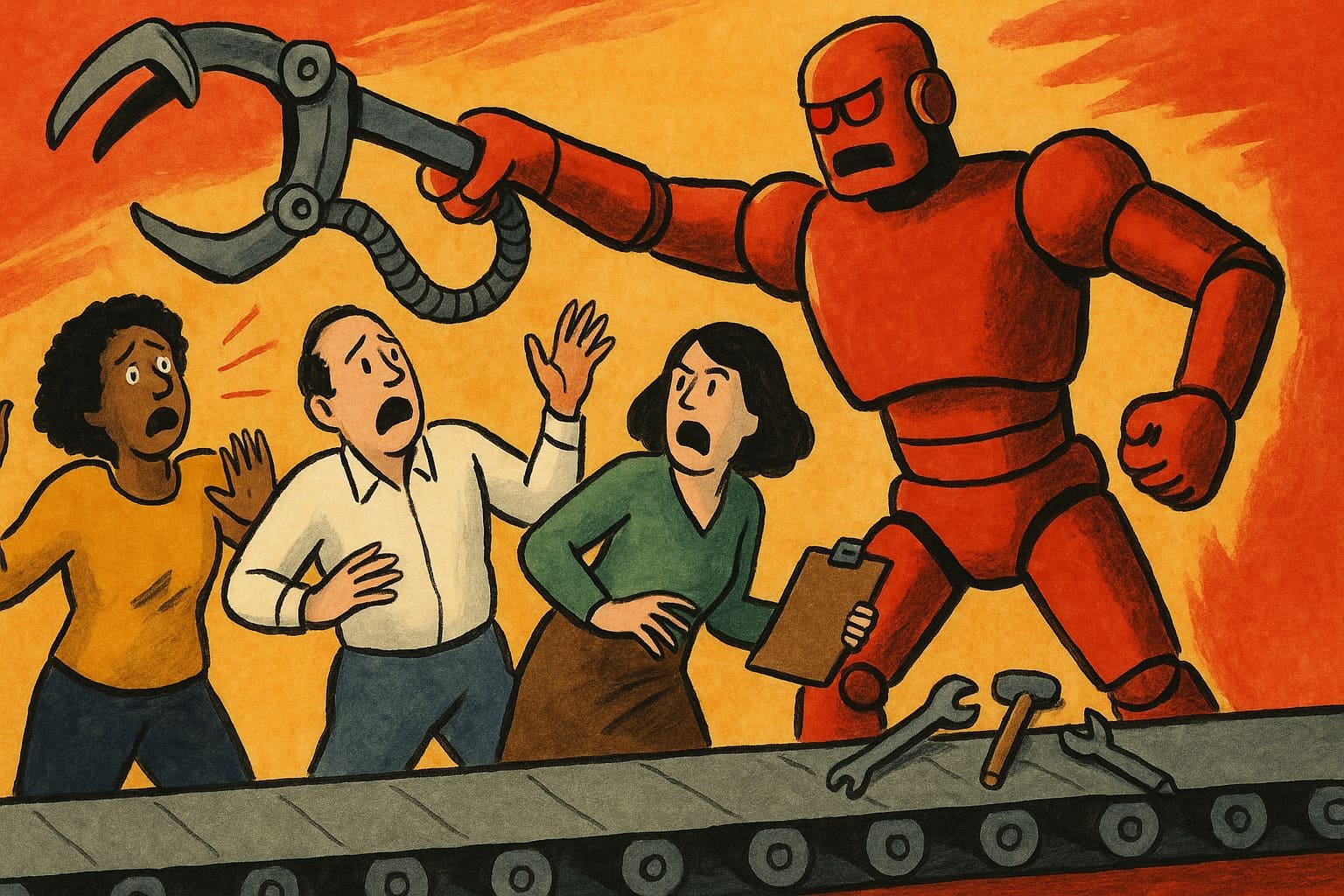
Public debate often frames automation as a contest between human workers and intelligent machines. That story attracts headlines because conflict feels dramatic. Everyday experience suggests another reality. Organizations that invest equally in workforce development, continuous learning, and thoughtful redesign consistently outperform those chasing labor reduction alone. Technology changes fastest when paired with capable people willing to learn new skills, question familiar habits, and embrace responsibilities that machines cannot meaningfully replicate through computation alone.
Factory lights dimmed while polished robotic arms stood perfectly still, waiting for another shift that would begin only after people decided what deserved building next. Machines may execute instructions with remarkable precision, yet purpose continues flowing from human imagination, responsibility, and shared ambition. Every generation inherits tools that reshape work, but character determines how those tools reshape society. When automation reaches your workplace, will fear write your story, or will curiosity claim the next chapter?
