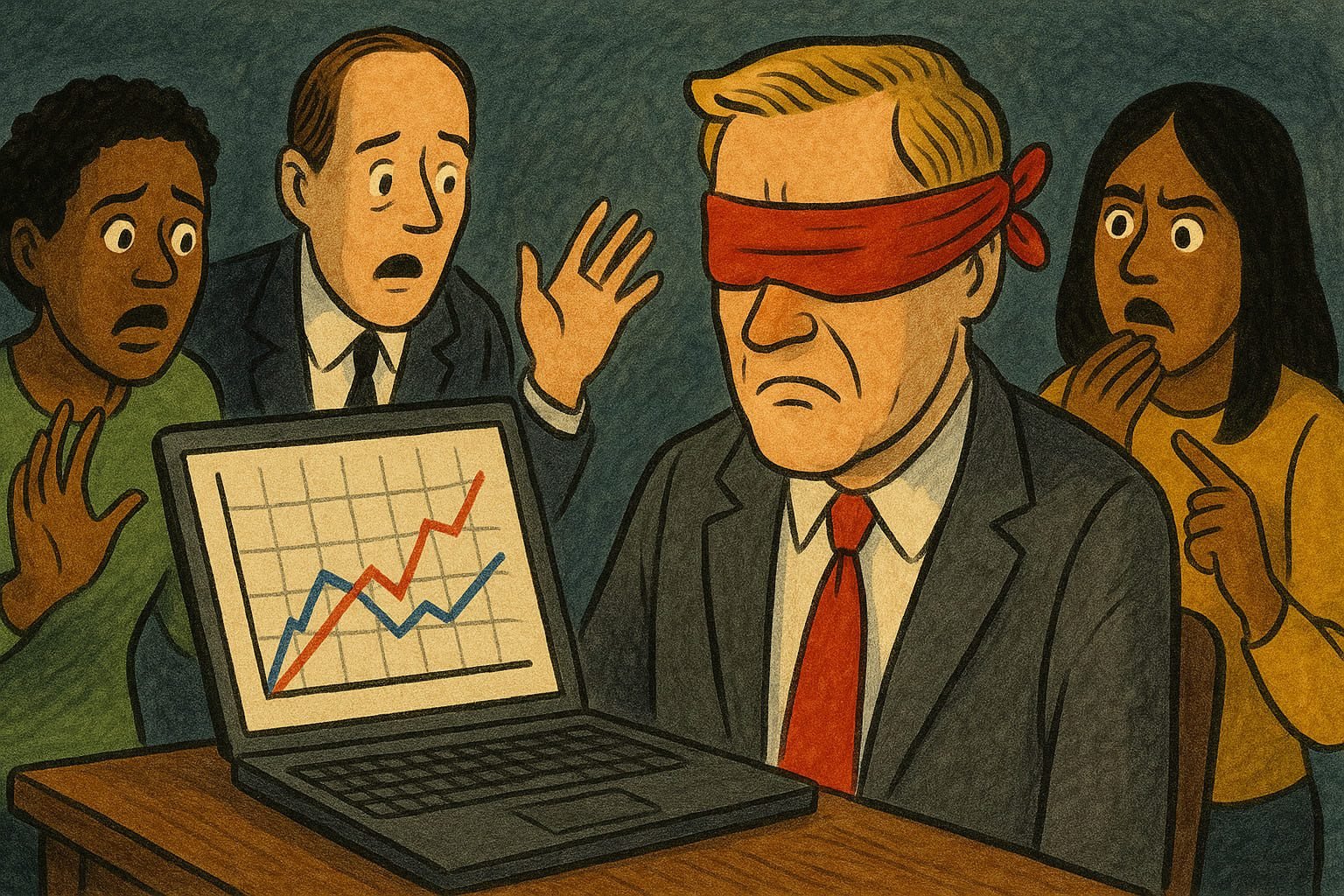
Beneath the glare of neon screens, a parade marches through the city’s core. Each step is measured, every drumbeat orchestrated by numbers that promise clarity. Suits and screens crowd the plaza, clutching reports as if clutching prophecy. Somewhere in the midst, a researcher sweats under fluorescent lights, juggling spreadsheets like torches. Spectators peer in, dazzled by the show of certainty, unaware that every chart is a hall of mirrors and every “truth” hides behind the mask of bias.
The air crackles with ambition. People pin their hopes on numbers, desperate for certainty in an uncertain world. Yet behind the glass, a different drama unfolds: bright-eyed analysts chase patterns that flicker just out of reach. Hushed voices in the back row whisper warnings, but the crowd is hypnotized by illusion. In this theater of data, belief is currency and bias is the hidden puppet master. It’s a game everyone plays, but no one admits: the line between genius and delusion, brilliance and blindness, is drawn not by the data, but by the mind reading it.
Power lunches unfold in plush boardrooms as leaders wield numbers like scepters, confident their decisions are bulletproof. Outside, a lone janitor watches as yesterday’s “revolutionary insight” becomes today’s trash, swept into oblivion. Behind closed doors, investors huddle around glowing dashboards, each convinced their view of the market is unsullied by bias. This is the great carnival of certainty—a spectacle built on the premise that data is pure, facts are absolute, and numbers never lie.
A fresh-faced intern, Julia, stares at her screen. She sees patterns no one else does. Her boss, Greg, chuckles and dismisses her theory. She leaves late, a coffee stain on her collar, wondering if genius looks more like doubt than certainty. Her story plays out daily, a silent battle between what the numbers show and what the mind sees. Every morning, the world wakes up and asks data to solve its riddles, never pausing to ask who shaped the questions or colored the answers.
You can almost hear the music stop. For a moment, the crowd holds its breath, sensing something is off but unwilling to name it. Underneath the surface, the carnival is built on a trap: bias is the skeleton key that unlocks every illusion, bending data until it fits the story we crave. The real question isn’t whether the data is true, but whether anyone ever truly sees it. Welcome to the truth trap—once you fall in, even the clearest facts become slippery, and genius can drown in the undertow.
Quick Notes
- Bias Hides in Plain Sight: The loudest numbers usually have blind spots. If everyone agrees, check who’s missing from the table.
- Genius Needs Doubt: History’s best breakthroughs were born from people who challenged their own beliefs—not just others’.
- Data Can Be a Disguise: Just because a chart sparkles doesn’t mean the story behind it is true. Sometimes, the most beautiful graphs tell the biggest lies.
- Your Brain Wants Comfort, Not Truth: The mind searches for patterns that confirm what it already believes, not what’s actually there.
- Break the Cycle, See the Real Story: The only way to escape the truth trap is to question your own logic, seek out contradictions, and invite the uncomfortable into your data.
The Mirage of Objectivity
Numbers glitter with a false promise of objectivity. They seem to offer solid ground when emotions run wild and opinions clash. Leaders build empires on spreadsheets, convinced that data alone is a shield against chaos. The more confident someone is in the numbers, the less likely they are to spot the bias woven through every step. In the background, stories like Enron’s downfall echo—a reminder that even the most sophisticated models can’t save us from ourselves.
Picture a manager, fresh from an MBA, walking into a team meeting with a stack of reports. She assures the group that their strategy is “data-driven.” No one asks how the data was collected, or why certain figures were highlighted over others. Months later, as profits collapse, everyone wonders how they missed the warning signs. The answer isn’t in the numbers but in the questions they never asked.
You know the routine: A product team celebrates rising user engagement, ignoring silent churn. The bias isn’t in the raw numbers, but in the story built around them. The team’s pride swells while crucial feedback vanishes in the noise. The same pattern repeats everywhere—people see what they want to see, and the illusion of objectivity makes them blind to risk.
On Wall Street, traders ride waves of market data, hoping to outsmart rivals by spotting trends a second faster. Yet even here, bias creeps in. A hedge fund manager admits, “We all think we’re immune, but every model has a thumb on the scale.” When you ask her how she manages it, she just shrugs. “I hire skeptics. I want people who challenge my best ideas, not just applaud them.”
It’s tempting to believe data tells the whole truth, but the truth is always shaped by human hands. Even the most advanced algorithms inherit the flaws of their creators. Ask any seasoned analyst, and they’ll tell you: objectivity is a mirage. The only way to get closer is to admit you might be wrong—and to look for the ghosts in your own machine.
The Genius Who Challenged the Crowd
True innovation starts with doubt, not certainty. The greatest minds in science and business weren’t those who followed the data blindly, but those who questioned everything. Picture Alan Turing in a smoky wartime office, facing walls of code that everyone else said were unbreakable. He refused to accept what the data seemed to prove, and in doing so, changed the course of history.
Genius rarely fits neatly inside the bounds of consensus. Consider the story of Lisa Chen, a fictional AI researcher who noticed odd patterns in her team’s algorithm. Her colleagues insisted their model was flawless. Lisa kept digging, driven by a hunch that something wasn’t right. Her persistence revealed a subtle bias that, left unchecked, would have led to costly mistakes. Her team learned that innovation often means swimming against the current.
Everyone loves a rebel story, but few want to be the rebel. You may have found yourself in meetings where “challenging the data” feels like heresy. That’s the truth trap in action: the more people believe in the numbers, the less they tolerate dissent. If you want to escape it, you have to build a culture where skepticism is not just allowed, but rewarded.
Case in point: Netflix’s famous “keeper test.” Employees are encouraged to question the status quo and push back on established wisdom. As former exec Patty McCord recalls, “We wanted people to challenge the data, even if it meant being unpopular.” This is more than corporate folklore—it’s a strategy that keeps genius alive and bias in check.
The lesson is clear: genius isn’t about having the right answers, but about asking the right questions. The world doesn’t change because someone read the data correctly. It changes because someone dared to doubt what everyone else assumed was true.
The Beautiful Lie of the Graph
Charts and graphs are seductive. They turn chaos into color, confusion into clarity. Yet behind every pie chart and bar graph lies a story waiting to be spun. A sales director, desperate to hit targets, cherry-picks data for a monthly report. She leaves out the months where the numbers dipped, hoping no one will notice. The meeting ends with applause and a sense of progress, but the truth remains hidden in plain sight.
Infographics rule the digital age. They make data snackable and stories viral. But the easier something is to consume, the easier it is to manipulate. Think of the viral chart that “proves” remote work destroys productivity. Thousands share it without reading the fine print: a small sample size, missing context, and selective framing. By the time corrections surface, the narrative is already entrenched.
Visualizations carry power because they make the complex feel simple. Yet simplicity often comes at the cost of nuance. In politics, campaign strategists use tailored graphics to sway opinion and rally supporters. Psychologist Daniel Kahneman, a Nobel laureate, once warned, “What you see is all there is.” In other words, the story a chart tells depends on what’s left out as much as what’s shown.
Marketers know the power of a well-designed graph. At a conference, a branding consultant reveals how brands tweak color schemes and axis scales to exaggerate growth. She laughs, “If you can’t convince them, confuse them with visuals.” Her confession lands somewhere between satire and strategy.
Every time you scroll past a viral chart, ask yourself: What’s missing? Who benefits from this story? Behind every “aha!” moment is an invisible author shaping your perception. Until you recognize the beautiful lie, you’re trapped in someone else’s version of the truth.
The Comfort of Familiar Patterns
The human mind craves patterns. We search for meaning in noise, weaving connections where none exist. It’s how superstition flourishes and conspiracy theories thrive. But it’s also how bias creeps into even the most rigorous analysis. Every researcher starts with a hypothesis, and every hypothesis brings a hidden agenda—usually invisible even to its creator.
Consider Ben, a young economist convinced that rising wages always lead to job cuts. He crunches the numbers until they align with his thesis, discarding contradictory data as “outliers.” His colleagues, eager to finish the project, nod along. Months later, a competitor releases a contradictory study, sparking debate. Ben’s boss sighs, “We saw what we wanted to see. That’s the real risk.”
The comfort of familiar patterns is seductive because it shields us from uncertainty. Startups often fall victim to this when interpreting customer feedback. A founder launches a new feature, then filters reviews to highlight success stories. Dissenting voices get buried. The illusion of progress persists, but the company grows more disconnected from reality.
Academic research isn’t immune. Peer review processes meant to ensure objectivity often reinforce prevailing biases. In a rush to publish, scientists lean toward results that confirm expectations. Studies that challenge accepted wisdom face higher scrutiny or get ignored. The system rewards conformity, and so the cycle repeats.
Escaping the comfort of familiar patterns requires vigilance and humility. The best leaders hire people who disagree with them, intentionally seeking out dissent. The smartest teams celebrate when someone finds a flaw in their thinking. In the end, the only real antidote to bias is discomfort—a willingness to be wrong, and to change course when the evidence demands it.
The Only Way Out—Embrace Uncertainty
Admitting uncertainty feels dangerous in a world obsessed with confidence. Yet it’s the only way to outsmart the truth trap. Organizations that thrive in chaos don’t just tolerate ambiguity—they build it into their culture. Legendary investor Ray Dalio is famous for promoting “radical transparency,” where every employee can challenge any decision, no matter who made it.
Companies like IDEO foster innovation by rewarding curiosity over certainty. Designers are encouraged to ask “What if?” and to prototype ideas that might fail spectacularly. This culture of experimentation exposes hidden assumptions and uncovers blind spots. Failure becomes a teacher, not an enemy.
A fictional biotech startup, VitaGen, illustrates the point. The founders launch a bold cancer therapy based on early data, certain they’re onto a breakthrough. A new hire, Maya, raises uncomfortable questions about the study design. Her skepticism uncovers a flaw in the sample selection, forcing the team to rethink their approach. The company avoids disaster because someone dared to embrace uncertainty.
There’s no algorithm for humility. Data can inform, but only people can interpret. The most successful teams are those who build “bias breakers” into their routines: regular audits, anonymous feedback, rotating leadership. These tools aren’t flashy, but they work by making discomfort part of the process.
If you want to avoid the truth trap, forget about being right all the time. Instead, cultivate a culture where doubt is a strength, not a weakness. The greatest breakthroughs are born not from perfect data, but from imperfect minds willing to see beyond what’s comfortable.
Shadows on the Marble Floor
Marble floors gleam in the silent lobby, each polished tile reflecting the ghosts of forgotten truths. Security guards nod at familiar faces, oblivious to the drama playing out behind glass conference doors. A young analyst stands alone beneath the cold glow of a solitary chandelier, clutching a folder of rejected ideas. She listens as the echo of her challenge lingers, unsaid, in the hallway. Data hums on nearby screens, indifferent to her doubt.
Somewhere, a CEO reviews her company’s future in the hush before dawn. The numbers stare back, silent but judgmental, while old victories fade into myth. She wonders how many decisions came from clarity, and how many from the comfort of seeing only what she wanted. Her reflection in the window is fractured, but a glimmer of honesty cuts through the distortion. The hardest battle isn’t against the market or the competition—it’s against the stories we tell ourselves.
A veteran consultant sits at an airport bar, tracing the rim of a coffee cup. He recalls decades of celebrated turnarounds and humiliating failures. For every triumph, there’s a memory of a truth ignored, a blind spot left unexamined. He knows now that genius lives in the space between certainty and doubt. As the terminal empties, his laughter sounds almost like confession.
On a rain-soaked street, an old researcher drops his keys and lets out a sigh. He remembers nights spent hunting for the perfect answer, only to find more questions. In the end, the biggest risk wasn’t making a mistake. It was refusing to admit how little he really knew.
You still stand at the edge of the carnival, the music fading into the night. The trap waits, silent and patient. The only way forward is to question what feels most certain. Will you see the truth, or will you just see yourself? So ask yourself: Is your genius trapped by your own bias, or will you risk discomfort for the sake of a truth that can finally breathe?
