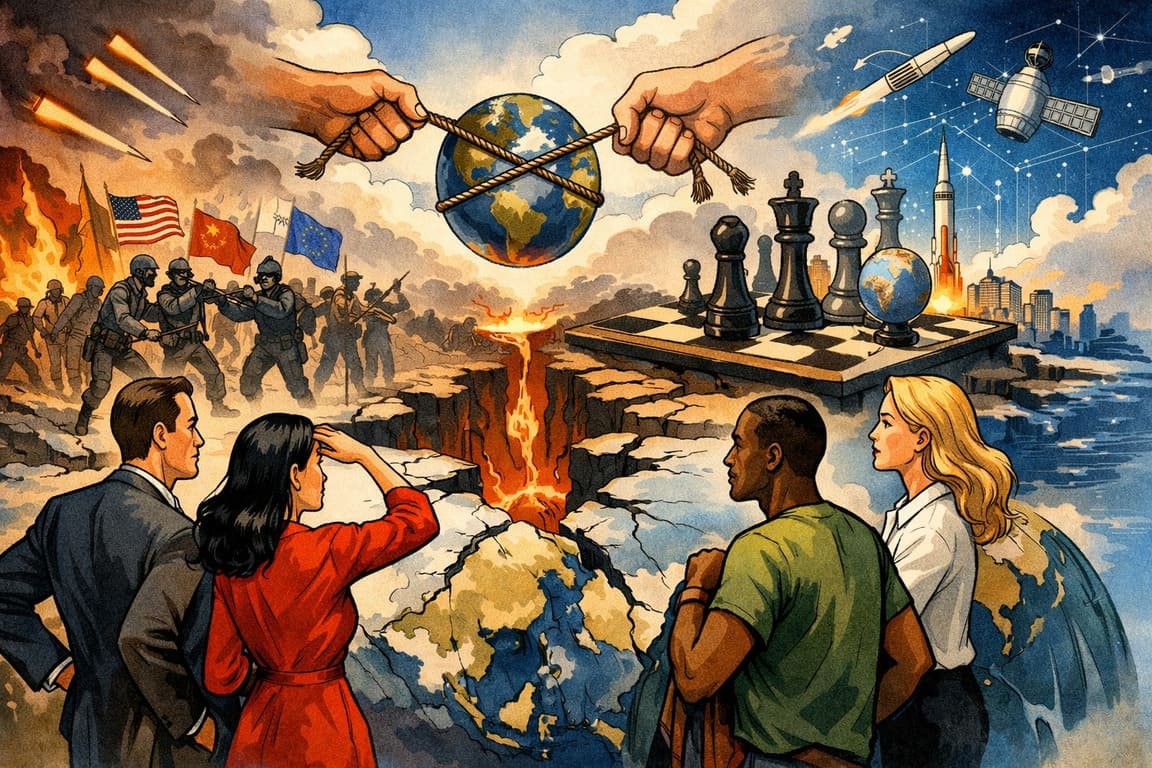
The flags still fly above government buildings, stiff against the wind, symbols unchanged while meaning slips subtly beneath them. Borders remain drawn on maps. Anthems still play. Yet authority no longer sits where tradition insists it should. Power has begun migrating quietly, not through invasion but through agreement, dependency, and convenience. Decisions affecting daily life increasingly originate far from voting booths or national chambers. The shift feels polite, almost invisible. Sovereignty does not collapse. It thins. What once felt absolute now negotiates constantly, shaped by forces that operate beyond any single flag’s reach.
For centuries, sovereignty meant control. Control over territory. Control over laws. Control over destiny. That clarity fades in a world wired together by trade, finance, technology, and climate systems that ignore borders entirely. A national policy now triggers global consequences instantly. A supply disruption in one region ripples everywhere. Governments promise independence while signing treaties that bind future options tightly. A former trade negotiator once admitted that modern agreements read less like partnerships and more like instruction manuals. Sovereignty remains in name. In practice, it functions conditionally.
Corporations have become unexpected governors. Their reach exceeds many states. Platforms dictate speech norms. Logistics firms shape labor realities. Financial institutions influence policy through capital flows rather than ballots. When a multinational relocates or withdraws, entire communities adjust without consultation. A mayor once described learning more about local employment prospects from a corporate earnings call than from federal briefings. Authority arrives through market decisions framed as inevitability. Accountability struggles to keep pace with actors that operate everywhere and nowhere at once.
Global institutions further complicate the picture. Organizations designed to coordinate now exert quiet pressure. Standards become rules. Recommendations become requirements. Compliance feels voluntary until deviation proves costly. Smaller nations feel this tension acutely. Aid arrives with expectations. Access comes with alignment. A health policy official once noted that rejecting international guidance risked isolation more than disagreement. Sovereignty becomes negotiation under unequal conditions. Independence feels theoretical when interdependence dictates survival.
Culture reflects the strain. National identity grows louder as control slips. Flags wave harder. Rhetoric sharpens. Populism feeds on the feeling of loss. Leaders promise restoration without naming what changed. The appeal resonates because something real has shifted. People sense decisions moving beyond reach. Blame seeks targets. Outsiders feel convenient. The paradox deepens. Efforts to reclaim sovereignty often require cooperation, reinforcing the very systems they resist. Defiance becomes performance. Power continues migrating quietly underneath.
Philosophically, sovereignty assumed a world of separable problems. Today’s crises overlap relentlessly. Climate change ignores passports. Pandemics mock border controls. Financial shocks travel digitally. No nation solves these alone. Cooperation feels necessary yet threatening. Autonomy competes with survival. A political theorist once remarked that absolute sovereignty makes sense only in isolation, a condition humanity abandoned long ago. The challenge lies not in restoring control but redefining it honestly within shared systems that demand compromise without erasure.
Technology accelerates erosion. Data flows cross jurisdictions effortlessly. Surveillance tools sold globally reshape domestic policing. Cloud infrastructure stores national information offshore. Cyber incidents blur peace and conflict. Governments depend on platforms they do not own. A cybersecurity advisor once compared digital sovereignty to renting a house where the landlord controls the locks. States attempt regulation. Platforms adapt faster. Authority chases innovation perpetually one step behind.
Economics tightens constraints further. Debt binds policy. Credit ratings discipline ambition. Currency markets punish deviation. Even powerful nations react to investor sentiment. A finance minister once described watching national priorities recalibrated by overnight market movements. Sovereignty bends to confidence metrics few voters understand. Choices narrow quietly. Leaders explain necessity. Citizens feel disempowered without understanding the mechanisms squeezing options behind closed doors.
Yet this shift does not mean disappearance. Sovereignty transforms. It becomes relational rather than absolute. Influence replaces control. Coalitions matter more than commands. Some nations adapt creatively, leveraging diplomacy, culture, and niche expertise to amplify voice. Others resist adaptation and feel diminished. The difference lies in realism. Clinging to outdated definitions breeds frustration. Updating them offers agency within constraint. Power today rewards flexibility over defiance.
Resistance emerges in unexpected forms. Local governance strengthens. Cities collaborate across borders. Regional networks solve problems faster than national hierarchies. A city planner once joked that mayors now practice foreign policy more effectively than diplomats. Practical cooperation fills gaps left by national stalemates. Sovereignty fragments downward as much as it diffuses upward. Authority relocates closer to lived experience even as it drifts globally.
History may remember this era not as decline but transition. The nation state does not vanish. It renegotiates its role amid forces too large to command alone. The danger lies in denial. Pretending nothing changed invites anger and disillusionment. Acknowledging reality opens space for new forms of legitimacy rooted in transparency rather than nostalgia.
Somewhere between a closed border and an open network, a new balance waits uneasily. Flags still fly. Power still moves. The shape of authority remains unfinished. What comes next depends on whether societies cling to sovereignty as memory or reshape it as practice, choosing adaptation over illusion while deciding who truly gets a voice in a world that no longer fits neatly inside lines on a map.
