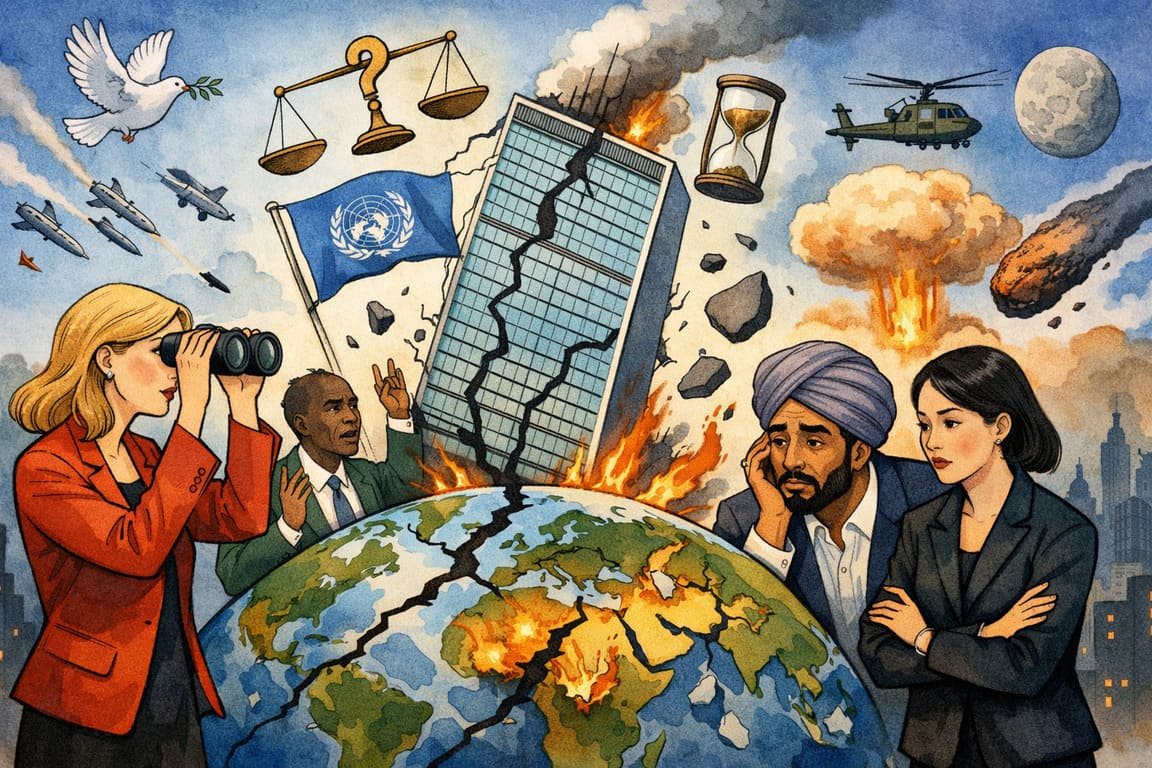
The hall is designed for patience. Marble floors absorb footsteps. Flags stand in careful symmetry. Voices are filtered through headsets that soften urgency into procedure. Outside, the world feels jagged and fast, driven by shock and spectacle. Inside, time moves by consensus. This contrast explains why the question no longer whispers. It presses hard. Can the United Nations, conceived in the aftermath of catastrophe, still function when catastrophe has become constant.
The UN was not born from idealism. It emerged from exhaustion. After the world tore itself apart, coordination felt preferable to chaos. The institution was designed as a brake, not an engine. That logic made sense when wars ended and peace could be administered. Today’s turbulence refuses to pause. Conflicts overlap. Crises compound. The UN now operates in a permanent emergency, a mode it was never engineered to sustain.
Criticism follows naturally. Vetoes paralyze action. Resolutions stack up without consequence. Peacekeeping missions arrive constrained by mandates and budgets shaped far away. These failures are real, but the conclusion often drawn from them is too simple. The UN does not override its members. It mirrors them. When cooperation weakens, the institution reflects that fracture back to the world.
National politics have changed the atmosphere inside the chambers. Global decisions now carry domestic penalties. A vote abroad becomes a headline at home. Leaders calibrate statements less for consensus than for electoral safety. Diplomacy turns performative. The UN becomes a stage where restraint looks like weakness and compromise risks backlash.
Speed has become the silent enemy. Modern crises unfold in real time, streamed and dissected instantly. The UN moves through negotiation, translation, and legal precision. That pace feels intolerable to publics conditioned by immediacy. Deliberation is mistaken for indifference. Process is confused with failure.
Yet much of the UN’s value lies in work that never trends. Aviation standards that prevent accidents. Health coordination that stops outbreaks quietly. Humanitarian corridors negotiated without cameras. These successes feel invisible precisely because they work. When systems hold, attention drifts elsewhere. When they break, blame concentrates.
A delegate once described success at the UN as plumbing. Nobody praises it when water runs clean. Everyone panics when it stops. The metaphor sounds unromantic, but it captures the institution’s role. Stability rarely announces itself. It accumulates quietly through rules, norms, and repeated cooperation.
The philosophical tension cuts deeper. The UN rests on the belief that rules can restrain power. That belief feels fragile in a moment when force regains legitimacy. Yet abandoning it does not eliminate power politics. It simply removes the forum where weaker states can speak at all. The chamber may frustrate, but silence favors only the strong.
Reform debates swirl constantly. Veto power. Representation. Funding models. The logic for change is undeniable. The structure reflects a world that no longer exists. Emerging powers demand voice. Smaller nations demand fairness. The obstacle is familiar. Reform requires agreement from those who benefit most from the status quo.
A small, telling scene plays out often. During late night negotiations, junior diplomats translate dense legal language into messages their governments can actually use. No applause follows. No history books record the moment. Yet these acts keep cooperation alive inch by inch. The UN survives through such unglamorous labor.
Public trust remains the most fragile resource. Many see the institution as distant, elitist, or ineffective. That perception feeds disengagement, which further weakens its authority. Rebuilding credibility requires honesty about limits. The UN cannot guarantee peace. It can guarantee a place to argue before violence becomes the only language left.
Younger diplomats bring a different pressure. Climate urgency, inequality, and digital transparency shape their priorities. They challenge old hierarchies subtly, persistently. Change arrives slowly in such spaces, but it does arrive when enough people refuse to treat inertia as tradition.
The UN’s survival will not be decided by architecture or slogans. It will be decided by whether nations still believe shared survival is worth the discomfort of cooperation. The building will remain standing either way. The question is whether it remains relevant, or becomes a monument to a moment when humanity briefly believed that talking, however imperfectly, was better than tearing the world apart again.
