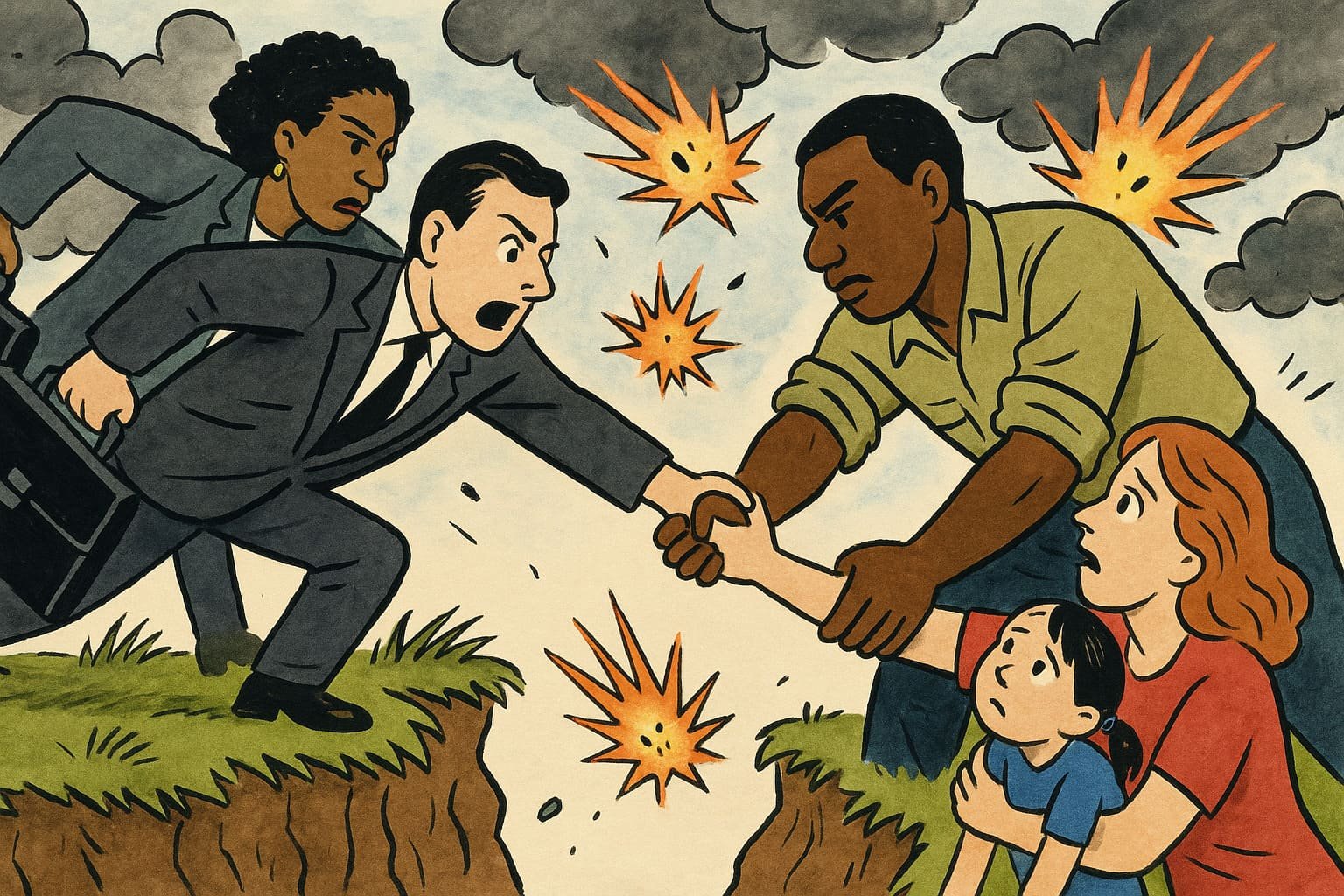
The apartment was quiet except for the glow of a laptop on the kitchen table. Outside, traffic moved in predictable waves, but inside, time had lost its shape. Dinner sat untouched while emails refreshed themselves like a heartbeat that refused to slow down. The space meant for rest had become an extension of the office, and nobody seemed to remember when that invasion began. The war between work and life had no official declaration. It simply arrived and never left.
Modern culture pretends this conflict is about balance, as if both sides are equal competitors. In reality, work rarely negotiates. It expands. It absorbs. It disguises itself as ambition, responsibility, even identity. Life becomes the leftover space between tasks. The language of productivity turns hours into assets and people into systems. Home stops being a sanctuary and starts feeling like a charging station.
You can see the damage in subtle ways. Conversations that never reach depth because someone is always half-present. Relationships maintained through scheduling apps. Children who associate attention with interruptions. Rest framed as something that must be earned instead of something required. The war is quiet, but its consequences are cumulative. Emotional distance grows without obvious conflict.
A project manager named Elias once realized he had not spent a full weekend offline in years. He prided himself on being reliable, responsive, indispensable. When his partner finally confronted him, he dismissed it as temporary stress. Months later, the relationship ended. The breakup felt sudden. The neglect had not. His availability to work had come at the cost of emotional absence at home.
Philosophically, the conflict emerges from how value is defined. Societies that measure worth through output inevitably turn time into currency. The more visible the labor, the more legitimate the identity feels. Domestic life, emotional labor, and personal reflection become invisible. They produce no metrics, no applause, no promotions. Yet they sustain everything else.
Stoic thinkers believed that time was the only resource that could not be replenished. To waste it on external validation was considered a form of self-betrayal. They argued that control over attention mattered more than control over circumstances. A person who cannot choose where their mind rests is never truly free, regardless of status or income.
A clinical researcher named Marisol once studied burnout patterns among executives. She noticed that most did not collapse from workload alone. They collapsed from identity fusion. Work had replaced community, meaning, and self-worth. When performance dipped, their entire sense of self destabilized. Recovery required rebuilding non-work identities, not reducing tasks.
Culture reinforces the problem by romanticizing overwork. Long hours become proof of dedication. Exhaustion becomes a badge of honor. People brag about being busy as if rest signals laziness. The narrative rewards sacrifice without questioning what is being sacrificed. Family becomes flexible. Personal needs become negotiable. The war normalizes itself.
Politically, economic systems benefit from blurred boundaries. When work invades private life, productivity increases without formal compensation. Remote tools promise freedom but often deliver constant availability. The home becomes an unpaid extension of the workplace. The line between professional obligation and personal time dissolves quietly, without legal or cultural resistance.
Technology accelerates the invasion. Notifications create artificial urgency. Messages feel immediate even when consequences are minor. The brain struggles to distinguish between real emergencies and symbolic ones. Attention fragments. Presence dissolves. Home becomes a physical space occupied by a distracted mind.
A teacher named Njeri once implemented a simple rule for herself. No screens after sunset. At first, the silence felt uncomfortable. She noticed how anxious she was without constant input. Gradually, evenings became slower. Conversations deepened. Sleep improved. The boundary felt arbitrary, yet its effects were profound. The mind remembered how to inhabit a moment.
Rescuing home life requires redefining success. It means valuing emotional availability as much as professional competence. It means treating rest as a strategic investment rather than a moral reward. It means building rituals that protect personal space from constant intrusion. These choices feel countercultural in environments obsessed with optimization.
The hardest part is confronting the internal narrative that equates worth with output. Many people fear that reducing work will expose emptiness or irrelevance. They worry that without constant achievement, they will disappear. This fear keeps the war alive. It convinces people that exhaustion is safer than stillness.
In a small living room filled with toys and unfinished projects, a man watched his child fall asleep while his phone vibrated on the couch. For once, he did not reach for it. The world did not collapse. The email waited. The moment did not. The choice felt insignificant and revolutionary at the same time.
The war between work and life cannot be won through better schedules alone. It requires cultural defiance and personal honesty. It demands recognizing that productivity is not a substitute for presence. That achievement cannot replace connection. That success loses its meaning when nobody is there to experience it with you.
Rescuing home life is not about quitting ambition. It is about relocating it. Ambition can exist in relationships, creativity, health, and reflection. It can aim at coherence instead of constant growth. The real victory is not having more time, but learning how to inhabit it fully. And the question that lingers, quietly but persistently, is whether your home still feels like a place you live in, or just another system you perform inside.
