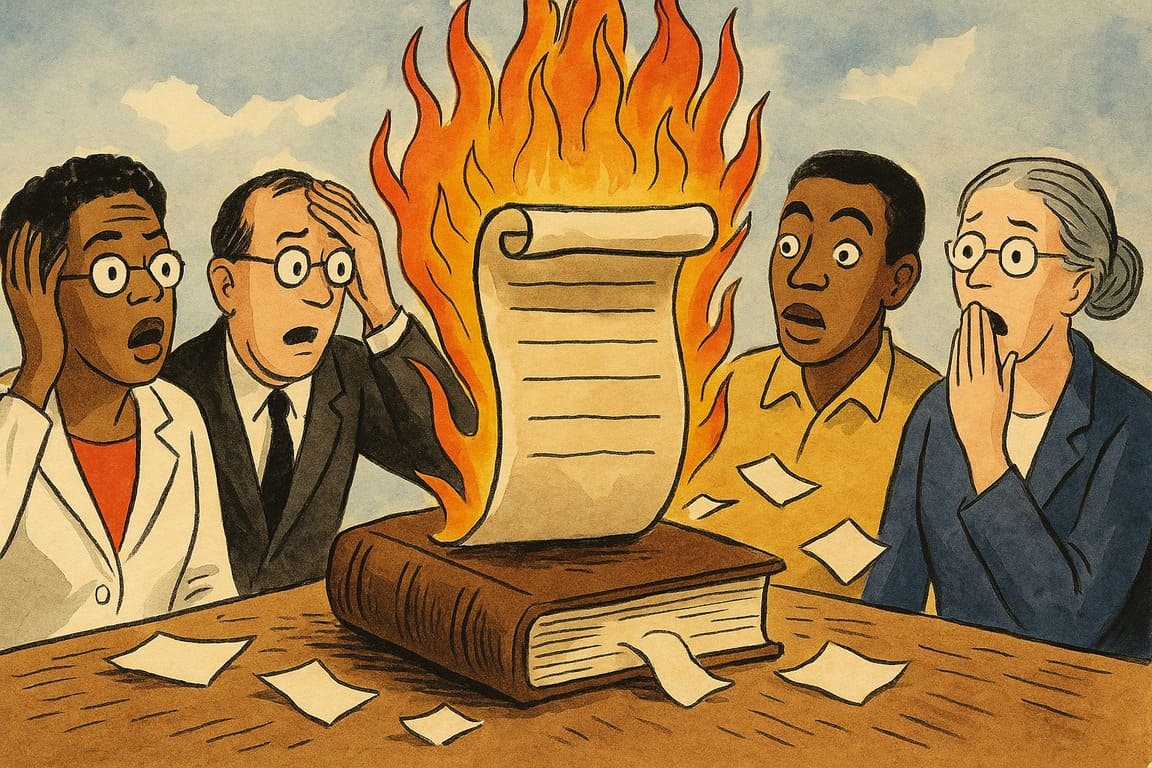
A marble corridor stretches into silence, lined with statues of forgotten thinkers and gilded plaques that catch the morning light. In a vaulted chamber at its end, a scholar paces before a battered lectern, fingers tracing the ridges of a yellowed manuscript. On the table beside her rests a pile of legendary papers: texts that once shattered certainty and redrew the boundaries of what was possible. The room feels alive with ghosts—Galileo’s heresy, Darwin’s challenge, Curie’s danger, Turing’s code. Each document is a loaded question, whispering, “What if everything you know is wrong?” In this vault of dangerous ideas, a single phrase written on the edge of an old page could topple empires or birth new worlds.
No monument in any city captures the wild impact of a truly revolutionary research paper. Most people walk past these milestones every day, never suspecting that their phones, medicines, or freedoms began as humble footnotes buried in journals or lost in university archives. The story of progress is really a story of documents—sometimes read by only a handful of believers, sometimes burned in the square. Real history doesn’t turn on treaties or battles alone. It pivots on the silent explosions that start in a margin or a diagram, spreading out to flood the world with new rules.
What makes a research paper powerful enough to rewrite history isn’t just a fresh discovery, but the courage to flip the script. When Watson and Crick first published the structure of DNA, a single sketch upended decades of debate and set off a race that continues to this day. Their findings didn’t just clarify how life works—they offered a key to healing, changing, and even designing the building blocks of existence. You might hold the latest health app in your palm, but its DNA was born in a draft passed between scientists over weak coffee and nervous laughter.
These papers have a strange habit of being ignored, ridiculed, or dismissed before they finally break through. Gregor Mendel, the monk with his pea plants, saw his theories shelved and forgotten until a new generation realized he’d solved the mystery of inheritance decades before genetics became a field. The lesson is blunt: world-changing research often wears the disguise of irrelevance. If you’re chasing applause, you’ll miss the chance to create what the world isn’t ready for—yet.
For every headline about a Nobel Prize, there are a hundred quiet revolutions. In a cramped office in 1950s London, Alan Turing typed out a vision of machines that could think—a paper met with skepticism and sometimes outright fear. Today, that vision animates the smartphone in your pocket, the car that parks itself, and the algorithms deciding what you see, read, and buy. His blueprint for artificial intelligence wasn’t just a technological leap. It was a cultural shockwave that still ripples through every debate on privacy, consciousness, and human purpose.
You might believe only the sciences produce papers that alter the course of history, but the social sciences and humanities have their own seismic moments. Think of Rosa Parks, whose simple act and the research of sociologists on civil disobedience catalyzed a movement for equality. Or Judith Butler, whose writing on gender bent and reshaped how identity is understood across continents. Every movement that shifts minds begins with words on paper—sometimes fierce, sometimes fragile, always risky.
A real-life case comes from Nairobi, where a young environmental scientist’s report on water contamination forced the government to overhaul regulations, saving thousands from illness. Her work, dismissed as alarmist at first, is now studied worldwide as a model of citizen science and advocacy. The chain reaction from a single paper can spark policy change, inspire protest, or launch entirely new industries.
What binds these papers together is the way they punch holes in accepted reality, letting in light. When Einstein scribbled his theory of relativity, he wasn’t just solving a mathematical puzzle. He was inviting the world to rethink time, space, and possibility. Companies that once traded on slow, safe bets now had to contend with a universe where the rules could shift overnight. Every market disruptor, from Tesla to TikTok, owes something to that willingness to question the given.
Each breakthrough also reminds you that knowledge is a living thing—never finished, always subject to challenge and reinvention. When Watson and Crick’s double helix model was first unveiled, it depended on the x-ray images painstakingly produced by Rosalind Franklin. Her overlooked contribution, only recently acknowledged, shows how the impact of a paper isn’t just about the names in the headline, but the entire messy, collaborative, and often controversial path to truth.
The drama doesn’t end when the findings go public. In fact, the greatest papers often ignite fierce debate and resistance. Rachel Carson’s “Silent Spring” triggered backlash from chemical companies and policymakers but eventually inspired the modern environmental movement. Her data was not just numbers, but a call to arms—a proof that science can be a lever for moral and social awakening. The noise and fury that follow a breakthrough are proof that the world is waking up.
Top research papers are never just technical manuals. They are battle plans, confessions, love letters to future generations. They take root in classrooms, boardrooms, and city streets. A teacher in Lagos shares Marie Curie’s work with her students not to dazzle with Nobel glory, but to show that the pursuit of knowledge can risk everything—even safety, even reputation—and still matter. The papers endure not because they are perfect, but because they are brave.
You are not just a reader of history, but a potential author of its next chapter. Every discovery, every insight, every observation holds the potential to reshape what comes next. The courage to publish, to argue, to demand new answers is the true spark behind civilization’s greatest leaps. Whether you’re writing a thesis, starting a business, or building a product, your willingness to chase the unknown is what puts your fingerprints on the future.
In the shadowed archive, the scholar presses her palm against the next blank page, breath misting in the cold. Somewhere in the hush, the first line is forming—jagged, uncertain, full of risk. The statues seem to watch, old eyes shining with memory and warning. Every revolution starts here, in the dark, when the world isn’t looking. The only real question is who dares to write the next sentence. You stand at the edge of history: are you brave enough to leave your own mark?
You are the spark and the storyteller—will your paper change everything, or will the world rewrite itself without you?
