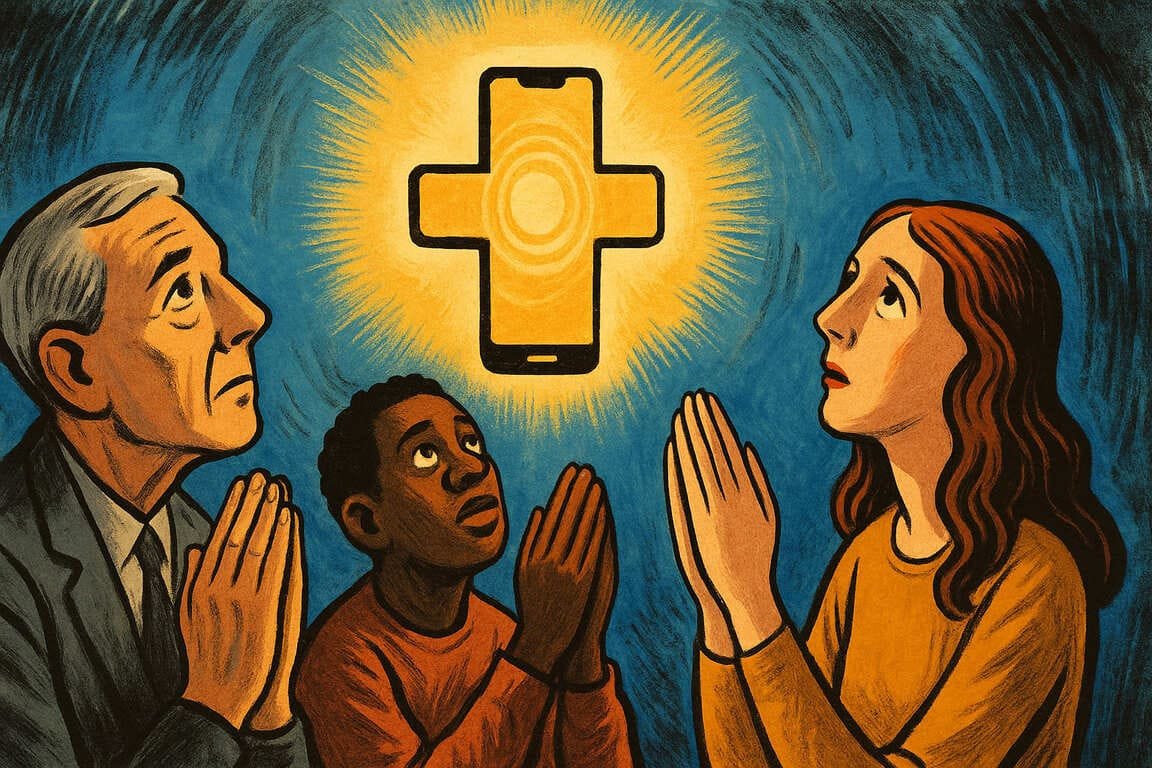
A row of worshippers stands in a glowing cathedral, faces bathed not in stained glass light, but in the blue aura of their phones. Heads bow, not in prayer, but over glowing screens where livestreams of gurus, hashtags, and virtual meditation circles fill the air with a humming devotion. The city outside pulses with LED billboards advertising inner peace, enlightenment available for download, spiritual wellness bundled as a subscription. In one apartment, a lonely man slides on a VR headset, entering a digital temple where his avatar floats above neon lotuses and algorithmic chants echo across a synthetic horizon.
Yet beneath the novelty, something deeper stirs. In coffee shops, yoga studios, and gaming lobbies, millions search for meaning in the pixelated ether. A child whispers a wish to a smart speaker, hoping for comfort. A mother texts daily affirmations to a friend, both comforted by emojis more than words. The new rituals are seamless, frictionless, and quietly addictive. Here, the soul is shaped not by ancient rhythms but by the algorithm’s invisible hand. Belief is streamed, purpose is ranked, and faith is measured in clicks and shares.
In this new church of the digital, the boundary between code and spirit dissolves, and nobody knows quite what they’re worshipping anymore.
Quick Notes
- Spirituality Goes Digital: Rituals, meaning, and belonging are now found online—apps, virtual gatherings, and algorithmic inspiration fill the void once held by tradition.
- Algorithms Shape Belief: Tech platforms curate purpose, nudging users toward certain values, communities, and even feelings of awe or transcendence.
- Connection or Commodification: The digital search for meaning can heal, unite, and empower—or turn inner life into a product, mined and sold for profit.
- Soul Hacking and Identity: Personal transformation happens, but often by design. Avatars, feedback loops, and “mindfulness tech” change how users see themselves.
- Choosing Meaning Over Metrics: Lasting growth means slowing down, questioning tech’s role in shaping values, and reclaiming authentic connection—online and off.
From Sanctuary to Feed
The search for meaning hasn’t vanished; it’s just changed channels. You once found purpose in shared rituals, weekly gatherings, and sacred spaces. Now, it arrives in morning push notifications, motivational podcasts, and viral stories. The holy day has become “self-care Sunday,” guided by an influencer’s Instagram live. When a pandemic shuttered churches and temples, millions built new sanctuaries in Facebook groups, Discord servers, and wellness apps.
It’s easy to see why. Digital communities offer belonging to anyone with Wi-Fi, erasing the old barriers of geography and stigma. Sara, a nurse in Nairobi, found hope after grief in a global WhatsApp circle that swapped prayers and stories at all hours. “It’s my family now,” she says. For many, the digital pulpit is more accessible than any physical altar.
But the transition is not without loss. Rituals shrink to “likes,” wisdom to “content,” and the mystery of faith gets flattened by SEO keywords. A meditation app launches a daily streak badge, and soon the pursuit of peace feels more like a competition. Pop philosopher Jayden Miles went viral for asking, “If your spiritual growth isn’t trending, is it even real?” The laughter hides an edge of truth.
Digital sanctuaries are inclusive, but also fragile. A troll, a glitch, or a shutdown can fracture fragile trust. Tech offers more connection than ever, but less commitment. The community that gathers at sunrise may dissolve by sunset, leaving the search for meaning ever unfinished.
Algorithmic Faith and the Engineering of Awe
Tech companies now write the scripts for spiritual experience. Recommendation engines, trained on data and engagement, learn what lifts your spirit, what soothes your worries, what gives you hope. The “Explore” page becomes a new oracle, suggesting quotes, sermons, and affirmations tailored for maximum impact. It’s comforting, but calculated.
In San Francisco, a popular AI “life coach” app guides users through daily rituals—gratitude lists, affirmations, even dream analysis. The app’s designers boast of “hacking awe,” creating feedback loops that trigger dopamine releases. Users describe feeling uplifted, then unsettled. “Sometimes I wonder if it’s my faith, or just the algorithm’s plan for me,” confides Amrita, a college student.
Influencers and tech leaders alike embrace “digital spirituality” as a trend. Startups pitch mindfulness platforms as cures for burnout, stress, and loneliness. Investors pour billions into apps that promise “meaning at scale.” But engineered awe is fragile. A wave of copycat apps floods the market, each pushing deeper, faster hacks for the soul.
Critics worry about manipulation. When belief is curated by code, it can be weaponized. Extremist movements, cults, and charlatans thrive in the same feeds as support groups and wellness gurus. The algorithm’s nudge can tip followers from hope to obsession, unity to division, compassion to outrage.
You get what you click. But sometimes, what you click gets you.
Commodifying the Inner Life
The search for meaning becomes a market. Every meditation session, mood check-in, and digital confession adds to a profile—sold to advertisers, therapists, and, sometimes, data brokers. Inner life becomes inventory. Mindfulness is repackaged as a subscription, prayer as an upgrade, belonging as a “premium community.”
Hannah, a teacher in Montreal, found solace in a meditation app during a hard divorce. The app’s soothing voices felt like companions. Then came a flood of upsells: paywalls for deeper wisdom, ads for luxury retreats. “It felt like my pain had a price tag,” she recalls. Tech’s promise to heal easily turns into an invitation to spend.
The commodification runs deeper. Virtual influencers, AI “gurus,” and synthetic communities deliver inspiration around the clock, never tiring, never doubting, always available—for a fee. Social platforms partner with wellness brands, blurring the line between support and sales.
This is not new, but it’s faster and more subtle. Faith and meaning, once the domain of families, elders, and community leaders, now compete with branded content and growth hacks. It’s easier than ever to find encouragement—and to get lost in the churn.
For every story of digital healing, there’s another of exploitation. The soul is real. The market is relentless.
Identity, Avatars, and Soul Hacking
Online, you can be anyone. The digital search for meaning is also a search for self. Avatars meditate on virtual mountaintops, chatbots offer “daily wisdom,” and communities form around the fiction of anonymity. Personal transformation is instant and infinite—change your username, change your life.
This freedom has power. Jamie, a nonbinary artist, found courage to transition through an online group where identity was fluid, judgment rare. “My real friends were pixels,” Jamie says, “but they saved me.” Virtual worlds, from gaming lobbies to meditation spaces, offer sanctuary for those out of place in the physical world.
But transformation comes by design. Algorithms nudge you toward certain identities, habits, and beliefs. A “mindfulness” app tracks your every mood, suggesting who you might be if you just upgrade. Feedback loops reinforce not just behavior, but self-concept. Tech’s most dangerous trick is making you think you chose the change.
Soul hacking isn’t always sinister, but it is rarely accidental. Tech platforms shape your story, then sell it back to you. The risk: in searching for yourself, you end up with a version optimized for engagement, not growth.
Real change is possible, but only when you know who is steering the wheel.
Reclaiming Meaning in the Age of the Algorithm
You don’t have to surrender your soul to the scroll. The path to real meaning—online or off—demands intention. Unplug, even briefly, to reflect on what matters. Seek out communities that prize depth over noise, people over platforms, questions over certainty.
Some innovators are pushing back. In Tokyo, a “slow tech” movement encourages digital sabbaths: time for real connection, unmediated by screens. A mindfulness startup in Sydney gives users all features free, surviving on donations and trust. “We’re not selling enlightenment,” says founder Mei Lin. “We’re just holding space.”
Question the stories you’re told—and the ones you tell yourself. Challenge apps that demand loyalty, avatars that never change, rituals that feel hollow. Reclaim boredom, silence, and ambiguity. The algorithm can deliver content, but only you can create meaning.
Digital spirituality isn’t a curse, or a miracle. It’s a mirror—reflecting what you bring, and magnifying what you ignore. The soul, rewired by tech, still hungers for authenticity.
Choose your faith. Choose your pace. Remember what it feels like to find meaning on your own terms.
Signal in the Noise: The Last Quiet Place
A lone commuter steps off the train, earbuds tucked away, phone silent. For a moment, the city is just a city—cold, bright, alive with strangers. In a quiet room, a grandmother lights a candle and prays, unseen by anyone but herself. The world’s noise ebbs, and something ancient stirs, untouched by algorithm, unsold, and utterly real.
The last place for meaning is not in your feed, but in your heart. What will you choose to worship when the screen goes dark?
