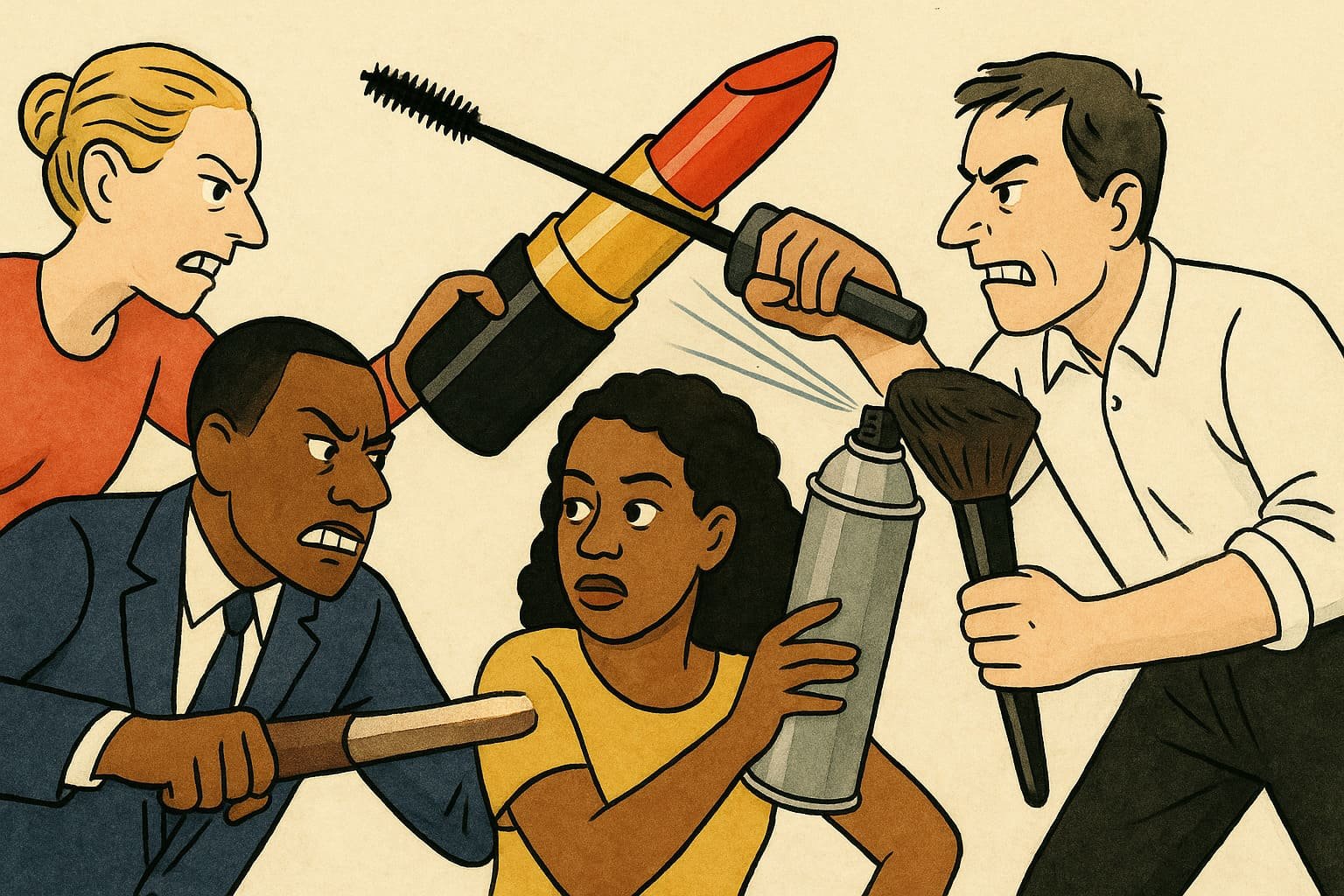
Under cold museum lights, a silent crowd gathers, each face bathed in sterile blue and white. The latest sculpture stands at the center, sharp as a threat, its beauty a blade slicing the still air. Critics whisper, phones raised, capturing angles they’ll twist into memes before the marble dust settles. In this room, admiration curdles into envy, and applause camouflages the hunger to outdo, to own, to destroy. Beauty, once a private solace, now stalks the halls as a predator; polished, predatory, and paid for in bloodless wars of taste.
Every eye is a judge, every jaw clenched for battle. The clash isn’t about the art. It’s about what beauty does to people when filtered through a feed, when weaponized by ambition, when hijacked by power hungry brands. All around, echoes of ancient philosophers; Plato, Confucius & Zhuangzi rebound off glass and steel, drowned out by the digital drum of likes and retweets. If Socrates walked these aisles, he’d find the forum replaced by hashtags, his questions lost in algorithms more savage than any Athenian crowd.
Behind the velvet ropes, an influencer livestreams with a bored pout, voice syrupy as she delivers judgment: “Stunning. Game-changing. Obsessed.” The audience online lurches forward, eager to align their own worth with a passing trend. Here, taste isn’t cultivated, it’s militarized. A color, a sneaker, a smile; suddenly ammunition in a war for status, clicks, and soul-crushing comparison.
A CEO in a corner, suit as sharp as the exhibit, watches his “edgy” campaign projected in real time, feigning indifference as focus groups dissect every line. His team once chased beauty for joy. Now, they track it for profit, data-mining desire, stripping elegance for metrics. Perfection has become currency. Imperfection gets you canceled.
Yet beauty, untamed, still flickers in a stolen glance or the reckless laugh of a child with paint on her fingers. Underneath the branding, the scoring, the viral crusades, something ancient waits; something tender, vulnerable, almost holy. The gallery becomes a battlefield, but somewhere in its heart, a question smolders: When did beauty become a weapon? And is there any way to disarm it before it destroys the very souls drawn to its light?
Quick Notes
- Beauty’s New Battlefield: Beauty is no longer a sanctuary; it’s been turned into a weapon that fuels rivalry, envy, and brand warfare. Think less Monet, more Marvel’s Infinity Gauntlet; wielded for domination, not delight.
- Algorithmic Ammunition: Social media and technology haven’t democratized taste; they’ve armed it. Today, a single viral image or trend can ruin reputations or mint new emperors overnight.
- Case Studies in Carnage: From fashion houses hijacking grassroots aesthetics to startups exploiting FOMO through “ugly-pretty” design, the casualties pile up. Even teenagers wield TikTok beauty standards like scalpels.
- Ancient Wisdom, Modern Tragedy: Philosophers once saw beauty as a bridge to truth. Now, stoic wisdom feels quaint as platforms monetize insecurity and turn taste into tribal war paint.
- The Search for Meaning: In the ruins of weaponized aesthetics, a hunger for something real persists. Vulnerability and raw imperfection may be the new rebellion but are you brave enough to look ugly in public?
Beauty’s Arsenal—From Paintbrush to Powerplay
Beauty once belonged to the dreamers, the artists, the awkward teens who painted in notebooks or lost themselves in symphonies after midnight. Now, it’s the sharpest sword in the marketing arsenal. Corporate campaigns weaponize color palettes, facial symmetry, and even the sound of a whispered brand name to cut through clutter and claim loyalty. Where the Renaissance saw beauty as harmony, today’s boardrooms treat it as tactical advantage.
Think of how sneaker culture mutated. Nike’s Air Jordan started as a celebration of athletic grace but soon became a currency for social capital. Streetwear’s aesthetic shifted from playful rebellion to calculated scarcity; each drop engineered for maximum FOMO. The taste clash here isn’t just about sneakers, it’s about the transformation of beauty into a zero-sum game. One person’s style becomes another’s humiliation in a heartbeat.
Anna, a junior designer at a global fashion label, watched her collection torn apart by “trend forecasters” who never touched fabric but dictated global taste with spreadsheets. “My joy died in those meetings,” she confessed to a friend. Her story isn’t rare. Every creative has felt the sting: a vision born of heart, now reduced to a weapon wielded by those seeking quarterly gains, not cultural resonance.
Across industries, leaders chase beauty like a hunted animal, hoping to bottle its magic before it turns on them. Apple’s minimalist hardware design, once radical, became industry gospel, then parody, then stale expectation. Suddenly, beauty’s not enough; it’s dangerous if left untamed, safe only when caged by brand guidelines and enforced uniformity. Even anti-beauty; deliberate ugliness gets weaponized for viral shock value, see Balenciaga’s “ugly sneaker” or Diesel’s anti-glam ads.
Philosophers warned about this. Nietzsche saw beauty as a temptation to power, a seductive tool for control. In the TikTok era, that prophecy has matured. Today, your taste isn’t just yours; it’s tracked, hacked, and sold to the highest bidder. The battlefield has moved from museums to your pocket, from galleries to the glass of your smartphone, where every swipe is a skirmish and every “like” a line drawn in digital sand.
Algorithmic Warfare—When Taste Goes Viral
You wake up, check your feed, and find that yesterday’s indie musician is today’s meme, tomorrow’s punchline. Taste moves at light speed, and you’re always one misstep from exile. Social media promised freedom of expression, but it delivered a new prison: the tyranny of the algorithm. Here, beauty isn’t just subjective; it’s weaponized as ammo for clicks, clout, and cancel culture.
Brands like Glossier used pastel pinks and dewy faces to redefine millennial beauty, then watched those same signifiers become parody fodder in a single viral tweet. A single “bad” photo can become global shorthand for “out,” turning personal expression into a public hazard. You’re no longer curating taste; you’re dodging aesthetic shrapnel.
For Ravi, a young architect, the algorithm was both gatekeeper and executioner. His avant-garde building design; praised by peers went viral for all the wrong reasons. A TikTok clip called it “a toaster with windows,” and soon, his inbox filled with ridicule, not commissions. Taste, once a debate among experts, now belongs to whoever shouts loudest with the cleverest meme.
Even tech’s biggest names fall victim. Instagram’s pivot from chronological to algorithmic feeds was pitched as “discovery,” but it quickly turned into an arms race for attention. Influencers fight for relevance, changing aesthetics weekly, sacrificing authentic vision for the safe bet that won’t get ratioed or memed into oblivion. Suddenly, beauty isn’t about appreciation, it’s about survival.
The wisdom of stoic philosophers feels out of place in this chaos. Marcus Aurelius wrote of inner beauty and resilience, yet how does that compete with a world where a face filter can erase flaws and “ugly” is the latest viral trend? In this new order, you’re not just a spectator; you’re collateral damage or a combatant, whether you want the fight or not.
Collateral Damage—Real Lives, Brutal Outcomes
Beauty’s new brutality leaves real scars. For every “It Girl” who rides a viral trend, there’s a legion of casualties; people who chased the weaponized aesthetic and got crushed. In school halls, teenagers face daily taste wars, policed by filters and sneaker drops, judged on angles, not essence. The fallout isn’t just social; it’s deeply psychological.
Evelyn, a high school teacher in Brooklyn, watched students arrive in anxiety-laced waves, terrified of posting a “bad” selfie. “It’s a firing squad out there,” she says, describing lunchtime rituals of scrolling, rating, and deleting. One student, Jade, stopped drawing entirely after classmates turned her sketchbook into a mocking meme. The message was clear: beauty belongs to those who play by brutal rules.
Adults fare no better. In the workplace, office politics play out through aesthetics; who wears the right brand, who curates the chicest Zoom background. At a San Francisco fintech startup, a project manager confided how her “unfashionable” dress sense cost her promotions. “They said ‘fit the brand’ I thought they meant values, not outfits,” she recalled, laughing bitterly. Her story is everywhere: identity flattened by corporate taste, creativity stifled by the threat of exile.
Case studies pile up in the news: wellness brands touting unattainable “clean beauty,” tech companies designing apps that reinforce sameness, media platforms amplifying trends until they’re toxic. The cycle feeds itself, manufacturing both winners and victims. Beauty, as a weapon, serves only those strong or cynical enough to wield it without shame.
Stoic thinkers argued for resilience against public opinion, yet even they never faced an audience as relentless or as weaponized as today’s. When aesthetic taste becomes both shield and sword, everyone is both attacker and target. You wonder, where does it stop? Who calls a ceasefire in a war no one agreed to join?
The Philosophical Fallout—When Meaning Surrenders to Metrics
In this arms race, something priceless is lost. The pursuit of beauty for its own sake; once a source of joy and connection gets replaced by numbers, rankings, and shallow status games. The deeper meaning, the sense of transcendence, dissolves under the weight of clicks and shares.
Take the art world’s obsession with auctions. Once, paintings sparked revolutions. Now, the hammer falls not for vision but for hype. Banksy’s shredded artwork wasn’t a protest, but a viral stunt dissected in boardrooms for marketing lessons. The artist’s original intent, to question commodification, gets steamrolled by the need for spectacle.
People adapt, but the soul doesn’t. At a global branding conference, entrepreneur Clara Ruiz challenged her peers: “If all beauty is weaponized, who heals the wounds?” Her words echoed off the minimalist walls, unsettling a room full of taste-makers. The answer, so far, is silence. The new philosopher-kings of taste are growth hackers and brand strategists, their wisdom measured in engagement rates.
Stoicism’s answer; cultivate indifference to the judgment of others sounds hollow when social currency determines opportunity and belonging. The metrics that promise clarity instead erase meaning, turning beauty into a commodity traded for attention and influence.
Yet, a counter-movement stirs. Slow fashion brands like Everlane and Patagonia reject viral cycles, championing authenticity and sustainability over shock value. Their fans don’t just buy clothes; they buy the story of resisting weaponized beauty. Is it enough? Maybe not yet, but it points to a hunger for something less brutal, more lasting.
The Search for Real—Can Beauty Be Disarmed?
Underneath the noise, a strange longing grows: for realness, for the imperfect, for beauty stripped of armor. In the same feeds that launch trends, movements for vulnerability surge; unfiltered skin, honest storytelling, hand-drawn art reclaiming space from digital gloss. The most subversive act now might be showing up messy, unfinished, uncurated.
At a Berlin creative agency, the team scrapped months of glossy pitch decks after a junior copywriter read them a poem about her father’s crooked smile. Clients teared up. The next campaign celebrated imperfection, drawing viral praise and business. The twist? In a world addicted to weaponized beauty, honesty became the sharpest tool of all.
Musician Billie Eilish shattered records with a sound and style no one could manufacture or predict. Her signature look; loose, baggy, defiantly unpolished flipped the script on traditional beauty standards, making millions of young fans feel safe in their own skins. When taste is a battlefield, authenticity is the only way to win without losing your soul.
Still, the war rages. Every algorithm update, every product launch, every trend cycle threatens to drag beauty back into the trenches. The challenge is not to abandon beauty but to reclaim it: to find awe in the ordinary, to make peace with imperfection, to choose meaning over metrics.
So, here’s the dare: stand in the gallery, scroll your feed, look at yourself or your work. Instead of reaching for the next viral “win,” search for the quiet flicker of real beauty hiding in plain sight. That’s where the arms race ends, and something like grace might begin.
Shattered Mirrors, Silent Victories
Night spills across the city, its neon glow reflected in rain-slick streets where old posters curl and peel. In a tiny apartment, someone sits alone, cradling a chipped mug, scrolling through endless images that promise transcendence but leave only hunger. The sounds of distant laughter and traffic mingle in the dark, a reminder that even the most flawless beauty cannot shield against loneliness.
Somewhere else, a gallery closes, the last visitor pausing before a painting marred by a deliberate slash. The guard sweeps up confetti from an influencer’s failed “activation,” the room empty but for echoes of applause. Here, beauty stands naked, wounded but unbroken, waiting for someone to notice what survives when the crowd disperses.
A startup founder leans over his balcony, eyes stinging from a day spent chasing relevance, watching city lights flicker out one by one. He remembers his grandmother’s quilt, hand-stitched from mismatched scraps, a work of imperfect love that never made a magazine cover. He wonders if the greatest power lies not in conquering taste, but in refusing to weaponize it.
Outside, the world spins. The next taste clash is already loading, a new round of casualties queued up for tomorrow’s spectacle. But for one breath, there is peace; a realization that beauty, like love, can only be brutalized if you consent to the fight. Some refuse, quietly, and reclaim wonder from the wreckage. You are not required to win this war.
So the next time you spot beauty wielded as a weapon, remember: you can step aside, lay down your arms, and find a quiet kind of victory. The only taste that matters is the one you’re willing to defend with your own imperfect, beautiful life.
Partnered. Provocative. Worth Your Scroll.
This is a Promoted Post by ESYRITE—yes, it’s paid, but never filtered. Our voice stays raw, real, and razor-sharp. We team up with bold ideas, game-changers, and stories that spark something real. If it’s here, it earned its place—no fluff, just impact. We don’t just promote—we provoke. Stay sharp. Dive deeper.
