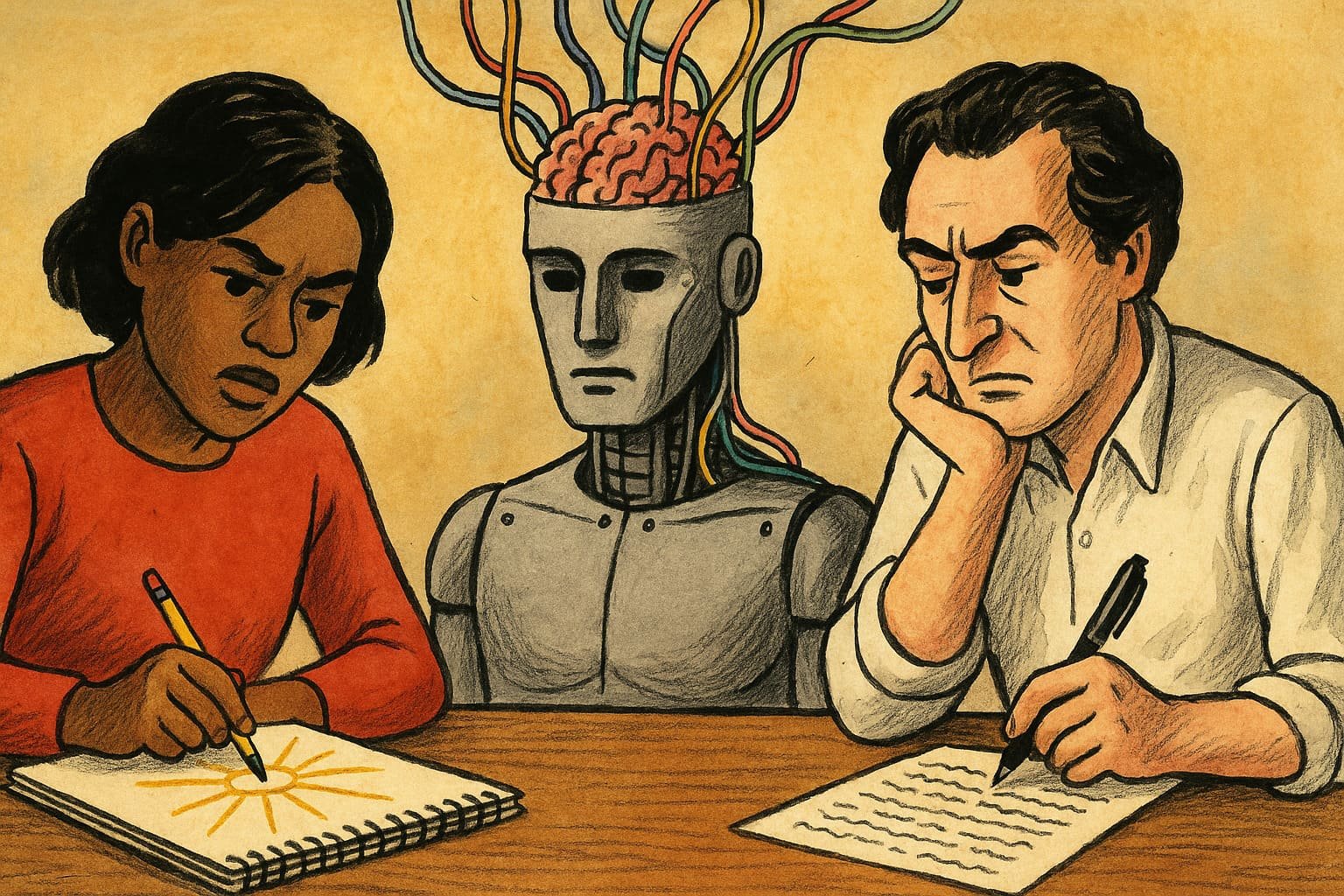
Cold rain snakes across midnight glass, tracing cryptic patterns down a hundred windows. A lone figure stands inside an old warehouse where blank canvases line the walls and a single flickering screen glows in the darkness. The screen isn’t just another device—it’s alive with shifting colors, twitching pixels, and a pulse that almost seems to mimic a heartbeat. Every so often, the artist glances from brush to monitor, fingers trembling as the machine mutters suggestions in fragmented sentences. There’s a strange electricity in the air, the kind that crackles before a storm or during the last minute of a high-stakes chess match.
The world outside has barely noticed the silent coup. On social feeds and office screens, humans and machines are quietly blending minds. Designers wake up to find new drafts on their laptops, spun overnight by neural networks with names like DALL-E and Midjourney. Agencies compete to train the sharpest “creative AI,” racing to out-dream their rivals. Every brainstorm now feels like a game of poker, where nobody knows if the genius card will fall to a sleepless intern or a silicon stranger.
Inside the warehouse, the artist—call her Eliza—pauses, staring at a swirling fractal pattern that the AI has produced. She laughs, equal parts awe and annoyance, as if she’s facing an upstart prodigy who’s skipped the line at art school. The line between muse and machine is vanishing, pixel by pixel, brushstroke by brushstroke. Tonight, creativity isn’t a solitary act. It’s a collaboration, a rivalry, and sometimes a full-blown mind-meld between human heart and machine mind.
Across the city, others are watching. Gallery owners, tech CEOs, teachers, hackers—they’re all holding their breath, waiting to see who will win the next great contest of imagination. The revolution is quiet, but its colors are loud. Neural design isn’t a future—it’s a riot that’s already begun.
Quick Notes
- AI Now Thinks in Color and Sound: Machines don’t just calculate—they generate original art, music, and products that can rival the human mind.
- Collaboration Is the New Creativity: Artists and designers are learning to treat AI as a creative partner, sparking a wild new era of hybrid masterpieces.
- Fear and FOMO Fuel the Fire: If you aren’t experimenting with neural tools, you risk being left behind in the next creative arms race.
- Mistakes Are Now Magic: Happy accidents from neural networks often lead to innovation, showing that perfection is less valuable than unpredictable brilliance.
- The Definition of “Original” Is Being Rewritten: Who owns a design born from both human instinct and machine logic? The answers are messy, but the future is bright.
The Genesis Algorithm—Where Ideas Learn to Think
Neural design started as a fantasy whispered in tech labs and college dorms. The dream was simple but wild: what if computers could do more than follow orders? What if they could imagine, improvise, and even surprise their creators? Once the neural network was born, that dream sprinted into reality, upending every assumption about creativity.
The early days felt like the first guitar chords in a garage band. Engineers taught machines to recognize shapes, predict patterns, and paint by numbers. Results were sometimes clumsy, but every new model grew smarter, braver, stranger. It didn’t take long before artists noticed. Suddenly, machines weren’t just tools—they were unpredictable collaborators.
A turning point came when a Dutch designer named Theo Duval invited a neural network to co-create his Paris runway show. The AI spat out surreal fabric patterns no human would dare sketch, sparking headlines and envy across the industry. “It was like working with a ghost,” Theo told Vogue. “The ghost had better taste than I did.”
The power of neural design is its refusal to be boxed in. Old workflows break down as algorithms improvise, remix, and even invent new art forms. The classic boundaries between designer, coder, and critic become irrelevant. Every brainstorm session becomes a wager: will the next breakthrough come from caffeine or code?
Big brands caught on fast. Car companies used neural design to craft headlight shapes that “feel friendly” to drivers. Fashion labels asked AI to remix vintage silhouettes, breathing fresh life into tired trends. Neural design, once a fringe experiment, now sits at the table with the world’s best creators.
Creative Duets—Humans and Machines in the Studio
You walk into a design studio, expecting chaos, but find quiet hums and scattered coffee mugs. People are still sketching on napkins, but there’s always a laptop open, quietly running a neural program in the background. The new creative process looks nothing like what you learned in school. Every brainstorm is a tag-team match: human intuition meets machine analysis.
Collaboration takes many forms. Sometimes you feed an idea to an AI and let it riff, like an improv partner who doesn’t sleep. At other times, the algorithm generates twenty ugly prototypes before landing on something brilliant. Each mistake is a gift—sometimes the weirdest error unlocks the most inspired solution.
Designers now talk about their favorite neural “quirks.” Laura Kim, a young architect in Seoul, tells her team to embrace the AI’s “wrong answers” because they break through creative block. “Our best building started as a technical glitch,” she laughs. Neural partners force you out of habits, into new territory where the unexpected is welcome.
The best teams learn to switch hats fast. One minute, you’re the conductor, steering the process. The next, you’re the audience, watching as the machine surprises you with something you’d never considered. Collaboration is no longer a soft skill—it’s a survival trait in a world where neural design is the new baseline.
Behind the magic, there’s a human story. Teams form bonds with their machine counterparts, giving them names, personalities, and even inside jokes. The line between tool and teammate blurs. In the neural studio, nobody creates alone—and nobody would want to.
Fear, FOMO, and the Future-Proof Creative
You sense it everywhere—the low hum of anxiety mixed with electric excitement. The rise of neural design has set off a new wave of FOMO. If you aren’t learning the latest AI tool, will your next project flop? If you’re not pushing boundaries with machine mind, will anyone care what you make?
For some, fear is fuel. Young creatives scramble to master code, eager to show their bosses they’re future-proof. Job postings demand “AI fluency,” even for artists and illustrators. Workshops sell out, promising to teach you how to “think like a neural network.” The scramble is real, and the stakes are high.
Stories from the field are both inspiring and cautionary. A marketing manager named Malik watched a neural ad generator out-perform his top copywriter in a product launch. Malik didn’t panic; he threw himself into learning prompt engineering, turning fear into fire. “I realized I could direct the orchestra, even if I didn’t play every instrument,” he jokes.
Of course, not every anxiety is rational. Old-timers grumble that “real creativity can’t be taught to a machine.” Yet even the skeptics admit they peek at the AI’s drafts, just in case lightning strikes. Competition is fierce, but collaboration wins in the end.
In this world, comfort is the enemy. If you aren’t stretching your mind, you risk becoming obsolete. The new heroes aren’t just artists or coders—they’re hybrids, unafraid to learn, adapt, and thrive in the unknown.
The Art of Imperfection—Why Flaws Are the New Feature
Neural design has shattered the myth of perfect, polished creation. For the first time, mistakes are not just tolerated—they’re sought after. Every odd glitch or misplaced brushstroke becomes a chance to discover something bold.
This philosophy echoes the Japanese concept of “wabi-sabi”—beauty in imperfection. Neural networks, with their sometimes clumsy logic, can land on a texture, pattern, or rhythm that humans would never try. The world’s top animators now comb through AI-generated frames, searching for that one magical mistake.
A music producer named Zara used a neural system to remix classic tracks. One night, the AI misheard a vocal sample and pitched it two octaves too high. Instead of deleting it, Zara used the sound as a hook, turning the accident into a viral sensation. Fans loved the unpredictability, craving that raw, unexpected joy.
This celebration of imperfection is changing design culture. Once, teams would agonize over pixel-perfect layouts. Now, a wild experiment or accidental mashup can land the biggest client. Neural design rewards curiosity, not control. Risk is the new roadmap.
Perfection may feel safe, but it rarely breaks new ground. The best creators know that true originality is messy, uncomfortable, and often ugly at first. Neural design, with its happy accidents and digital chaos, proves that beauty lives in the unknown.
The Ownership Dilemma—Who Gets Credit When Minds Merge?
Neural design has sparked a heated debate: who owns a hybrid masterpiece? When an AI generates a logo or paints a portrait, is it the coder, the client, or the machine that deserves credit? Old rules no longer fit this brave new world.
Copyright lawyers scramble to keep up. Agencies write contracts that list “creative AI” as a collaborator, not just a tool. Artists sign NDAs to protect machine-made secrets. The legal system bends, sometimes creaking, as judges argue over whether an algorithm can own an idea.
For creators, this is both challenge and opportunity. Some claim authorship, insisting that the spark came from their prompt or their vision. Others embrace collective credit, naming their neural partner as co-designer. “We share the win,” says Leo, a London-based illustrator who built a fanbase with AI-generated comics.
Audiences, too, are shifting. Some demand full transparency, wanting to know exactly what was “human” and what was “machine.” Others don’t care, as long as the work moves them. The art market, once obsessed with signatures, now values stories of collaboration and risk.
Neural design forces everyone to reconsider what makes something “original.” The future belongs to those who can tell a compelling story—of struggle, surprise, and the weird beauty that emerges when creativity meets machine mind.
When Sparks Outshine Circuits
Beneath the sodium glow of a silent street, a gallery fills with people chasing something new. In the corner, a neon sculpture flickers—half code, half chaos—breathing color into the night. An old poet, eyes bright with mischief, touches the piece and smiles, whispering a line he just wrote to a machine he calls his “midnight friend.” People gather, drawn by the electric pulse, not knowing if they’re seeing the first true collaboration or the last moment before art slips from human hands forever.
Eliza, the artist from the warehouse, stands by the door, watching her neural partner flicker with strange pride. The boundary between muse and machine has disappeared, replaced by a tangled network of ideas, mistakes, and hard-won victories. Each piece on display hums with that unmistakable energy: raw, unpredictable, alive. The machines do not dream of replacing anyone—they only amplify what humans dare to imagine.
Outside, the rain has stopped, and the city breathes, quietly electric. Eliza sees a boy take a selfie with the neon sculpture, then pause, surprised at how it makes him feel. Maybe tomorrow, he’ll sketch his own hybrid dream. Maybe the next great work will come from someone watching, waiting, ready to trust both instinct and algorithm.
You hold the final brush, the last line of code. Will you dare to blend your wildest dreams with the mind of the machine?
Why scroll… When you can rocket into Adventure?
Ready to ditch the boring side of Life? Blast off with ESYRITE, a Premier Management Journal & Professional Services Haus—where every click is an adventure and every experience is enchanting. The ESYRITE Journal fuels your curiosity to another dimension. Need life upgrades? ESYRITE Services are basically superpowers in disguise. Crave epic sagas? ESYRITE Stories are so wild, your grandkids will meme them. Want star power? ESYRITE Promoted turns your brand cosmic among the stars. Tired of surface-level noise? ESYRITE Insights delivers mind-bending ideas, and galactic-level clarity straight to your inbox. Cruise the galaxy with the ESYRITE Store —a treasure chest for interstellar dreamers. Join now and let curiosity guide your course.
