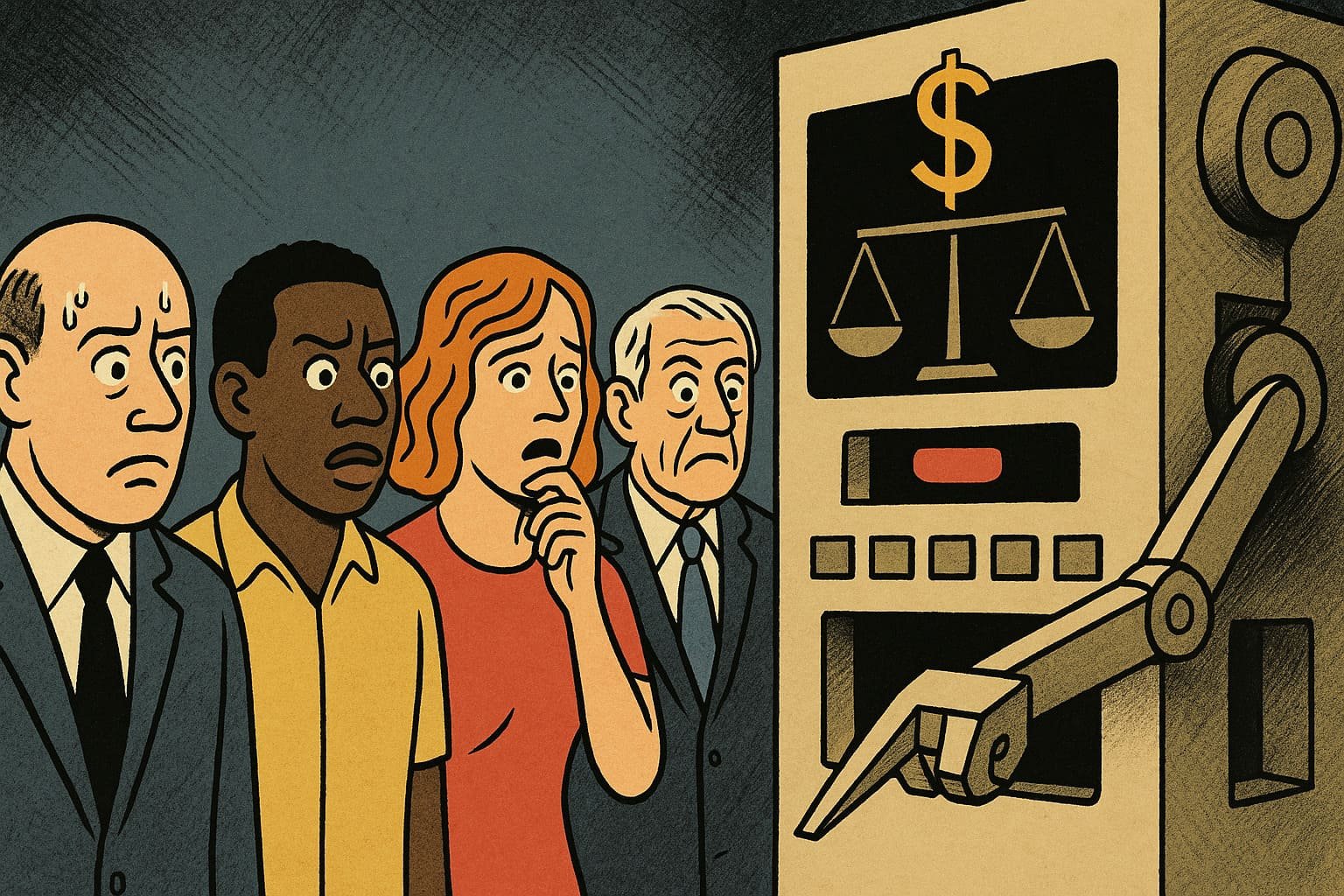
Beneath the harsh glare of fluorescent bulbs, a lone figure stands on polished concrete, gaze locked on a digital scoreboard flickering overhead. Rows of faceless judges materialize, each composed of code, waiting for the verdict to land. The scent of burnt coffee drifts from a neglected mug, mixing with the electric charge of anticipation. A silent crowd, hidden in the shadows, feels the chill, watching as their fates are written in lines of machine logic. No gavel falls, no voice commands order, just a cold, impassive calculation deciding what a lifetime of choices could never settle.
Somewhere, a nervous startup founder scrolls through investor feedback, realizing that a ranking algorithm has determined her product’s worth. Her hands tremble, knowing that one tweak in the code can erase years of effort. In another city, an Uber driver sits in a parked car, heart pounding as he refreshes his star rating, his income now chained to anonymous judgments filtered through digital abstraction. No jury of peers, only the silent arithmetic of data points and user complaints, each click another brick in the wall.
A talent scout once trusted gut instinct and handshake deals, but now he’s glued to predictive analytics, letting AI-driven sentiment analysis tell him who deserves a shot. The scouts themselves become the scouted, as their careers are scored by unseen formulas tracking performance, potential, and even charisma. Behind every “congratulations” or “unfortunately,” a series of calculations spins away, indifferent to late nights or quiet resilience.
In the old world, justice was blindfolded for a reason. In the new one, algorithms claim to see everything, promising objectivity but leaving behind trails of bruised egos and missed nuance. Decisions that once took place behind closed doors now echo through code repositories and user dashboards, their effects spilling into real lives in ways no committee could foresee.
The real twist? These algorithms don’t just sort people—they teach people how to act, think, and even feel. With every swipe, score, or recommendation, the world reshapes itself to fit the math. The Moral Machine Paradox has arrived, and the audience isn’t just watching. Everyone is inside the ring, awaiting the next decision.
Quick Notes
- Judgment in the Digital Arena: Algorithms now rule the crucial moments of work, life, and reputation, rendering verdicts that can lift or destroy with chilling speed. Expect no mercy, only the precision of code.
- Your Life in Numbers: Every action becomes data, every interaction another metric. Algorithms decide who rises, who falls, and who never even gets a chance to play.
- Stories Behind the Score: From gig workers and startup founders to celebrities and students, lives are shaped or shattered by the machine’s verdict. Micro-stories expose how human effort collides with cold logic.
- Ethics Rewired: Code claims objectivity, but real lives are messier than any data model. Bias, hidden priorities, and cultural quirks slip into the system, sometimes leaving more questions than answers.
- What Will You Do?: As algorithms judge, reshape, and rewire humanity, will you adapt or rebel? The only certainty is that the rules are being rewritten—sometimes right beneath your feet.
Life on the Scales—Everyday Judgment Goes Digital
Glass offices shimmer with silent tension as professionals learn that algorithms will decide their fate. In a world obsessed with efficiency, employers feed resumes into parsing engines, hoping to find the “perfect fit” without ever shaking a hand. Some applicants never reach a human eye, their careers stunted by a typo or an unlucky keyword. This isn’t science fiction; it’s an ordinary Tuesday for anyone sending out a job application. The old handshake has been replaced by binary code, rewriting what it means to be seen.
Across the globe, credit scores become character assessments, turning complex lives into simple yes-or-no answers. Consider Elena, a small business owner who survived a rough patch and rebuilt her reputation. Her years of sacrifice dissolve in an instant when an automated credit system denies her a loan. The machine doesn’t care about resilience, only patterns. Elena’s story isn’t rare; it echoes in every corner where people hope for a second chance.
Gig workers, the lifeblood of the on-demand economy, find themselves prisoners of invisible rules. One rideshare driver, Kofi, keeps an emergency change of clothes in his trunk after a single low rating dropped his average and almost cost him his job. He now lives in constant vigilance, smiling wider, speaking softer, catering to whims because one mistake could end his livelihood. Algorithms shape every interaction, making risk-avoidance the new survival skill.
Musicians, artists, and writers feel the squeeze as streaming services and social platforms dictate who deserves an audience. Chloe, an indie musician, once counted on loyal fans, but now relies on recommendation engines to break through the noise. Her songs are judged not by their soul, but by user engagement and listen-through rates. The machine’s taste becomes culture itself.
Even education bends under the algorithmic thumb. Universities use AI to screen applicants, with holistic essays and personal stories taking a backseat to predictive models. The sense of “fair play” is replaced with the promise of efficiency. The question isn’t who you are, but how you scan in the system. Each decision, from scholarships to internships, gets filtered through lines of code, turning dreams into probabilities.
The Code Behind the Curtain—Who Writes the Rules?
Deep inside a windowless office, engineers pour over data, tweaking lines of code that will ripple across millions of lives. These coders are the new lawmakers, and yet their motives are rarely questioned by those outside the system. With every update, the rules shift, sometimes without warning. What counts as “good behavior” or “success” is just a tweak away from oblivion or glory. When algorithms run the world, the question of who owns the code becomes a fight for power.
Take the story of Ben, an early-career coder at a major tech firm, who realized his team’s machine learning model was flagging job candidates from certain neighborhoods more harshly. He tried to raise the issue, but management dismissed it, focused only on “results.” Ben watched as his code created new kinds of barriers—ones more hidden and harder to challenge than old prejudices ever were. The code looked clean; the impact was anything but.
Transparency becomes a luxury, not a norm. Major companies guard their algorithms like state secrets, fearing both regulation and competitive sabotage. For the average user, the black box remains closed. Questions about fairness, bias, or unintended consequences are met with boilerplate responses or not at all. The illusion of objectivity hides layers of assumptions baked into every formula.
When scandals break—like a social platform fueling outrage, or a hiring algorithm excluding minorities—public outcry flares and dies. Apologies are issued, teams promise to “do better,” and then the cycle restarts. Real accountability slips away because the power behind the code rarely faces the world it shapes. The programmer’s keyboard, not the ballot box, sets the boundaries.
Still, resistance brews on the edges. Activists, investigative journalists, and whistleblowers chip away at the walls, demanding answers and fighting for new rules. Not every engineer is complicit. Some walk away, others fight from within. The paradox is simple: in the age of machine judgment, only human courage can rewrite the code.
Lives Rewired by Algorithms
A shy student named Malik gets flagged by a plagiarism detector after paraphrasing class notes with unusual flair. His teacher trusts the software, not the story. Malik pleads his case, but the final word comes from the machine. He watches his academic dreams waver, all because of a few suspicious sentences. Behind every flagged essay or suspicious application is a person with a tale, rarely heard, always judged.
Sharon, a mid-level manager in a retail chain, receives an abrupt email: her performance dashboard shows a drop in “engagement.” She knows her department just weathered a product recall, but the numbers don’t care about context. Sharon’s team feels the heat, working late to nudge their stats higher, while the original crisis remains unsolved. She grows wary of speaking up, knowing that metrics, not conversations, hold the final say.
Even romance is not immune. Dan, a software engineer, finds his dating app profile shadowbanned after being reported for a misunderstanding. He spends weeks tweaking photos, rewriting bios, and messaging support, only to receive the same automated reply. The system does not negotiate, it just enforces. Dan’s love life hangs on an algorithm’s silent, unseen rules.
A TikTok creator, Marisol, watches her videos vanish from trending lists after the platform’s moderation algorithm marks them as “sensitive.” She pours over community guidelines, searching for clarity. Each upload is a gamble—one wrong word, one misread visual, and her audience evaporates. The platform’s silence is the loudest answer.
Within hospitals, AI-driven triage systems begin to prioritize patients, assigning resources based on probabilities and historic outcomes. Doctors find themselves at odds with their own experience, fighting to override a machine’s calculation. A patient, terrified and alone, waits for care, never knowing that a model, not a person, decided who lives and who waits.
The Ethics Illusion—When Machines Pretend to Be Fair
Algorithmic judgment arrives cloaked in the promise of neutrality. “It’s just math,” say the builders, deflecting blame. Yet every choice about what to measure, weigh, and optimize hides a thousand silent assumptions. In the hands of well-meaning companies, fairness becomes a slogan. In the wrong hands, it’s a weapon.
Bias creeps in through every crack: historical data, cultural blind spots, and untested priorities. The old prejudices of human judgment don’t vanish, they migrate. An algorithm built to select the “best” candidate will mirror the past, preserving inequalities under a fresh digital gloss. When scrutiny arrives, explanations get buried in technical jargon and shifting goalposts.
One famous case involved a health insurer using an algorithm to flag patients for extra care. The model systematically favored certain groups, denying support to those who needed it most. Public outrage led to an overhaul, but for many, the damage had already landed. The lesson: even noble intentions can backfire if the system forgets the messy, complex humanity it claims to serve.
Whistleblowers like Joy Buolamwini and Timnit Gebru stepped forward, exposing bias in facial recognition systems. Their stories became rallying cries, inspiring a global reckoning with the ethics of AI. Companies pledged to improve, but progress stumbles. Real change remains slow, as legal frameworks lag behind the speed of innovation.
Ethical codes and AI “bill of rights” appear, but the pressure to automate, optimize, and profit rarely slows. The world keeps moving, as new systems launch and old ones linger. In the end, the question isn’t just “Can we build fair algorithms?” but “Do we even know what fairness looks like?” When every answer becomes a function, the hardest questions get lost.
Humanity Reprogrammed—Who Judges the Judges?
The greatest paradox of the moral machine isn’t that it judges people—it’s that people, in turn, begin to act for the algorithm. Employees obsess over key metrics, not real progress. Social media users chase likes, not connection. Job applicants pad resumes with the right keywords, hoping to pass the first digital gatekeeper. The machine teaches everyone to play its game.
A YouTuber named Brian once built his channel on wild, creative experiments. Over time, he learned that the algorithm loved consistency, length, and familiar formats. His content evolved, not toward artistic vision, but toward whatever scored best with the recommendation engine. Brian’s fans noticed the shift. So did his passion.
Executives in Fortune 500 boardrooms run A/B tests on new strategies, seeking whatever moves the needle. Their own instincts matter less than the dashboards glowing on the wall. Strategy becomes optimization, not vision. Teams fear stepping out of line, knowing that data-driven discipline punishes deviation.
The tension reaches the ordinary, too. Students “study for the test,” not for understanding. Friends post for engagement, not for genuine moments. The algorithm doesn’t just reflect the world; it reshapes it, pulling people into its logic. The game is always running, and the only way to win is to keep playing.
Yet a quiet rebellion grows. Innovators, teachers, and leaders begin to question the cost. Some build “slow” products, valuing meaning over metrics. Others teach teams to question the numbers and trust lived experience. The paradox remains: the only way to outsmart the machine is to remember what it forgot. Humanity becomes the ultimate counter-algorithm.
Who Is Really On Trial?
Inside a cavernous data center, a woman stands before a wall of servers, their hum echoing like distant thunder. Lights flicker across her face, each one a silent pulse of decision. She remembers the day she lost a promotion to an algorithm, the week her friend’s song vanished from every playlist, the year her son’s scholarship hinged on a score no one could explain. The air feels charged, thick with the memories of invisible trials.
She gazes at the machinery, searching for answers in the blinking lights. Shadows twist on the polished floor, drawing strange shapes that hint at old questions: Who decides what matters? Where does fairness begin? Each step she takes, another verdict is rendered in silence, her life a tapestry of calculations she never asked to join.
Through the glass, a storm brews outside, thunder rolling in distant waves. Inside, the only sound is the rhythm of her own breath, the slow, uncertain music of someone standing between past and future. She wonders if justice can ever emerge from a machine, or if true fairness still belongs to flawed, feeling people. No algorithm can measure the weight of a dream.
The final shot lingers on her hands, fingers splayed on cold glass, the reflection half her own, half a mosaic of every life touched by code. In that moment, the room holds its breath, waiting for a new kind of answer, one that no machine can give. So ask yourself: when the algorithm judges you, whose truth will you live by?
Why scroll… When you can rocket into Adventure?
Ready to ditch the boring side of Life? Blast off with ESYRITE, a Premier Management Journal & Professional Services Haus—where every click is an adventure and every experience is enchanting. The ESYRITE Journal fuels your curiosity to another dimension. Need life upgrades? ESYRITE Services are basically superpowers in disguise. Crave epic sagas? ESYRITE Stories are so wild, your grandkids will meme them. Want star power? ESYRITE Promoted turns your brand cosmic among the stars. Tired of surface-level noise? ESYRITE Insights delivers mind-bending ideas, and galactic-level clarity straight to your inbox. Cruise the galaxy with the ESYRITE Store —a treasure chest for interstellar dreamers. Join now and let curiosity guide your course.
