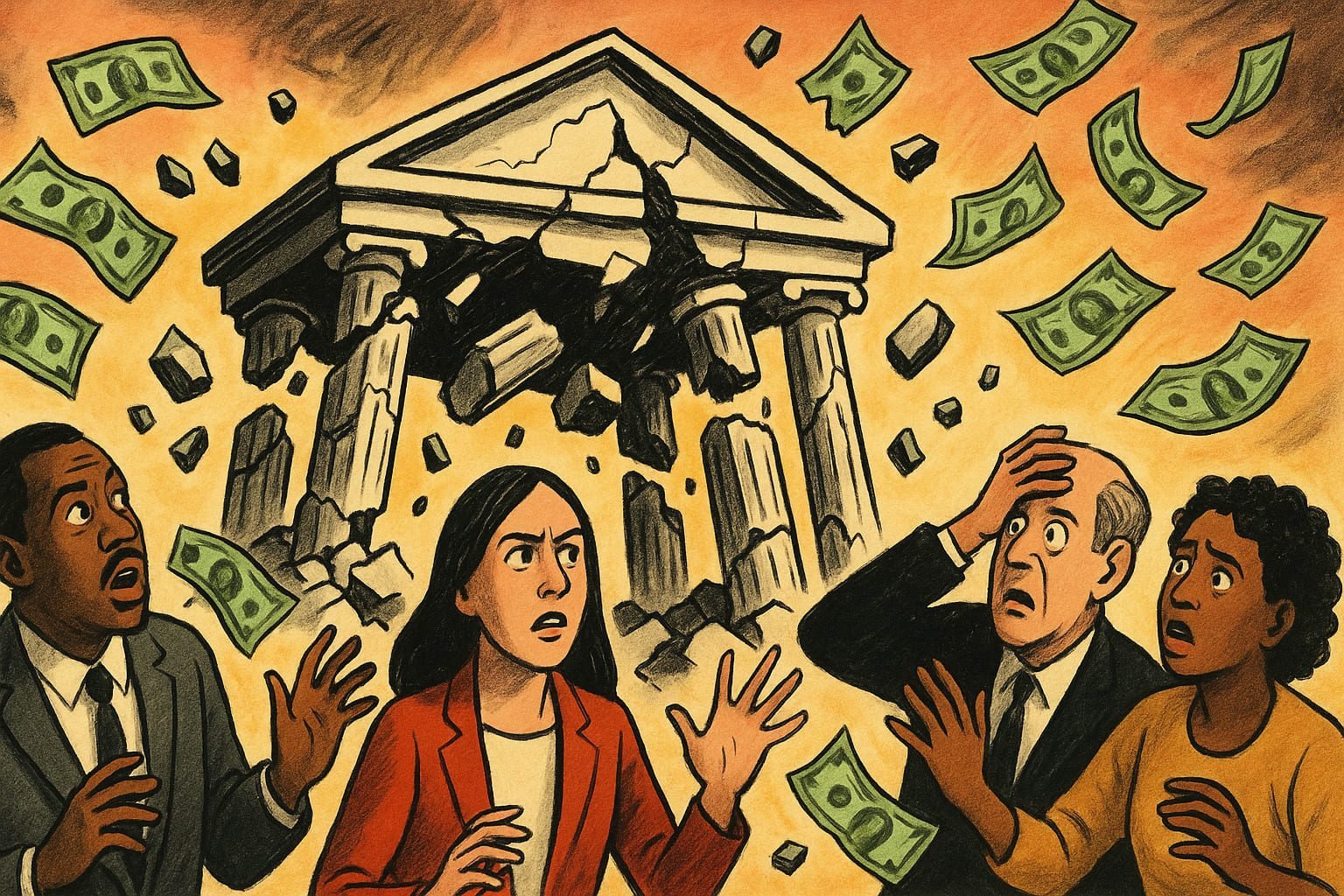
Imagine waking up to news that your savings might be less safe than you thought. The headlines scream panic, while politicians scramble to offer reassurance. Social feeds are on fire with conspiracy theories and nervous jokes about “printing money until we’re all billionaires.” In boardrooms and basement apartments alike, one question echoes: Are central banks losing control, or is the world just addicted to financial drama?
Behind every currency symbol, there’s an invisible machinery; a web of trust, ritual, and unspoken promises. Now that machinery is rattling. Central banks, the legendary “adults in the room,” are facing unprecedented tests. Their old tools don’t work as neatly, and the very rules of money feel up for grabs. Inflation spikes. Debts balloon. Digital coins promise to set us free or send us spiraling.
Yet beneath the panic, a stranger possibility flickers: Is this chaos a sign of something crumbling, or just the birth pains of a smarter, fairer financial world? The answers aren’t simple, but the stakes have never been higher. If you’ve ever wondered what really keeps your money safe or why everyone from Silicon Valley coders to street vendors in Nairobi suddenly cares about monetary policy; grab your metaphorical popcorn. The biggest economic showdown of our age is already here.
Quick Notes
- Historic Shift Unfolding: Central banks face challenges from digital disruption, public skepticism, and shifting economic landscapes, signaling a once-in-a-generation crossroads for global finance.
- Trust on the Brink: The public’s faith in central banks is waning, as inflation, debt, and inequality spark deeper questions about who benefits from the current system.
- Rise of Alternatives: Cryptocurrencies, fintech startups, and grassroots currencies are not just sideshows; they’re fundamentally reshaping how people think about and use money.
- Philosophical Rethink: Money is no longer just numbers; it’s a story about values, identity, and collective trust, demanding a radical new approach to economic leadership.
- The Future Is Personal: Your own financial choices, skepticism, and willingness to learn will define how you weather the coming changes because, in the end, the new money order is built one person at a time.
Cracks in the Vault: When Trust in Central Banks Wavers
Old-school wisdom once treated central banks as sacred fortresses, immune to the storms of politics and market noise. The image: a cadre of steady-handed technocrats steering the economic ship while the rest of us carried on. For decades, this myth brought comfort. Money was money. Banks were banks. The world felt orderly.
Those illusions shattered the night the Swiss franc broke free from its peg, sending global markets into a tailspin. Traders lost fortunes in minutes. Pensioners stared at screens in disbelief. For the first time, regular people questioned whether central banks were truly infallible. If the “guardians of stability” could be caught off-guard, what did that mean for everyone else?
Sarah, a florist in Athens, tells a story that still echoes. Years ago, when her country flirted with bankruptcy, her savings vanished almost overnight. Watching central bank officials offer explanations on television, she realized they were guessing as much as anyone. That fear of invisible decisions shaping daily reality haunts many to this day.
The digital era only multiplies the pressure. Every tweet, meme, or viral video has the power to undermine confidence. Rumors of insolvency can spark runs on banks before officials finish their morning coffee. Central banks now fight on two fronts: stabilizing economies while waging a never-ending PR battle against skepticism.
Public trust, once earned slowly, now evaporates in a flash. The post-pandemic rollercoaster; wild stimulus, then sudden tightening, made many wonder whether anyone, anywhere, still understands the playbook. The world’s financial guardians have never faced more scrutiny, or more restless crowds demanding change.
Inflation, Debt, and the Shadows of Crisis: Why the Old Tools Aren’t Working
Inflation isn’t just an economic term. For families on tight budgets, it’s a gnawing fear at the grocery checkout. When prices soar, trust erodes. Central banks often claim to have inflation “under control,” but recent spikes in food, housing, and energy prices spark anxiety and frustration across the globe. People want answers, not talking points.
Debt hangs over the system like a gathering storm. For every government program, there’s an IOU tucked away; owed to creditors, citizens, and future generations. The more debt piles up, the more fragile the system feels. Central bankers assure us that the math works, but many recall famous collapses where that confidence evaporated in an instant.
Meet Carlos, a small business owner in Buenos Aires. When his country’s currency nosedived, his dreams shrank with it. No amount of technical jargon from policymakers could hide the reality: policies meant to “restore balance” often left ordinary people footing the bill. Carlos turned to alternative payment apps and even bartering to stay afloat, sidestepping the banking system entirely.
Traditional policy levers raising or lowering interest rates, injecting cash into the system; once worked like clockwork. Now, with global trade, new technologies, and political polarization, those levers sometimes backfire. Instead of calming markets, they create new waves of uncertainty. The old tools haven’t just lost their shine; they sometimes make things worse.
Trust in central banks has become a casualty of this new volatility. When people see their savings eroded or their livelihoods threatened, they start looking for escape routes. That search is reshaping finance faster than any technocrat can chart.
Digital Gold Rush: Crypto, Fintech, and the Birth of Parallel Economies
Money no longer means the same thing everywhere. Cryptocurrencies broke into public consciousness as the digital “gold rush,” promising an escape from the world’s fragile currencies. Bitcoin millionaires, NFT auctions, and meme coins made headlines, while bankers scrambled to keep up. To many, these innovations offer freedom; a chance to hold wealth outside the grasp of governments and central banks.
Riya, a freelance web developer in Mumbai, shares a story echoed by millions: she started accepting cryptocurrency payments to dodge currency controls and transfer delays. Friends thought she was reckless, but when local banks froze during a liquidity crunch, Riya had cash while others waited in line for answers. Her story is no outlier. Across continents, people are voting with their wallets, embracing new forms of money that feel safer and more modern.
Fintech startups accelerate this change. Digital wallets, peer-to-peer payment platforms, and micro-loans have leapfrogged the old guard. In Lagos, small traders run thriving businesses powered only by smartphones and QR codes, bypassing traditional banks entirely. The impact ripples outward; empowering entrepreneurs, challenging cartels, and rewriting the rules of access.
Not all that glitters is gold. Crypto markets crash with ferocity, and scams abound. Yet, the genie is out of the bottle. Central banks can no longer dictate terms unopposed. The public now has real alternatives and growing power to demand better.
The story of money is being crowdsourced. With every blockchain experiment, the world inches closer to a future where trust is decentralized. The big question: can the keepers of old money learn to adapt, or will they be outpaced by the innovation they once ignored?
Money, Meaning, and the New Social Contract: Philosophy in the Marketplace
Money has always been about more than math. It’s a living story about trust, belief, and collective purpose. As central banks falter, people ask deeper questions: Who decides what value means? Why do we trust one piece of paper or digital token over another? Money, at its core, is faith made tangible.
Maslow’s hierarchy, the famous pyramid of needs, puts safety at its base. For most, money represents that safety; a shield against chaos. But what happens when the very institutions meant to protect that shield seem shaky? Across societies, people rethink what true security looks like. Some invest in “hard” assets; gold, land, art. Others turn to social networks and community currencies, trusting neighbors more than bankers.
Daniel Pink’s “Drive” theory suggests that autonomy, mastery, and purpose motivate us most deeply. The rise of grassroots currencies and digital collectives proves the point. When people control their money, they feel empowered. When money reflects community values, it does more than buy goods; it weaves people together.
Pop culture riffs on this anxiety and hope. From heist movies where “the system” is always rigged, to rap lyrics about beating banks at their own game, our stories reflect a desire for agency. The lesson: People crave a financial system that serves, not rules, them.
Real-life experiments are underway. In Bristol, local “pounds” circulate side-by-side with national currency. In rural Kenya, digital tokens fuel community projects, sparking both debate and optimism. Every experiment chips away at old certainties, building something new from the ground up.
The Personal Rebellion: How Everyday Choices Forge Tomorrow’s Financial World
The fate of central banks isn’t decided in marble halls alone. It’s shaped by millions of tiny acts—choosing a payment app, supporting a local business, trusting (or distrusting) a new technology. In quiet moments, people decide whether to opt into the old system or build a new one. That’s the quiet revolution changing everything.
Ari, a schoolteacher in Amsterdam, switched to a digital-only bank after growing tired of endless fees and paperwork. Her friends followed. Now, their weekend brunches buzz with talk of “staking” coins and scanning QR codes at the farmers’ market. The financial world is personal now; tailored to every habit, every belief, every fear.
Old habits die hard, and so do old powers. Central banks aren’t disappearing overnight. They’re adapting; rolling out digital currencies, experimenting with transparency, wooing a skeptical public. The journey is messy, uneven, sometimes even comic. Yet, history shows that real change rarely comes from the top down. It bubbles up from kitchen tables, coworking spaces, and street markets.
The next chapter of money is being written right now, by you and everyone you know. Each choice chips away at old dogmas and gives birth to new possibilities. The question isn’t whether central banks will survive. The real question is whether they can earn our trust and keep it.
The world is waiting for leaders who listen, for systems that empower, and for money that means more than numbers on a screen. The future won’t be delivered. It will be created; one belief, one risk, one bold experiment at a time.
When the Old Money Magic Fades: What Will You Trust?
The world’s money machine is humming, sputtering, and reinventing itself; sometimes all at once. The headlines about central banks “crumbling” might spark fear, but beneath the panic lies a thrilling truth: We are living through a moment when old financial certainties are dying, and new ones are being born. The magic of money has always depended on trust, and that trust is now up for grabs.
As people reclaim agency over their financial lives, the definition of “security” transforms. Maybe you still trust the central bank’s promise. Maybe you’re betting on blockchain. Maybe you’re inventing a currency with friends or choosing to invest in real-world skills. All these choices matter. Each decision is a vote in the great, ongoing experiment of money.
If you feel anxious, you’re not alone. If you feel excited, you’re not alone either. The real risk isn’t in questioning old powers; it’s in refusing to imagine new ones. The next time someone whispers that the world’s financial system is falling apart, remember: sometimes things must fall to make way for something braver, smarter, and more human.
So, ask yourself: When the money magic fades, what will you trust? And what kind of future will you help build with that trust?
Partnered. Provocative. Worth Your Scroll.
This is a Promoted Post by ESYRITE—yes, it’s paid, but never filtered. Our voice stays raw, real, and razor-sharp. We team up with bold ideas, game-changers, and stories that spark something real. If it’s here, it earned its place—no fluff, just impact. We don’t just promote—we provoke. Stay sharp. Dive deeper.
