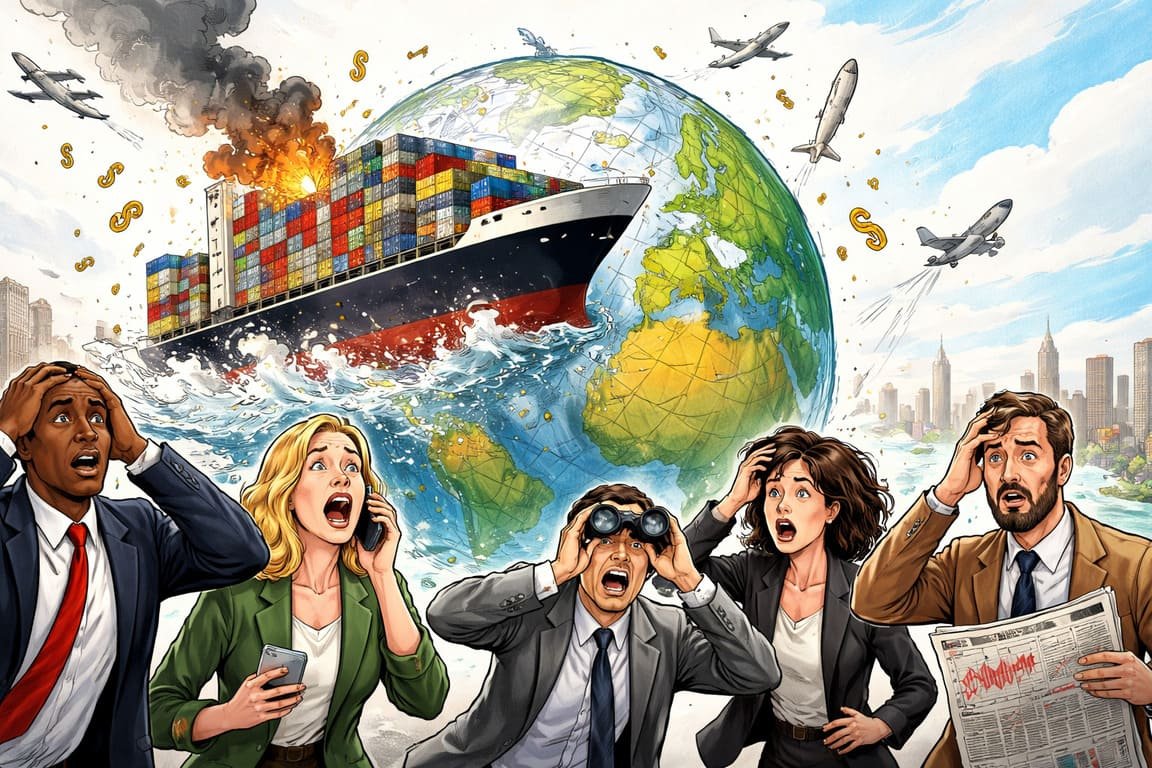
The port wakes before sunrise, but the rhythm feels altered. Cranes stand ready while fewer containers move. Engines idle longer than they used to. The choreography that once felt automatic now hesitates, as if the system itself is thinking twice. Global trade has always been the quiet engine behind modern life, unseen yet essential. Lately, that engine coughs, not in collapse, but in uncertainty that leaves governments and boardrooms staring at dashboards that no longer explain what comes next.
For decades, trade followed a comforting assumption. Goods would move faster, cheaper, and farther every year. Supply chains stretched confidently across continents, built on trust that borders would stay open and logistics predictable. That confidence cracked when shocks arrived back to back. Pandemics, conflict, political rivalry, and climate disruption exposed how thin efficiency becomes when resilience is absent. The model did not fail overnight. It revealed its fragility slowly.
The idea of a trade crash sounds dramatic, yet reality is more disorienting. Trade did not stop. It fragmented. Routes shifted. Partners changed. Redundancy replaced optimization as the guiding principle. Companies once obsessed with shaving costs began paying premiums for reliability. Warehouses moved closer to consumers. What was once dismissed as waste became insurance.
Politics moved from the margins to the center of commerce. Trade stopped pretending to be neutral. Tariffs returned as leverage. Export controls became security tools. Interdependence, once praised as peace keeping, started to feel like exposure. Nations reassessed who they rely on and why. Trade policy transformed into a statement of identity rather than a purely economic calculation.
A fictional supply chain director described the moment clarity arrived. The spreadsheet was flawless, balanced, and useless. Every assumption embedded in it relied on stability that no longer existed. Suppliers were reliable until borders closed. Shipping lanes were efficient until they were not. The lesson lingered uncomfortably. Optimization without buffers creates speed, not strength.
Consumers feel this shift in quiet ways. Prices fluctuate unpredictably. Products vanish, then reappear months later. Choice narrows. The promise of endless availability softens into conditional access. This subtle friction reshapes expectations. Abundance no longer feels guaranteed. Scarcity, long assumed solved, returns as a lived experience.
Developing economies absorb sharper consequences. Many built growth strategies around access to distant markets. When trade patterns realign abruptly, factories stall and employment evaporates. The ladder once climbed toward prosperity wobbles. Globalization lifted millions, but its uneven structure leaves those gains vulnerable when conditions change.
Technology complicates the picture further. Automation erodes labor advantages that once anchored trade routes. Digital services cross borders without containers or customs. Data becomes a prized commodity, regulated unevenly and guarded fiercely. Value moves invisibly, challenging frameworks designed for physical exchange. Trade becomes less about movement of goods and more about control of systems.
Psychology now shapes strategy as much as economics. Certainty evaporates. Long term planning feels risky when rules shift quickly. Businesses shorten horizons. Governments hedge positions. This caution slows investment and amplifies volatility. Fear of disruption becomes disruptive itself, creating feedback loops that resist stabilization.
Some describe this moment as deglobalization. Others call it recalibration. Both miss the nuance. Trade is not ending. It is reorganizing around trust rather than scale. Regional networks strengthen. Strategic partnerships deepen. Universal openness gives way to selective alignment. The world still trades, but with suspicion layered into every contract.
Environmental pressure accelerates this evolution. Long supply chains carry carbon costs that no longer escape scrutiny. Sustainability metrics influence sourcing decisions. Local production gains political and moral appeal. Climate responsibility enters boardroom conversations alongside margins and timelines. Commerce absorbs values it once treated as external.
History offers perspective. Trade has always expanded and contracted with political tides. What feels unprecedented is the simultaneity of shocks. Multiple stressors arrive at once, leaving little recovery time. Adaptation becomes continuous rather than cyclical. Flexibility replaces confidence as the core competency.
As night settles over ports, factories, and logistics centers, decisions remain unfinished. The old playbook no longer guarantees success, yet the new one is still being written. Global trade is not crashing in flames. It is changing lanes at speed without clear signage. And as nations and businesses navigate this unfamiliar road, one question demands attention with growing urgency: in a world redefining how value moves, who will adapt fast enough to turn uncertainty into advantage instead of clinging to a model that already moved on?
