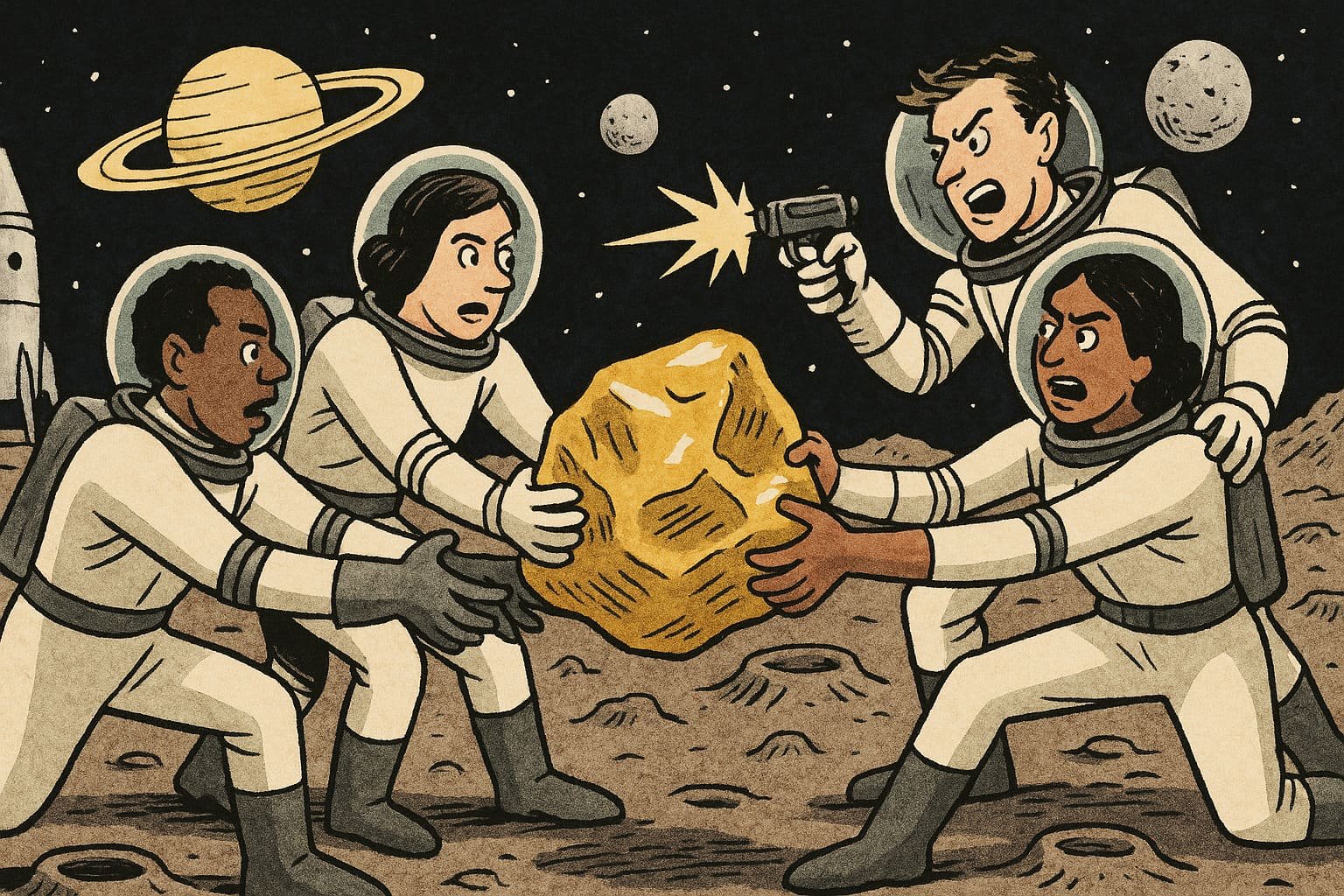
Imagine a world where trillion-dollar fortunes aren’t made in boardrooms or on Wall Street, but in the silent, swirling void above our heads. Suddenly, governments and billionaires are gambling everything; not on oil or AI, but on celestial real estate that could make or break human civilization. The stakes? Not just untold riches, but control over the future itself. One morning, you wake up to news that a private space company has claimed rights to an asteroid worth more than the GDP of most countries. Somewhere else, a nation threatens war over a lunar outpost, while hackers race to take down satellites.
This is not science fiction. It’s today’s new world order; a galactic gold rush where the old political rulebook is useless, and power goes to those bold enough to fight for it. The question isn’t if space wars will break out, but who will win when they do. Behind every “historic” rocket launch, there’s a shadow game of power, money, and muscle. For every dream of peaceful exploration, there’s a race for dominance, disruption, and survival.
This article pulls back the cosmic curtain to show what’s really happening in the space race far beyond the headlines and hashtags. You’ll see why Silicon Valley’s brightest minds are obsessed with lunar mining, how nations are quietly preparing for orbital war, and why your country’s future could hinge on treaties no one is talking about. If you think Earth’s power struggles are chaotic, wait until you see how the universe plays politics.
We’re about to break down the five tectonic shifts defining today’s “Galactic Gold Rush” with real stories of ambition, sabotage, secret alliances, and impossible dreams. Each section unpacks a key battleground, giving you fresh, actionable insight that you’ll never find on a news ticker. By the end, you’ll not only know who’s winning, but how you can prepare for the biggest land grab in human history one where the map keeps changing, and the rules are still being written. Ready to step into the cosmic arena? Strap in. Because the most high-stakes gold rush of all time is just getting started, and its shockwaves will touch every life on Earth.
Quick Notes
- The Space Race is a New Wild West: Powerful players; nations, corporations, and billionaires are now jockeying for control of the stars, creating a frontier where chaos and opportunity mix.
- Satellites Are the New Battleground: Control of orbital infrastructure means control of economies, militaries, and communication, making satellites the prime targets in this silent war.
- Asteroids, Moons, and Martian Soil Mean Power: Whoever claims the resources beyond Earth; water, minerals, or data could hold the keys to humanity’s next century of prosperity or disaster.
- Old Laws Are Breaking Down: Existing treaties and agreements are unable to keep up with new ambitions, forcing a renegotiation of what’s fair, legal, and ethical in space.
- Your World Will Change: The outcomes of these struggles will affect life on Earth from internet access to global security, energy prices, and even the next generation’s opportunities.
Billionaires, Bureaucrats, and the Cosmic Game of Thrones
Old rivalries didn’t disappear; they just moved off-planet. Space isn’t empty; it’s a chessboard where every nation and tech mogul wants to be king. For decades, the U.S. and Russia traded rocket launches like jabs in a heavyweight fight. Today, the cast is bigger and the game is far wilder. China quietly builds lunar bases while American billionaires like Elon Musk and Jeff Bezos race to plant flags on Mars and the Moon, seeing interplanetary dominance as the next big IPO. These space barons aren’t just driven by curiosity or patriotism. They know whoever controls off-world resources can tilt entire economies and rewrite the global balance of power. Political leaders smile for photo ops in mission control rooms, but behind closed doors, they draft strategies to outmaneuver rivals.
When NASA awarded contracts for lunar transport, it wasn’t just about engineering; it was about who would dictate terms of engagement on the lunar surface for years to come. Consider the tense standoff between China’s Chang’e missions and U.S. Artemis program planners. Both have their eyes on the lunar South Pole, home to coveted ice deposits and a strategic view of Earth. Each side pours billions into technology and training, aware that first-mover advantage could mean exclusive rights to resources that will never be up for grabs again. The rivalry is fierce, and unlike the Cold War, it’s no longer confined to nation-states.
Entrepreneurs with deep pockets blur the line between public and private, making alliances with governments one day and outbidding them the next. Startups and smaller nations jockey for relevance, using creative partnerships to wedge themselves into the conversation. Take the Israeli team that nearly landed on the Moon; its crash was a PR nightmare, but it proved small players could dream big and disrupt the power balance.
The stakes get higher as new technologies lower the cost of entry. Suddenly, a few brilliant engineers with venture capital can threaten state monopolies. This democratization of launch capability stirs anxiety and hope in equal measure, promising a future where anyone with the nerve and vision could join the race if they’re willing to risk everything. The political chess game in space is brutal, and every move shapes the next century.
Satellite Wars: Silent Skirmishes, Real Consequences
Beneath the spectacle of rocket launches, a quieter war rages. Orbit is now the world’s most valuable real estate, and satellites are the prize. Whoever owns, disrupts, or destroys them controls the flow of data, trade, military secrets, and even the weather. It’s a silent conflict, but its consequences roar across every continent.
Governments understand this better than anyone. When India demonstrated anti-satellite weaponry, it wasn’t just a technical flex; it sent a chilling warning to every satellite operator. China and Russia conduct shadowy tests, probing the limits of what’s possible and legal in the orbital domain. Meanwhile, the United States quietly deploys “guardian” satellites designed to intercept and defend.
Behind the headlines, private companies like SpaceX and OneWeb fill the sky with mega-constellations, blanketing the planet in fast, cheap internet. But these swarms of satellites are both opportunity and threat. If one company controls the orbital highways, they wield power that could upend how nations communicate, bank, and even fight wars. The result is a high-stakes arms race; one where a hacker in a basement or a rogue satellite could trigger a crisis that spirals out of control.
Mini-case: In 2022, an anonymous cyberattack briefly knocked out a European satellite network, crippling internet for millions and exposing the fragility of orbital infrastructure. The incident didn’t just disrupt service; it forced politicians and CEOs to rethink how vulnerable their countries and businesses truly are in this new era. Suddenly, insurance policies, trade deals, and national security doctrines are being rewritten with satellites in mind.
The risk isn’t just technical. When one country jams a rival’s satellite, it’s not always clear who pulled the trigger. Plausible deniability makes escalation all too easy. Imagine a scenario where a satellite goes dark over a disputed region; politicians scramble, markets panic, and alliances fracture. It’s a new form of warfare, fought without gunfire but with the power to reshape the world.
Mining the Stars: The Real Gold in the Galactic Gold Rush
While most eyes remain fixed on launches and politics, a quieter revolution simmers among scientists and investors: the promise of cosmic resources. Picture a world where water, platinum, and rare minerals are pulled not from beneath our feet, but from the surfaces of asteroids or icy lunar craters. Whoever masters this process doesn’t just get rich they define the next era of civilization.
Visionaries like Peter Diamandis and companies such as Planetary Resources once pitched the idea of asteroid mining as outlandish. Yet, quietly, national space agencies have begun mapping targets, running experiments, and even drafting laws to carve up resources before anyone else can. The first nation or company to successfully bring back space gold could destabilize entire industries overnight.
Personal story: I once interviewed a startup founder whose team worked for years on an asteroid prospecting project. He told me, “We knew if we struck platinum in space, everything on Earth would change; currency, geopolitics, you name it. Suddenly, oil barons would look like blacksmiths.” The founder’s project ultimately failed, but it forced global banks and lawmakers to ask, “What if someone actually succeeds?”
Mars, too, is emerging as a battleground not just for human exploration, but for resource extraction and sovereignty. SpaceX’s plans for a self-sustaining Martian colony have sparked heated debates. If Musk or any other private player can create a viable settlement, who gets to own the mineral rights? Who enforces laws, prevents exploitation, or stops conflict between settlers?
Case in point: A recent legal dispute erupted when two companies both claimed the same lunar mining rights based on conflicting interpretations of existing treaties. With no court or police force to step in, the matter nearly escalated to international arbitration. This is the messy, unpredictable future of resource politics in space; a wild west where fortunes are won and lost in the blink of an eye.
Treaties, Taboo, and the Collapse of Old Rules
The first wave of space explorers played by the rules of the Outer Space Treaty; a relic drafted when moon landings were still a dream. Today, those agreements creak under the weight of ambition, greed, and uncertainty. The legal landscape is a patchwork of vague promises and hopeful declarations, with loopholes wide enough to fly a starship through.
Nations and corporations now argue over what counts as “ownership” in space. Does planting a flag mean anything? If a company builds an outpost, do they own the land beneath it? When the U.S. passed the Commercial Space Launch Competitiveness Act, it essentially told the world: “If you mine it, you own it.” Not everyone agrees. Europe and Russia demand new negotiations, while China and India quietly draft their own rules.
Mini-case: The Artemis Accords; a set of principles drafted by the U.S. to guide lunar exploration have won many signatories, but they remain controversial. Countries not invited to the table see them as a power grab, a way to lock up the best real estate before others have a chance to compete. The result is rising tension and suspicion, with smaller nations fearing they’ll be shut out of the cosmic boom forever.
Ethical dilemmas are everywhere. Should we allow private companies to extract lunar ice and leave nothing for future generations? Who polices environmental impact, labor rights, or even basic safety when the workplace is a vacuum? In space, exploitation can happen in the dark, with no one to blow the whistle.
The old framework can’t keep up with these new realities. Legal scholars warn of a future where “might makes right,” and the most aggressive actors set the rules. The collapse of old norms means a new era of legal and ethical experimentation—one that could either unite humanity or sow the seeds of its greatest conflicts.
Earth in the Crosshairs: How Space Wars Shape Your Everyday Life
Most people think of space as distant, abstract, and separate from daily reality. But the decisions made in orbit ripple back to Earth in ways that shape your wallet, your safety, and your future. The cosmic gold rush isn’t just about billionaires and bureaucrats; it’s about who will thrive in a world where the ground beneath your feet is just one piece of the puzzle.
Your smartphone, car, and even the food on your table depend on satellites for navigation, timing, and logistics. A single disrupted satellite can cause chaos, stock markets falter, planes are grounded, and communication stalls. The more nations and corporations fight for control, the greater the risk that a dispute “up there” turns into a crisis “down here.”
Mini-case: When a commercial satellite operator in California discovered a rival hacking attempt, they called in not just cyber experts, but government negotiators. The incident led to a new public-private partnership aimed at creating stronger defenses; a reminder that space security is now everyone’s business, from farmers to financiers.
The coming wave of space-based solar power, orbital manufacturing, and asteroid mining could transform entire industries. Energy could become cheap and abundant, but only if monopolies don’t block access. Jobs might shift to new sectors, creating opportunities but also uncertainty. Political leaders who ignore the new space economy risk leaving their countries behind. As the galactic gold rush heats up, the best-prepared individuals and organizations will adapt, learn, and build resilience. Ask yourself: How will your life, your business, or your nation respond when space is no longer the final frontier, but the first battleground for the next century?
The New Power Play: Are You Ready for the Cosmic Shockwave?
History’s greatest fortunes were made not by playing it safe, but by seizing wild, uncharted frontiers. The Galactic Gold Rush is bigger, bolder, and riskier than anything that’s come before. As rockets roar, treaties fray, and satellites light up the night, remember: This is a game where the winners will write the future and the losers may never get a second chance.
Some will say the dangers are too great, or the unknowns too terrifying. But every revolution needs its dreamers and its rebels, those willing to break the old rules and invent new ones. The space wars aren’t coming; they’re already here, fought in silent orbits and secret boardrooms, with consequences that will echo for generations.
If you want to understand who truly runs the world, stop looking at city skylines or corporate balance sheets. Look up. The new emperors and insurgents are building empires above your head, battling not for territory, but for destiny itself. One day soon, a child will ask why we fight so hard for a piece of empty sky. The answer will shape not just our legacy, but the fate of every generation to come.
So ask yourself: When the next gold rush erupts; when the universe itself is up for grabs will you be a spectator, or will you claim your place among the stars? Now, take a moment. Breathe. And consider: The universe isn’t waiting. Why should you?
Partnered. Provocative. Worth Your Scroll.
This is a Promoted Post by ESYRITE—yes, it’s paid, but never filtered. Our voice stays raw, real, and razor-sharp. We team up with bold ideas, game-changers, and stories that spark something real. If it’s here, it earned its place—no fluff, just impact. We don’t just promote—we provoke. Stay sharp. Dive deeper.
