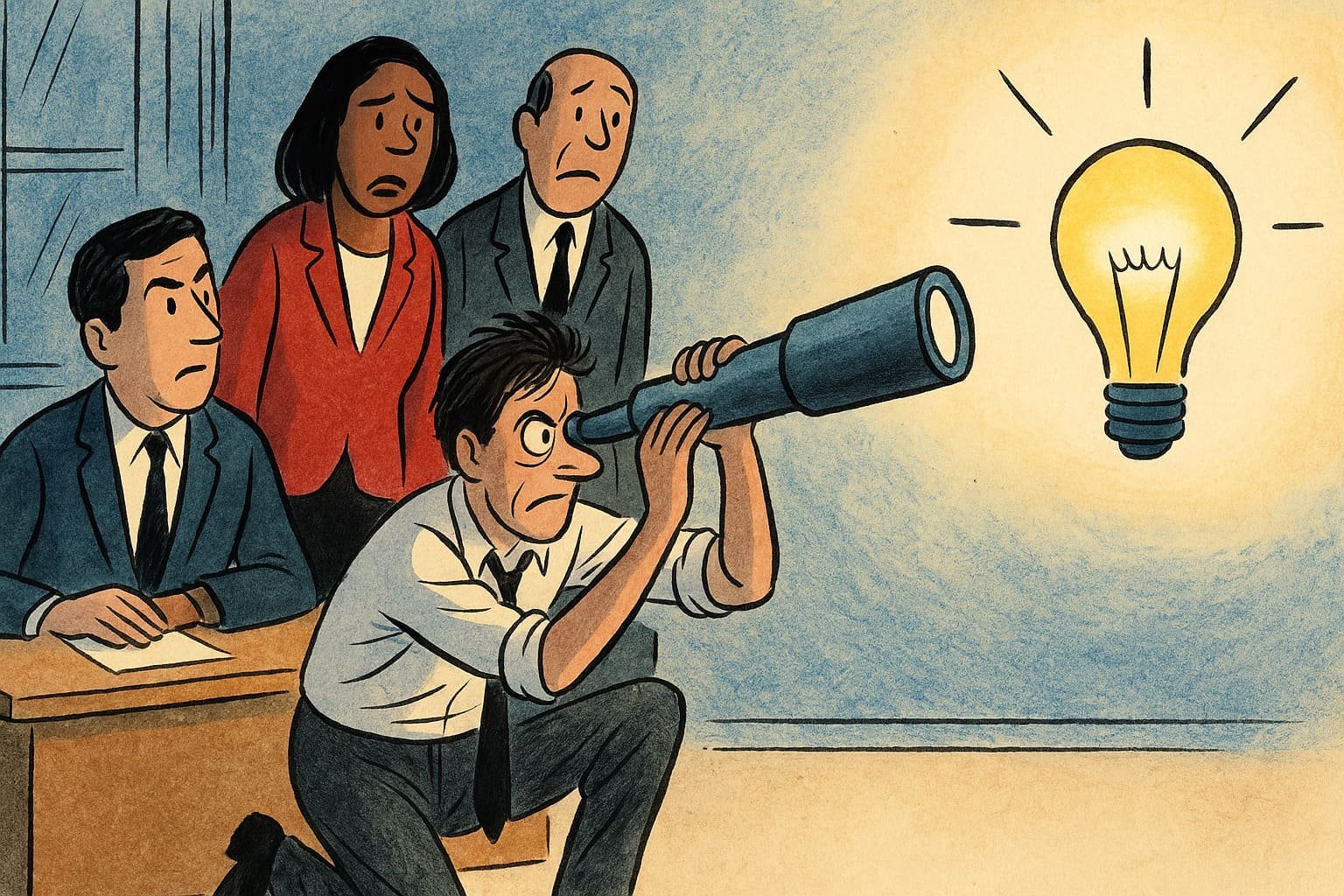
The fluorescent lights glare in a silent office as if auditioning for a scene in a dystopian movie. Coffee cups, some half-drunk, litter the glass table where the founder’s notebook sits open, each page a web of arrows and feverish notes. The city outside pulses with possibility, but in here, the air feels thick, electric, heavy with the breath of a vision that refuses to sleep. No one hears the distant echo of laughter from friends left on read, or the soft plead of a partner’s unanswered texts. Here, obsession is the currency, and every tick of the clock sounds less like progress and more like a dare to push even harder.
People love the founder myth. The lone wolf with a blueprint to the future, pacing in hoodies, writing destiny in code. Audiences eat up the pitch-perfect TED talk, the viral press release, the LinkedIn epiphany. No one mentions the wild eyes at 3 a.m. or the invisible weight pressing on a founder’s shoulders as another big investor call looms. There’s an art to delusion, painted in the colors of hope and self-sacrifice, but also in bruises—on pride, on relationships, on health. Vision is magnetic, but in the hands of a founder, it can become a force of nature, pulling everyone into its storm.
Tomoko Watanabe, a startup coach in Tokyo, tells founders to “guard their vision with compassion, not fear.” Yet, the stories piling up in the margins of tech history are not of gentle pivots, but of heads-down sprints into brick walls. Nobody claps for balance at the launch party. Instead, onlookers root for the hero’s journey, even as the hero starts speaking only in product metaphors. It’s almost poetic how the world cheers obsession, right up until it combusts.
Everyone’s watched that co-founder at demo day, eyes glazed, rehearsing lines like an actor who can’t stop auditioning even after the curtain falls. The pitch is flawless, but behind the scenes, the team whispers about burnout and missed birthdays. In Silicon Valley, obsession is sold as “passion on steroids.” The truth is, it’s closer to possession—a founder haunted by the ghost of future unicorns.
Startup obsession is not a bug, but a feature—celebrated, blogged, meme’d. Yet as founders trade sleep for equity, and partners for product-market fit, one has to wonder: when does vision ignite, and when does it burn everything to the ground?
Quick Notes
- Obsession is the Startup Drug: The wild rush of startup building turns healthy ambition into feverish tunnel vision. Founders often swap friendships, health, and clarity for another hour at the whiteboard.
- Perfection Becomes Poison: Every tweak, pivot, and “all-hands” feels mission critical, but perfectionism silently suffocates creativity and alienates the very people who could save the company.
- Delusion Is the Shadow Side of Vision: The belief that only one person can see the true future blinds founders to advice, warning signs, and signals that it’s time to change course.
- Relationships Take the First Hit: Partners, friends, and teammates become casualties when the business becomes an idol. The human cost of “all-in” is paid in quiet departures and burnt bridges.
- Only the Truth Survives: The myth of heroic obsession unravels as companies either crash or, in rare cases, break through. The hardest lesson is learning where vision ends and delusion begins.
The Seduction of Perfection: When Every Pixel Feels Fatal
Everyone in startups remembers that first moment—when the product goes from idea to demo. It feels like creating life from nothing. You, staring at the screen, decide that every pixel, every phrase, every customer email must be perfect. Every bug fix is a line drawn in the sand against mediocrity. Sleep becomes optional. Meals are an inconvenience. That dopamine hit when you “ship it” convinces you that obsession is not only normal but necessary.
Somewhere between the second and fifth all-nighter, you lose the plot. The user experience you once designed for people becomes a monument to your own taste. Instead of delighting customers, you’re chasing their approval like a parent desperate to impress a distant child. Elon Musk’s legendary perfectionism at Tesla and SpaceX set new standards, but the world forgets how many times those standards nearly crushed the people closest to him.
Vera, a young founder in Berlin, spent two years iterating on a productivity app that nobody wanted, convinced that one more feature would spark a revolution. Her friends staged a mock “funeral for Vera’s social life,” complete with cardboard gravestones for every missed birthday. She laughed it off—until she realized she hadn’t called her mother in six months. “It was like being underwater,” she later told a journalist. “I could see people waving, but I couldn’t reach them.”
Perfection is addictive. Each tiny improvement feels like a step toward immortality, but the real world doesn’t play by startup logic. The gap between “good enough” and “never finished” swallows teams whole. It’s a siren song: you chase flawlessness, but drown before you get there.
Startup culture loves the myth of the brilliant misfit who polishes until the world notices. Yet, research and reality agree: progress dies in the petri dish of obsession. The best founders know when to walk away from their own masterpiece, even if it means letting go of the illusion that perfection equals success.
Tunnel Vision: The Mirage of Onlyness
Tunnel vision masquerades as focus, but it’s a dangerous optical illusion. When you’re the founder, you start believing nobody else understands the dream quite like you do. You micromanage marketing, write code after midnight, and fire off “urgent” feedback at odd hours. The more you grip the wheel, the less your team trusts themselves to drive.
This belief in “onlyness” isn’t just ego. It’s fear. Fear that if you let go, the whole ship will sink. The startup world teems with examples: Adam Neumann at WeWork insisted on designing office layouts and approving minor details long after his company had ballooned beyond his reach. He thought only he could “see the vision.” The result? Investors revolted, employees lost faith, and the company’s legendary valuation evaporated.
Gina, who launched an edtech platform out of Mumbai, tried to control everything from curriculum to customer service scripts. She even edited social media posts herself, convinced that the smallest deviation would unravel the brand. Her CTO, Rahul, eventually left, burned out from fighting for autonomy. “She wanted a team of clones,” he said. “But you can’t scale a dream that way.”
When you’re blinded by your own flashlight, shadows creep in unnoticed. Ideas that challenge the founder’s orthodoxy get shelved. Feedback morphs into threat. Decisions slow to a crawl as everyone waits for the “visionary” to decide what’s next. The irony is, the most successful founders aren’t those who see everything, but those who build teams that can see more than one person ever could.
Obsession with “onlyness” is the trapdoor beneath every breakout story. Companies don’t implode because the founder wasn’t smart enough—they fall apart because vision calcified into doctrine. Great founders are teachers, not prophets. They build cults of curiosity, not compliance.
Human Fallout: The Cost No One Counts
Behind every unicorn headline, there’s a string of casualties. Not just failed companies, but fractured families and friendships. The founder’s compulsion to win at all costs often exacts a tax no one ever talks about—until it’s too late. The first to notice are rarely the investors. It’s the spouse who finds dinner growing cold. The friend whose text goes unanswered. The parent who gets “Sorry, I’ll call next week” on repeat.
Take the story of Marcus, a fintech founder in London. He missed his son’s school play three years in a row. Each time, he promised, “Next year will be different.” But the product never launched on time, and the fundraising never ended. By the time Marcus sold his company, he had a yacht and a new apartment, but his son barely spoke to him.
Startups like Theranos became cautionary tales not only for investors but for everyone who believed in a leader’s story over their own gut instincts. People followed Elizabeth Holmes because her vision was intoxicating. Yet, the deeper the delusion, the more dangerous the fallout. Families drained their savings, engineers ignored ethical red flags, and trust became the ultimate victim.
Obsessive founders create islands around themselves. The walls are built of ambition, but also fear—fear of losing relevance, of admitting weakness, of discovering the dream isn’t what they thought. The most heartbreaking moments in startup lore are not the lost millions, but the moments when someone wakes up, surrounded by trophies, and realizes the price was everything that mattered.
Not all fallout is dramatic. Sometimes, it’s as simple as a best friend fading into the background, a team member losing their voice, or a founder losing the sense of who they are outside of work. The culture that rewards all-nighters and sacrifices masks the silent epidemic of loneliness and regret.
The Obsession Paradox: Growth or Implosion?
Obsession is both the startup’s fuel and its Achilles’ heel. It’s what pushes a team through the impossible, but it also blurs the line between belief and fantasy. Sometimes, obsession sparks breakthroughs—like when Sara, a gaming founder in Seattle, spent a sleepless week solving a server crash that saved her company from implosion. Her team, once skeptical, rallied around her relentless energy. The story became legend.
But the same obsession, unchecked, can unravel the dream. For every Elon Musk who bends reality, there’s a cautionary tale like Billy McFarland of Fyre Festival. What started as audacious vision quickly devolved into a feedback loop of denial. The world watched in disbelief as optimism turned to disaster, and the “founder delusion” went viral for all the wrong reasons.
The paradox is cruel. You need enough obsession to outrun gravity, but not so much that you float away from reality. Founders who learn to balance drive with humility survive longer. They hire people smarter than themselves. They step away from the product to see the bigger picture. The best know that obsession should be shared, not hoarded.
Teams feed off the founder’s energy. If all they see is panic, perfectionism, and paranoia, the culture mirrors that back until no one can breathe. The healthiest startups ritualize perspective: therapy stipends, scheduled no-work weekends, anonymous feedback channels. Sometimes, it takes a mentor—like venture partner Paul Graham, who famously tells founders to “focus on things that don’t scale”—to break the spell of obsession.
Obsession without boundaries is not courage. It’s self-sabotage disguised as leadership. The most resilient founders know that vision, when wielded wisely, inspires. When wielded recklessly, it destroys.
Beyond the Myth: Can Vision Survive Reality?
Every founder wants to believe their vision will outlive them. The myth of legacy lingers in the air at every startup’s “exit party.” But the final test isn’t how many headlines you collect, but whether you build something that can breathe without you. The handoff from obsession to sustainability is the hardest trick in business. Most never pull it off.
Jen, a healthtech founder in Nairobi, worked for seven years without a real vacation. She built clinics, trained hundreds, and raised millions. The company grew, but she shrank. Only when a stress-induced collapse forced her to step back did the team discover they could lead themselves. The startup survived. Jen, at last, found space to live.
True vision survives its creator. Steve Jobs obsessed over every curve of the iPhone, but it was Tim Cook’s steady hands that made Apple endure. The story repeats: a founder’s vision lights the spark, but only trust, systems, and a willingness to let go can keep the fire alive.
Some founders exit quietly, their names fading from the website. Others crash and burn in spectacular fashion, taking loyal followers with them. The question each founder faces is simple: can you build something so robust that it will love you back—even if you step away? Or will the company become another cautionary tale, a vision turned prison?
The myth of the lone genius will always attract dreamers. But the next chapter belongs to those who know when to trade obsession for perspective, and when to hand the keys to someone else. Only then does vision become legacy.
Obsession’s Lament
In a dim-lit room scattered with yesterday’s ambitions, a lone figure sits by the window, watching the city’s glow pulse against the night. The silence is punctuated by the faint hum of a laptop, the only companion left after months of tunnel vision. Pages of a notebook curl with spilled coffee, each scribbled line a ghost of dreams that once felt immortal. Through the glass, life continues, uncaring, while ambition flickers inside like a candle gasping for air. The founder, surrounded by trophies and regrets, wonders if anything remains when the applause fades.
A street below, a team member laughs at a joke, their voice echoing up like a reminder that the world does not pause for unfinished visions. The scent of cold takeout lingers, sharp with the taste of opportunity lost and found. Every object in the room—posters, mugs, cables—whispers a story of sacrifice. In the stillness, even the shadows hold their breath, waiting to see what the founder will choose next.
No advice, no slogan, no TED talk interrupts the hush. Only the raw ache of possibility. The city blinks, uncaring, as if to say that the world will always spin, with or without one person’s obsession.
You must decide if you are building a dream that frees you, or a cage with your name on the door.
