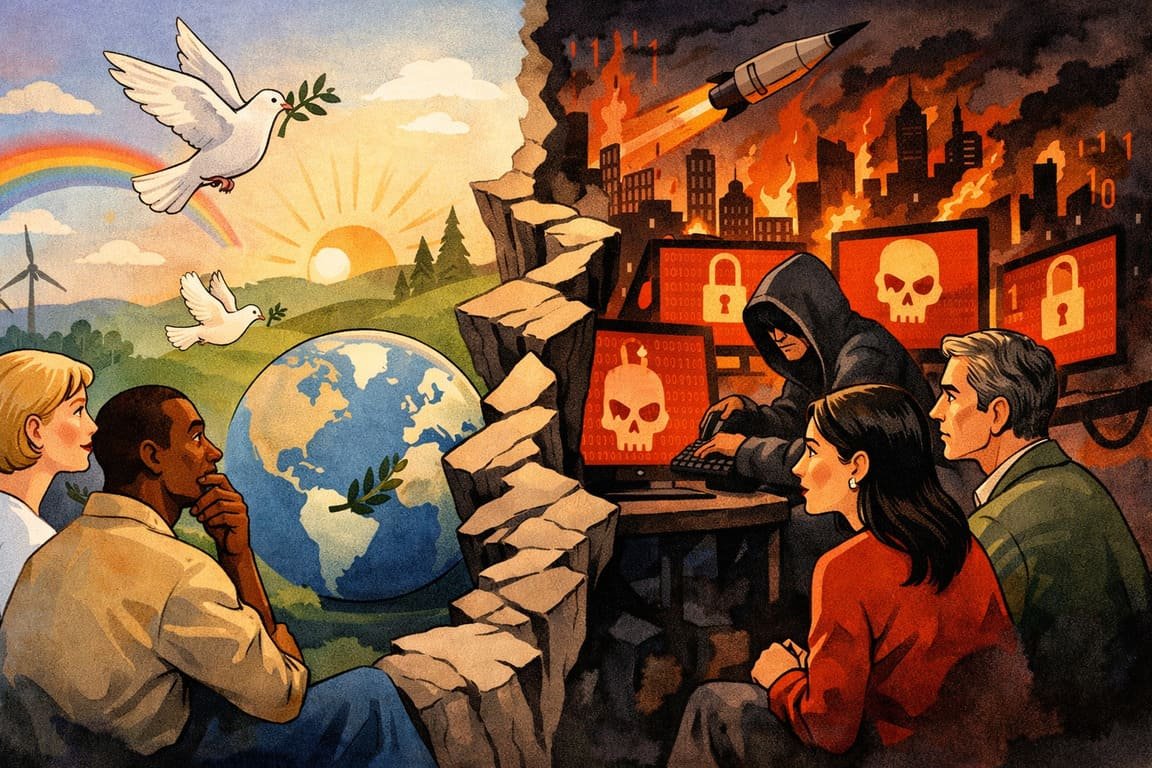
The control room never slept. Screens glowed with maps that showed no borders, only vectors and probabilities, warning symbols blooming silently across grids that powered cities, hospitals, and homes. No alarms sounded. No smoke curled into the air. Yet something had already been touched. In the modern age, conflict rarely announces itself. It arrives quietly, dressed as routine disruption, leaving peace intact in name while hollowing it out in practice.
War once demanded visibility. Armies moved. Missiles launched. Declarations framed responsibility. Cyber conflict dissolved those rituals. A few lines of code could empty bank accounts, shut down transit, or freeze medical systems without a single uniform crossing a line. Harm arrived without spectacle. Attribution blurred. Retaliation hesitated. The rules that once contained escalation struggled to find traction.
States recognized the appeal immediately. Cyber operations offered reach without fingerprints. Deniability replaced deterrence. When responsibility could be plausibly denied, restraint weakened. Aggression felt cheaper. The line between espionage and attack thinned until it became negotiable, interpreted differently depending on who benefited from the ambiguity.
Critical infrastructure emerged as the quiet battlefield. Power grids. Water systems. Supply chains. These networks were built for efficiency and connection, not hostility. Security arrived later, layered on rather than embedded. Every connection promised convenience while inviting vulnerability. Modern life became dependent on systems that could not easily pause, making them ideal pressure points in silent conflicts.
Private companies found themselves guarding the gates. Software updates rippled across continents. A single vulnerability in widely used code could echo globally. These firms held responsibility once reserved for states, yet lacked democratic mandate. Their choices shaped collective safety while accountability remained diffuse, negotiated after damage rather than before.
The human cost surfaced in ordinary moments. A hospital administrator named James watched appointment systems freeze mid morning. Surgeries paused. Records locked. No attacker appeared. No demand followed immediately. Patients waited, confused and anxious, experiencing the impact of geopolitical games without context or consent.
Diplomacy lagged behind reality. International law evolved around territory and force. Cyberspace ignored both. Norms existed on paper, but enforcement proved elusive. Verification faltered. Trust eroded. Agreements relied on restraint in a domain that rewarded secrecy. Peace required cooperation where advantage tempted betrayal.
Culture absorbed the threat subtly. Breaches became routine headlines. Warnings faded into background noise. People adjusted expectations downward, accepting risk as ambient, like weather. This normalization carried danger. When disruption feels inevitable, accountability dissolves. Resilience weakens not from attack, but from resignation.
Philosophically, cyber conflict challenged the meaning of peace itself. Is peace the absence of visible violence, or the absence of harm. When livelihoods collapse and systems fail without bloodshed, peace becomes semantic rather than lived. The metrics of stability no longer matched experience.
Some argued cyber conflict prevented worse outcomes. Disruption replaced destruction. Code substituted bombs. The logic felt seductive. Yet escalation still lurked. Miscalculation remained possible. Digital actions could provoke physical response. The ladder still existed, only the rungs had changed.
Resilience emerged as the most credible defense. Redundancy. Education. Cooperation across sectors. These strategies lacked drama. They demanded patience rather than spectacle. Yet they reduced temptation by denying easy wins. Peace, in this context, depended less on deterrence than on robustness.
Ethical responsibility blurred. Developers wrote tools. Leaders authorized operations. Contractors executed quietly. Harm landed far from intention. Accountability scattered across layers, making moral clarity difficult to locate even as damage accumulated.
The screens kept glowing. Attacks continued. Defenses evolved. Peace persisted, fragile and conditional. Its survival depended not on treaties signed in public, but on restraint exercised in silence, and on whether societies refused to accept a future where quiet damage replaces visible war as the price of modern stability.
