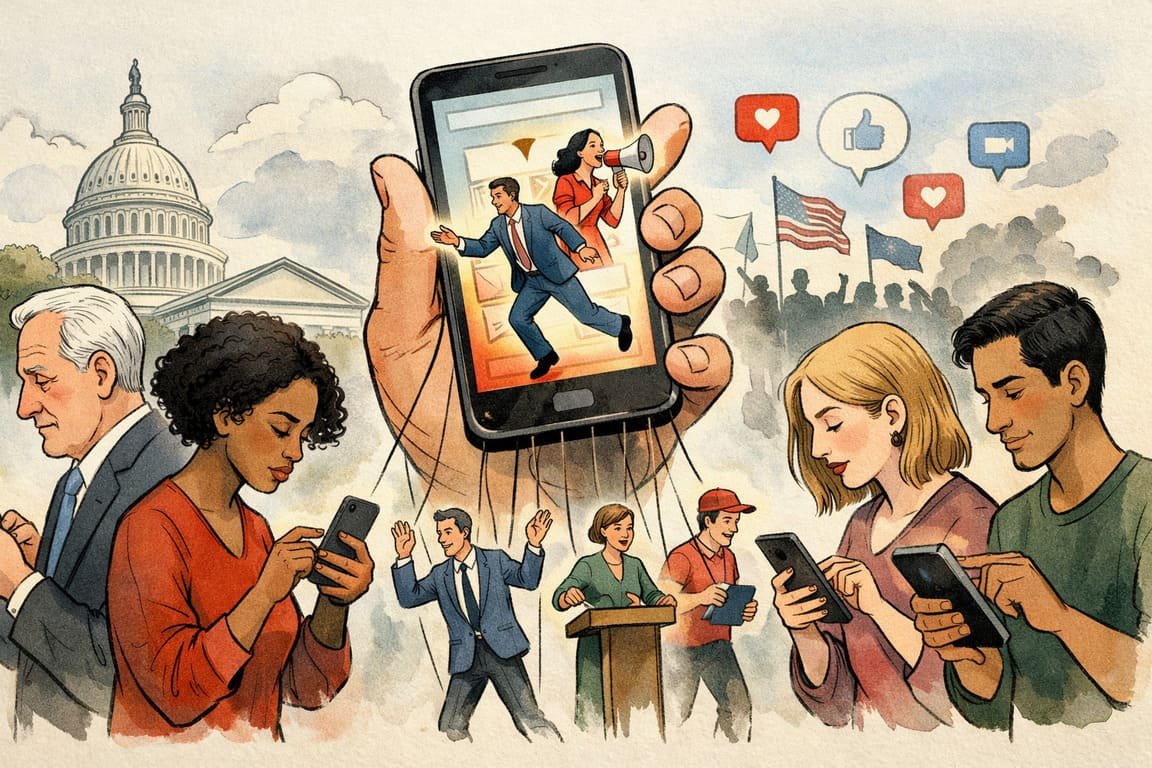
The rally no longer needs a stage. It lives inside a pocket, glowing softly, waiting for a thumb. No chants echo. No banners wave. Instead, a feed refreshes, pauses, then moves on. Politics has shrunk into gestures so small they feel harmless, yet those gestures now tilt elections, harden identities, and shape collective mood. Power did not disappear. It learned how to travel lightly, hiding inside habits people barely notice anymore.
Technology did not storm politics with force. It entered politely, framed as efficiency. Social platforms promised connection. Data analytics promised precision. Digital campaigns promised reach without cost. Each step felt sensible, even democratic. Together, they rewired influence itself. Persuasion migrated from public debate to private screens. Shared narratives splintered into personalized realities. The political arena multiplied, invisible and unaccountable.
Elections once unfolded in common spaces where ideas collided openly. Today, persuasion thrives on segmentation. Voters receive messages tuned precisely to fears, aspirations, and browsing behavior. Two neighbors can inhabit entirely different political worlds while sharing a fence. This fragmentation weakens shared truth. When facts become customized, disagreement stops being debate and becomes disbelief.
Campaign strategy followed the incentives. Policy depth gave way to engagement metrics. Clicks replaced applause. Messages were tested, refined, discarded based on reaction speed rather than coherence. Outrage proved efficient. Complexity did not. The system rewarded emotional spikes over thoughtful argument. Politics adapted quickly, shedding nuance to survive in the attention economy.
A volunteer once knocked doors armed with talking points generated from online behavior models. Conversations felt strangely scripted. Voters responded with phrases absorbed from feeds, not personal reflection. Later that night, targeted ads echoed the same language back at the volunteer. The loop felt airtight, persuasive, and deeply unsettling. Influence had become recursive.
Platforms insist neutrality, framing themselves as mirrors rather than actors. Yet mirrors that curve shape perception. Infinite scroll encourages immersion. Notifications interrupt reflection. Recommendation engines amplify familiarity, nudging users deeper into existing beliefs. None of this requires explicit instruction. Control hides in design, not decree.
Governments struggle to respond. Laws written for television campaigns strain under algorithmic persuasion. Regulating content raises free speech alarms. Ignoring manipulation invites abuse. The dilemma paralyzes institutions already mistrusted. When rules lag reality, power flows to those who move fastest, not those who deliberate best.
Foreign interference exploits these gaps with chilling efficiency. Influence campaigns need not persuade broadly. They target fault lines, inflaming division until societies argue with themselves. Attribution stays murky. Response stays muted. The battlefield blends seamlessly into everyday scrolling. Defense becomes a matter of awareness rather than armor.
The psychological cost accumulates quietly. Constant political stimuli exhaust attention and empathy. People disengage not from apathy, but from overload. Democracy weakens when citizens retreat. Silence favors those most skilled at gaming the system. Participation becomes polarized between hyper-engagement and withdrawal.
Philosophically, the shift raises uncomfortable questions about agency. When choices are nudged invisibly, how free are they. If behavior can be predicted accurately enough, persuasion begins to resemble preemption. Consent thins when influence feels ambient rather than intentional. The line between guidance and manipulation fades.
Economics sharpen the bind. Political advertising funds platforms generously. Engagement drives revenue. Reform threatens profit. Resistance follows naturally. This conflict of interest rarely surfaces in campaign speeches, yet it shapes every feed. Money and code collaborate quietly, far from polling stations.
Some countercurrents emerge. Transparency tools reveal why content appears. Alternative platforms experiment with chronological feeds. Civic technologists rebuild spaces for slower, shared discussion. These efforts struggle against habit and scale, but they matter. They remind societies that digital environments are designed, not inevitable.
Education offers a slower defense. Media literacy, algorithm awareness, and critical thinking rebuild agency gradually. Yet education lacks the instant payoff of viral tactics. It requires patience in a system optimized for immediacy. The mismatch remains stark.
Late in the evening, someone closes an app feeling informed yet strangely hollow. The day’s politics arrived in fragments, each demanding reaction, none inviting reflection. The game continues regardless, swipes counted, attention monetized, winners declared. The unsettling realization lingers longer than the screen’s glow: when power learns to speak through habits rather than arguments, democracy must decide whether it still recognizes itself in the mirror of the feed.
