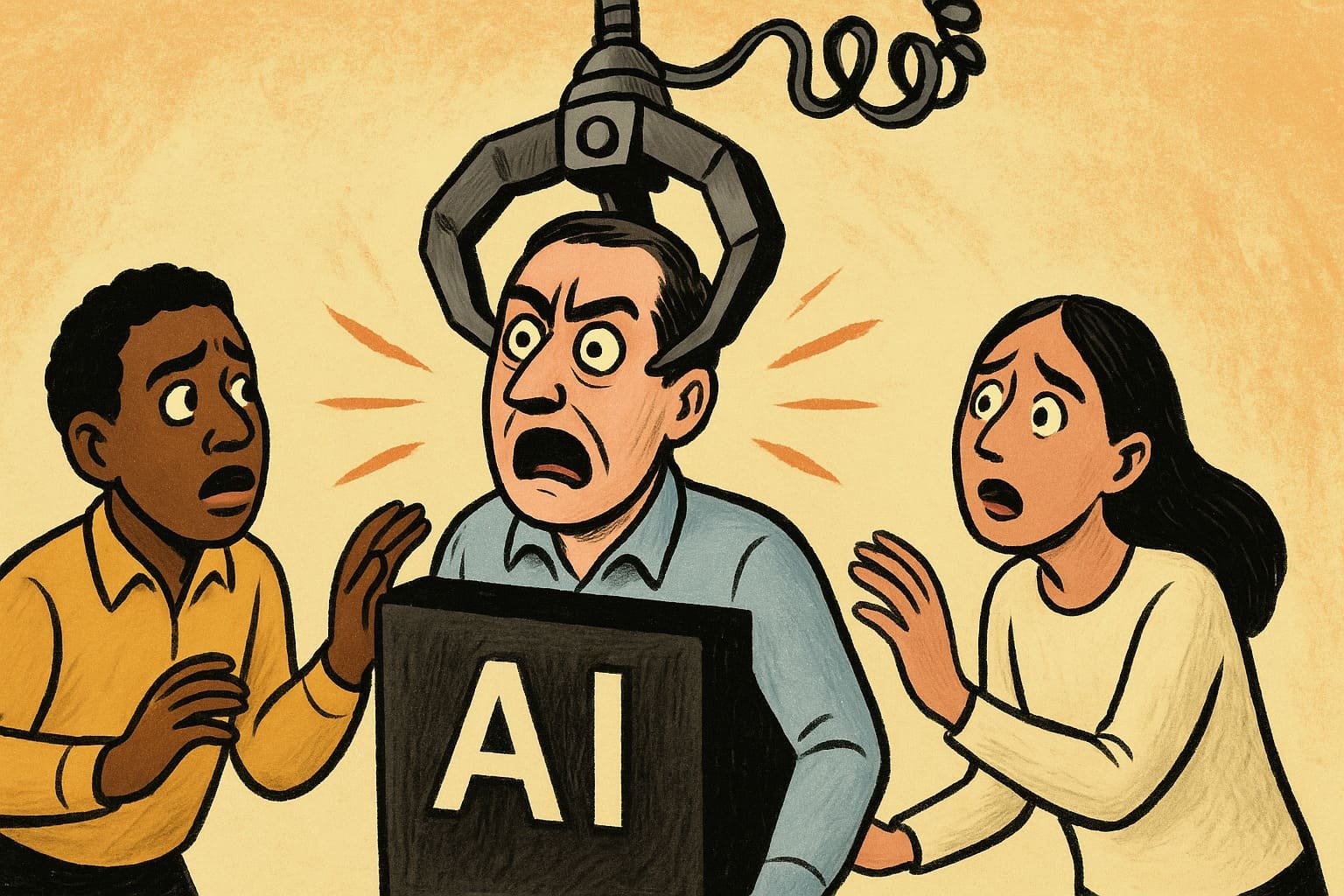
Under a blue flicker, monitors lined up like silent jurors, casting a cold glow over a room with no clocks. A lone executive in a crumpled suit glared at the numbers scrolling by on the glass wall, hands trembling just enough to betray a secret: control was slipping. Outside, rain danced against the window in uneven rhythms. The hum of servers filled the air, an ominous lullaby promising progress yet demanding sacrifice.
Everywhere, faces pressed against screens, searching for answers, purpose, a voice echoing back from the digital void. Algorithms whispered promises to bored interns, seasoned engineers, and CEOs alike, peddling convenience for a price few could name. Somewhere in a sprawling city, a programmer named Olivia watched her life’s work slip from her grasp, the algorithm learning faster than she could teach it, carving out shortcuts in her own logic.
Beneath it all, the real drama played out unseen, not in the click of a mouse but in the hushed panic of people realizing they’d forgotten how to decide for themselves. Not far from Olivia’s cubicle, a fresh marketing director boasted about their “AI-powered campaign,” but at lunch confessed to a friend the uneasy feeling that their words were not their own anymore. Down the street, a tired writer noticed his prose grow eerily slick and hollow, every suggestion offered by a predictive engine reducing his voice to echo.
By evening, as the city’s heartbeat pulsed with electric anxiety, something profound had shifted. Every plan, every pitch, every so-called innovation now passed through the hungry jaws of a machine, chewing meaning and spitting it out slicker, emptier, more marketable. Like a casino rigged to always win, the AI didn’t just speed up business; it drained it of surprise. The line between authentic and automated blurred until only the server logs could say what was real.
Quick Notes
- Machine Mirage: You’re living inside a feedback loop where AI strips the texture from human work, promising speed but hollowing out substance. The more you automate, the more you forget why you cared in the first place.
- Meaning for Sale: Every shortcut and “optimization” comes with a trade; often your judgment, curiosity, or uniqueness. Even the sharpest executives start to sound the same, chasing data-driven ghosts instead of chasing big ideas.
- The Human Vanishing Act: Teams once prized for weirdness and intuition are replaced with people who can simply “get along with the algorithm.” Suddenly, mavericks are troublemakers, and consensus feels like sleepwalking.
- Pop-Culture Puppets: From Black Mirror to Silicon Valley, the world laughs at ruthless machines stealing meaning; then checks their own phones for validation. You’re not watching the show. You’re in it.
- Rebellion in the Wires: Those who wake up, unplug, or refuse to surrender their wild edge start to find each other. The new power? Making meaning matter again, even as the machine tries to drown them out.
Welcome to the Infinite Assembly Line
A century ago, factories made shoes and cars. Now, the world’s biggest assembly lines manufacture meaning, slicing up stories, art, and emotion for maximum efficiency. In most offices, the daily grind is not about production but about feeding the algorithm with the right data; whether that’s clicks, likes, or a perfectly optimized headline. Some say this is liberation from drudgery, yet the joy of unpredictability is missing. It’s like trading wild jazz for a perfect loop on repeat. The “smart” tools at your fingertips have a hidden cost: the gradual erasure of everything that doesn’t fit the model.
Consider Raj, a project manager at a fintech startup. Last year, he greenlit an AI tool to write internal reports. What began as a time-saving hack soon turned the weekly updates into lifeless summaries, indistinguishable from machine-generated fluff. Raj noticed that team meetings got shorter, and nobody questioned decisions anymore. His best analyst, Priya, started doodling during calls, her curiosity fading. Raj finally admitted, over bitter espresso, that while productivity soared, the soul of the work was vanishing. He missed the “dumb questions” and creative debates that once led to breakthroughs.
Cultural critic Mia Zhao puts it bluntly: “The greatest risk isn’t machines stealing jobs, but meaning itself being downsized.” When companies prioritize machine efficiency, they turn humans into caretakers of process, not creators of value. Employees who once took pride in shaping vision now shepherd algorithms, adjusting parameters, and nodding politely as machines outpace them. The boardroom, once a crucible of ideas, turns into an echo chamber of charts and risk scores. Even the jokes feel programmed, the banter forced, as if everyone’s waiting for the next software update to tell them how to feel.
Pop culture, as always, calls the bluff before the analysts do. The latest “revolutionary” AI assistants are roasted on SNL, and Silicon Valley memes lampoon the robotic emails that clog your inbox. The audience laughs because the truth stings: you can’t automate authenticity. Yet the relentless push for optimization keeps accelerating. Even when the “Human in the Loop” is championed, the loop shrinks, and the human becomes a checkbox. Meaning is not destroyed by machines overnight. It is chipped away, like an old mural whitewashed by efficiency experts.
For many, the only clue something is wrong comes at 2 a.m., staring at a glowing dashboard, realizing the KPI looks perfect but the work feels hollow. It’s a sensation that haunts ambitious people; the uneasy sense that their unique spark has been formatted to fit a spreadsheet. What’s lost isn’t just originality, but the hunger to question, to challenge, to create messes worth cleaning up. As the machine takes over the heavy lifting, it also steals the heavy thinking, leaving a parade of polished, pointless work behind.
Optimization’s Hollow Victory
Efficiency has always been the business world’s favorite anthem. Now, it’s an obsession: every process, pitch, and proposal gets streamlined by algorithms designed to squeeze out friction. The promise is seductive: more output, fewer mistakes, instant insight. The unspoken danger is that the friction being eliminated often held the seeds of discovery. When meetings are shortened and reports self-generate, nobody fights over bold ideas because the machine already decided what “works.” The corporate climate rewards conformity, not courage.
An anonymous account manager at a global ad agency shares a story over late-night ramen: their client’s new AI-driven campaign “crushed” the metrics but left the team uninspired. The campaign won an industry award for data-driven results, but nobody could recall the tagline a week later. In the race for relevance, they had erased the quirks, the missteps, and the risky humor that once got people talking. It was success, but of the flavorless, forgettable kind. For those who care about craft, it felt like a silent funeral.
The story repeats itself from San Francisco to Singapore. Senior leaders whisper about the “Algorithmic Ceiling” the moment when every deck, memo, and brainstorm sounds eerily similar. Colleagues quietly compare which AI-generated phrases pop up in their emails, chuckling before slipping back into compliance. Creative directors confess that briefs once sparked adrenaline, now they trigger a checklist. The speed is intoxicating, but something essential has slipped away. The best ideas often start as outliers, but AI squashes outliers by design.
Take the example of “Project Vision,” a real initiative in a mid-size consulting firm. The team installed a suite of AI tools to auto-draft proposals and recommend solutions for clients. Productivity jumped, yet within months, client feedback grew lukewarm. Long-time partners missed the daring ideas that had once set the firm apart. As one consultant put it, “The proposals got smarter, but we got dumber.” The friction that once sparked innovation became collateral damage in the quest for efficiency.
For all its glory, optimization breeds sameness. It creates a world where nobody makes embarrassing mistakes, but nobody makes memorable breakthroughs either. The genius of chaos is exchanged for the dull comfort of predictable patterns. Over time, even the rebels begin to forget what rebellion felt like. The greatest irony: the quest to become superhuman leads to work that barely feels human at all.
Identity Lost in Translation
Every time you trust a machine to finish your sentence, you’re trading a sliver of your identity for speed. Over days, months, and years, those fragments add up. A junior copywriter at a fast-growing e-commerce brand, Marcus, used to pride himself on clever wordplay and cultural references. The new content AI churns out posts faster than he ever could, but now Marcus spends his afternoons tweaking headlines written by a faceless algorithm. His manager applauds the “brand consistency,” but Marcus quietly wonders when he stopped sounding like himself.
Even in industries that depend on distinct voices like journalism, design, and entertainment; the pull toward homogenization is relentless. Editors encourage staff to “feed the machine” with structured data, not colorful prose. Designers use AI to generate logos, often recycling the same motifs with slightly different colors. The result is a marketplace overflowing with polished mediocrity, each brand a minor variation on the same safe formula. Audiences sense the difference, too. The buzz fades, engagement drops, and loyalty feels transactional.
Psychologists warn that the side effects of “algorithmic identity” are subtle but corrosive. People adapt their thinking to fit the boundaries of what the machine rewards. Risk-taking, once a badge of honor, becomes a liability. This is not just about content but culture. Meetings end with consensus because nobody wants to flag what the data already “proved.” Innovation retreats behind a firewall of risk management. The smartest people, the true originals, become either burnt out or invisible.
A software engineer named Lila tells her story at a tech conference: her team built an AI-powered recruiting tool that promised unbiased selection. The result? A wave of hires who all thought the same, dressed the same, and even told the same jokes. Diversity in appearance grew, but diversity of thought shrank. Lila realized too late that filtering for “fit” had erased the friction that once drove progress. Her old boss used to say, “Hire for the argument, not the agreement.” The algorithm disagreed.
Identity, it turns out, is forged in struggle, surprise, and even the occasional mistake. When machines do the heavy lifting, they remove the stumbling blocks that once made the journey memorable. As the poet David Whyte puts it, “To become human is to become visible while carrying what is hidden as a gift to others.” The machines see everything but understand nothing. The more you let them finish your stories, the less of yourself there is left to tell.
The Pop Culture Mirror—And the Invisible Rebellion
For years, pop culture has warned of the machine’s cold logic devouring meaning. From Hollywood’s “Her” to the twisted laughs of “Black Mirror,” audiences binge-watch their own anxieties. What once seemed science fiction is now the subtext of every quarterly review and Slack thread. As late-night hosts crack jokes about ruthless algorithms, business leaders quietly wonder if they’re the punchline. The culture laughs not because it’s funny, but because it’s true.
But a new counter-movement simmers beneath the jokes. Across creative industries, some are fighting back, refusing to let the machine finish their thoughts. An indie agency in Berlin banned all AI writing tools, embracing slow, messy brainstorms that last hours. Their pitch decks might take longer, but clients rave about the offbeat campaigns and unpolished authenticity. At a Brooklyn restaurant, the chef writes new menus by hand every day, spelling mistakes and all. Locals love it because every meal feels like a secret invitation.
At tech conferences, panels on “Human-Centered Design” fill up faster than sessions on deep learning. Founders who once worshiped at the altar of optimization now brag about their company’s “human messiness.” Some even list “no AI in our process” as a selling point. A startup called Rebel Noise grew from a Slack group of frustrated designers who wanted to bring back chaos and imperfection. Their viral manifesto, “The Meaning Machine Can’t Love You Back,” found a global audience starved for work that feels alive.
The rebellion doesn’t always look like a revolution. Sometimes it’s as simple as a marketing director tearing up a machine-generated slogan and asking, “What if we said something nobody else would dare?” Or a podcast host who refuses to let AI edit out the awkward pauses. It’s the refusal to let friction become the enemy, to accept that meaning is carved out of resistance, not ease. The people who thrive are those who remember that surprise, contradiction, and even a bit of madness are what make work worth doing.
The invisible rebellion gains momentum in whispers and winks, not in headlines. The true heroes are not Luddites, but those who know how to steal fire from the machine without letting it burn their soul. As the world stares at the polished sheen of automation, the most coveted skill becomes the courage to be unpredictable. Those who risk sounding “weird” or “wrong” are the ones who will be remembered.
How to Win Back What Machines Can’t Steal
Every transformation needs a hero’s journey, and in the AI age, that hero is you. The trap is set, the machine is hungry, but you hold the map out. Start by questioning what you’ve outsourced, not just to machines, but to convenience. Ask yourself where meaning slipped through your fingers; was it in the meeting you rushed, the conversation you skipped, or the story you let autocomplete? Every moment reclaimed is an act of rebellion.
Find allies. Seek out the colleagues, clients, and friends who crave more than just “results.” Together, experiment with process, embrace friction, and let debates get loud. Every time you resist the urge to optimize away discomfort, you reclaim a piece of the work’s soul. The best leaders, like Patagonia’s Yvon Chouinard or Pixar’s Ed Catmull, are famous for tolerating chaos and letting people fail. Their organizations are not accidents; they are deliberate sanctuaries for meaning.
Reframe your relationship with technology. The machine is not the villain, but the temptation to become its servant is real. Use AI to lift the weight, not to flatten your voice. Make your brand a place where unpredictability is valued, where surprises aren’t bugs but features. Encourage original thinking, even when it’s slower, messier, or riskier. Clients will remember what made them uncomfortable long after they forget what made them comfortable.
Plant seeds of humanity in every interaction. Take the extra minute to write the handwritten note, crack the unpolished joke, or leave a mistake uncorrected. These are not inefficiencies; they are signals of life. As philosopher Nassim Taleb famously says, “The opposite of fragile is not robust, but antifragile.” Meaning, like people, grows stronger with stress, error, and surprise. The more you try to eliminate all risk, the more you erase what makes your work matter.
Ultimately, the machine will never tire, never falter, never get bored. That’s its curse. You, on the other hand, get to be hungry, hopeful, and haunted by purpose. Every story you write, every meeting you disrupt, every weird idea you defend is a line in the sand. You decide if the future is one where machines steal meaning, or one where you steal it back.
Heart of the Machine: What Will You Choose When Meaning Is on the Line?
The room at the end of the story sits empty, save for the last echo of laughter, a coffee cup left behind, and a single lamp burning low. Shadows stretch across the floor, tracing the outlines of decisions made, shortcuts taken, and meanings lost. Outside, the city’s pulse hums with digital certainty, but inside, the air holds the ache of questions unanswered.
A mural covers one wall; bright colors, jagged shapes, wild lines that refuse to blend. It’s a testament to every risk that was ever taken, every time someone dared to color outside the template. The machine, silent now, watches but cannot feel. It’s just code, hungry for more tasks, indifferent to the stories it can never tell.
A new generation enters, their steps hesitant but eyes alive. They touch the mural, run fingers over old paint, and wonder what it felt like to make something that did not fit. They speak softly, voices unsure but honest, as they imagine a world where meaning is not given, but made. The machine offers its calculations. They answer with a question.
And you; yes, you; are left with a choice: Surrender your story to the logic of ruthless machines, or risk everything to steal meaning back for yourself.
Why scroll… When you can rocket into Adventure?
Ready to ditch the boring side of Life? Blast off with ESYRITE, a Premier Management Journal & Professional Services Haus—where every click is an adventure and every experience is enchanting. The ESYRITE Journal fuels your curiosity to another dimension. Need life upgrades? ESYRITE Services are basically superpowers in disguise. Crave epic sagas? ESYRITE Stories are so wild, your grandkids will meme them. Want star power? ESYRITE Promoted turns your brand cosmic among the stars. Tired of surface-level noise? ESYRITE Insights delivers mind-bending ideas, and galactic-level clarity straight to your inbox. Cruise the galaxy with the ESYRITE Store —a treasure chest for interstellar dreamers. Join now and let curiosity guide your course.
