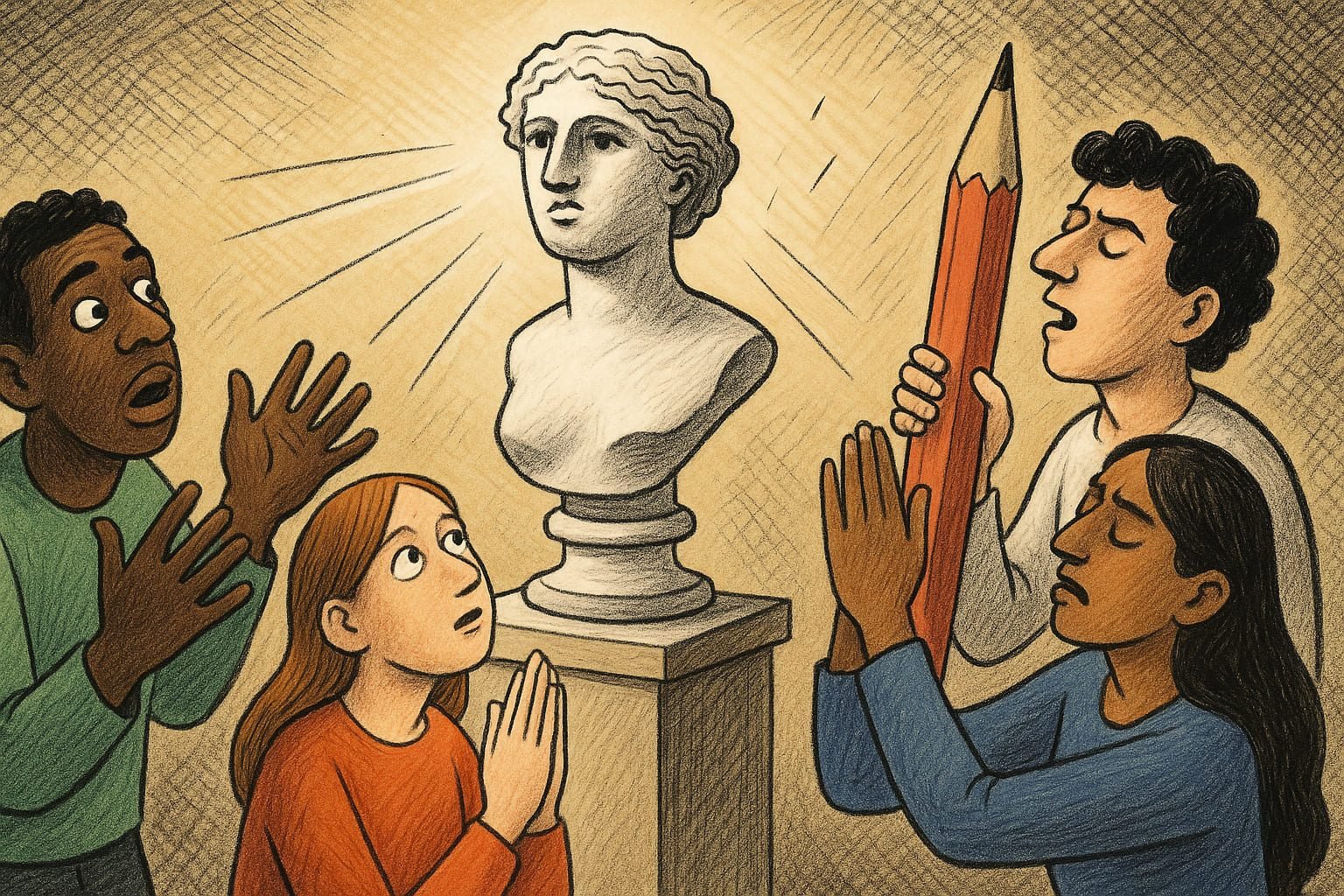
Neon spills from a cracked doorway on a rain-slick street. Inside, the buzz of forgotten computers is barely audible above the silence of intent. Glass glimmers, casting distorted rainbows onto faces hunched in rapture, their eyes drawn not to icons or gods, but to a screen pulsing with lines and vectors. Here, devotion has been rewired. No incense, no stained glass, just the soft hum of electricity and a congregation united by the gospel of beauty. Even the janitor pauses, hypnotized by the swirling palette that flickers across the monitor, the scent of old coffee mixing with the warm ozone of ambition. This is not a workplace. It is a shrine where designers kneel before their own inventions, chasing a mythic perfection that flickers just beyond the next pixel.
Beneath the relentless glow, stories gather like dust in the corners. A junior designer named Ravi once slept under his desk for a week, trading dreams for deadlines, obsessed with the curve of a single button. The team only noticed when his sketchbook filled with tiny, looping arrows vanished, leaving only a sticky note that read: “Perfection is a moving target.” Everyone remembers when the founder, Cassie, threw her prototype out the window at sunrise, cursing at the universe for not giving her the right shade of blue. Even clients have their rituals. One CEO insisted on previewing mockups at midnight, believing the witching hour revealed secrets daylight would hide. Each character, drawn in by the gravitational pull of good design, carries a talisman; a favorite pen, a lucky color, a playlist that promises to unlock genius.
Nothing about this world is accidental. Fonts whisper. Shadows plot. Negative space seduces. Yet the magic of design hides in plain sight, much like the quiet power of gravity. Its worshippers chase transcendence in pixels and ink, convinced that beauty is not an option but a necessity, a force that can bend minds, sell dreams, and even heal wounds. The uninitiated marvel at the surface. True believers, however, see design as sacred architecture for the soul; each detail a prayer, every choice an act of devotion. In this cathedral, the price of entry is obsession.
Quick Notes
1. Design Is a Cult, Not a Career: You’re not “using” design; you’re inside it, being changed. Real designers talk to color swatches like lovers and fight over whitespace like it’s sacred land. If you’ve ever fought a client for a millimeter of margin, you belong.
2. The Beauty Trap Hooks Everyone: That dopamine hit from a perfectly spaced logo isn’t just for art students. Companies bet millions on aesthetics because they know it rewires brains; just look at the Apple Store, which feels more like a luxury spa than a tech shop.
3. Perfectionism Is the Dark Prophet: Every design team has a Ravi who will trade sleep and sanity for symmetry. Ask yourself: is your creative “best” killing your actual life? The myth of the perfect pixel hides a cult of burnout.
4. Real Stories Power Real Obsession: Every brand with legendary design; think Nike, Supreme, even IKEA has a war story about going against the grain. If your design isn’t a little bit controversial, it’s forgettable.
5. You Worship What You Build: Your next project isn’t just a task. It’s a monument to what you value. The secret is not more tools, but more soul. Your obsession is your secret weapon and maybe your curse.
The Cult of the Pixel—Why Design Is Modern Worship
Look closer at any workplace obsessed with aesthetics and you’ll see rituals that would fit right in at an ancient temple. The lead designer, Tara, is the high priest, blessing every new campaign with color codes and grid lines. There’s a silent choreography in the team’s Slack channel, where feedback flows like whispered prayers, and even the janitor’s cart gets upgraded with stickers from last year’s launch. If you’ve ever watched someone debate the virtues of Helvetica versus Gotham, you’ve witnessed faith in pure form. Real believers don’t just want something to look right; they want it to feel like destiny. The thrill of harmony, the agony of compromise, the ecstasy of a perfect reveal: these are not business goals, but moments of transcendence.
Step into the studio after hours and the air is thick with a strange devotion. Even the cleaning crew walks carefully, wary of disrupting the “energy” left behind by frantic creatives. One night, a UX lead named Amir; barefoot and wired on espresso dragged everyone to the roof to “see how the sky organizes light.” At first, it sounded like madness, but the next day, their app’s color scheme shifted to a deeper, richer hue. That single palette change triggered a surge in engagement, confirming that obsession can be as practical as it is poetic.
Obsession with design doesn’t stay at work. It leaks into life. Notice how the designer friend always arranges their fries by length, or how a creative director repaints their apartment every spring, chasing the elusive “mood” that will spark a breakthrough. These micro-rituals spill into pop culture too, where “aesthetic” TikTok challenges drive trends, and Instagram filters shape not just memories, but identities. Each image becomes a digital prayer; offered up for likes, validation, and the fleeting feeling of belonging.
Aesthetic worship isn’t just about beauty; it’s about control. When Steve Jobs obsessed over the curvature of the original iPhone, he wasn’t just demanding excellence; he was trying to bend reality, shaping the way millions would touch the world. Design becomes a form of soft power, a secret weapon used by the faithful to build empires. For those who don’t understand, it looks like vanity. For insiders, it’s destiny.
Ironically, the deeper you go, the less you talk about “design” at all. It becomes instinct, like breathing or faith. The only question that matters is, “Does it move you?” As the cult of the pixel spreads, one thing is clear: we’re not just shaping products. We’re being shaped by them, rewired by our own hunger for the divine.
Beauty That Manipulates—How Design Hacks Your Brain
Beauty, when engineered just right, can manipulate more than taste; it can rewrite instinct. The right shade of blue calms a user into trust. A sharp, aggressive red can spark urgency and fear. Designers know this isn’t by accident; it’s ancient biology dressed up as modern branding. Walk into a Starbucks, and you’re greeted by comforting green and brown colors proven to slow your heart rate and trigger warmth. Sit inside a Tesla and notice how the minimalist dashboard makes you feel instantly futuristic, even if the traffic outside hasn’t changed.
Scientists have spent decades decoding the power of symmetry, proportion, and color psychology. But ask any designer, and they’ll tell you the secrets aren’t found in research papers, but in the field; watching users’ eyes as they dance across a landing page or tracking how hands fidget with the feel of a well-made notebook. Case in point: when Airbnb’s team replaced their original blue with a “friendlier” pinkish-red, bookings surged. No change in price, no fancy ad campaign. Just a different mood.
The manipulation goes further. Social media apps don’t just steal your time; they hijack your senses. Infinite scroll, pulsing notifications, and carefully chosen avatars create an endless loop of reward and anticipation. Design is the invisible hand that guides you from curiosity to compulsion, from the thrill of discovery to the guilt of overindulgence. You think you’re in control, but the patterns have you by the soul.
Consider the story of Milo, a freelance illustrator who designed a children’s health app. After months of playful sketches, the final product launched to lukewarm reviews. Only when a psychologist pointed out that the animations were too fast and the colors too harsh did Milo realize that what felt “exciting” in the studio felt “anxious” in a child’s hands. The fix: slow down, soften the palette, add a gentle ping instead of a blast. Usage tripled, and Milo found religion in restraint.
The lesson: beauty isn’t just for the eyes. It’s a Trojan horse for ideas, beliefs, and behavior. Every touchpoint is an opportunity to inspire or manipulate. The next time you feel yourself falling in love with an interface, a sneaker, or a cup of coffee, remember: beauty is a spell. Who’s casting it, and why?
The Perfectionism Trap—When Good Taste Becomes a Prison
Every designer has stood at the edge of madness, staring at the same project long after everyone else has gone home. That relentless drive for perfection isn’t a sign of skill; it’s a curse disguised as ambition. You tweak, polish, and revise until reality warps. What once felt possible now seems impossibly flawed. Perfectionism, for all its promises, is the prophet of burnout.
The story of Cassie’s prototype, thrown from the studio window, lives in office legend. She wasn’t angry at her team; she was furious with herself for believing she could summon perfection on command. When the prototype landed in a puddle, ruined, she laughed so hard she cried. Only then did the breakthrough come: good design solves a problem, not an ego.
Perfectionism breeds silence. You hide drafts. You fear feedback. You stare at the cursor, convinced that one wrong move will expose you as a fraud. Many talented creatives have walked away from their calling, haunted by the belief that their work will never be enough. Some return later, wiser, having learned that the pursuit of flawless design often kills the very magic they’re chasing.
Team cultures can amplify or cure this affliction. At IDEO, teams are taught to share ugly, half-formed ideas on purpose. “Fail faster” is the mantra, and the best products often start as jokes or sketches on napkins. When mistakes become lessons instead of crimes, design becomes play again.
Perfectionism has a sneaky twin: comparison. Instagram, Dribbble, and Pinterest become torture chambers for the creative mind, where every scroll brings another reason to doubt yourself. The antidote? Share your process. Celebrate ugly drafts. Worship progress, not polish. Perfection is a mirage that moves as you chase it. True mastery is letting go.
Iconoclasts and Rebels—How Contrarian Design Changes the World
Great design rarely comes from playing it safe. In fact, most of what we now celebrate started as heresy. When Dieter Rams stripped down Braun’s radios to bare geometry, people laughed. Now, every smartphone owes him a debt. When Virgil Abloh turned streetwear into luxury, the establishment scoffed. Today, the lines outside Off-White stores are pilgrimages.
Contrarian thinkers don’t worship existing icons; they break them apart to create something new. Take the story of Lina, a junior art director at a conservative agency who insisted on using clashing colors for a nonprofit campaign. “Ugly is memorable,” she told her boss, quoting a line she’d scribbled on a napkin at lunch. The campaign went viral, not because people loved the design, but because they couldn’t stop arguing about it. Sometimes, the real secret to impact is discomfort.
Design thrives on paradox. Apple’s minimalism only works because the rest of the world is cluttered. The wild maximalism of Memphis Group furniture endures because it refuses to fade into the background. Even fast-food chains use garish, “ugly” colors to trigger hunger in seconds. What you’re told not to do often becomes your secret advantage.
Rebellion takes courage, not just talent. Many of the world’s greatest creatives started by breaking rules in small ways; misaligning text, refusing to “fix” a flaw, or ignoring the latest trend. Each act of defiance chips away at conformity until what’s left is pure originality. Teams that value dissent over harmony spark more innovation than those who demand agreement.
If you want to leave a mark, ask yourself what you’re willing to fight for. The secret: the design that’s mocked today often becomes the legend tomorrow. History is written by the iconoclasts, not the imitators.
The Ritual of Making—Why Obsession Is the Real Secret Ingredient
What’s left when the buzz fades, the project ships, and the clients move on? Only the ritual. Every designer, founder, or creator who lasts in this business finds comfort in the daily grind. There’s a quiet power in repetition: opening a blank file, sharpening a pencil, aligning elements with care. These are not chores, but incantations. Each action reinforces belief that beauty, once conjured, can change the world.
There’s a story of two product teams; one from a global agency, one from a tiny local startup locked in a silent battle over a new logo. The agency brought big budgets, elaborate mood boards, and algorithms to predict trends. The startup’s lead, Mona, brought a battered sketchbook, three colors, and an obsession for symmetry. The agency’s design won a few industry awards. Mona’s logo, born from obsession and ritual, became a cultural icon in her city, spray-painted on skateboards and coffee cups years after launch. Her secret was not her skill, but her willingness to return, again and again, to the work.
Designers often describe entering a “flow state,” but the truth is messier. Most days are spent wrestling with frustration, chasing a vision that only reveals itself through repeated failure. Obsession, when managed, fuels endurance. When ignored, it corrodes joy. The line between mastery and misery is thinner than most admit.
Real creativity isn’t a lightning strike; it’s a ritual bonfire. It grows brighter with each spark, each small act of devotion. The best ideas don’t come from sudden inspiration, but from the discipline of showing up, no matter how tired or uninspired. In this sense, every creator is a worshipper, every project a prayer.
Ask any legend in the industry and you’ll hear the same thing: talent fades, but obsession endures. If you’re looking for the “insane secret” behind design, it’s this: the real magic is showing up when nobody’s watching.
The Last Shrine of the Faithful
As dawn creeps through the city, a lone figure sits surrounded by the detritus of a night spent chasing ghosts. Sketches litter the floor, empty coffee cups pile near an open window, the air tinged with ink and possibility. No audience, no applause. Just the soft tap of keys and the slow, careful movement of a cursor. In this silent cathedral, the final act is always the same: one more try, one more edit, one more reach for beauty.
Shadows shift as a new day breaks, illuminating details missed in the artificial light. Each scar on the desktop, every smudge on the screen, is proof of a battle fought between vision and reality. Outside, the city blurs to life, unaware of the silent drama unfolding within these four walls. A bell rings somewhere, faint and distant, as if marking the passing of another hour spent in pursuit of something sacred. Here, obsession and artistry have fused into a single, silent ritual that no algorithm will ever fully understand.
Sometimes, the world will never see the hours poured into a single line or the heartbreak over a color that almost worked. But every masterpiece, every legend, begins in this quiet, relentless striving; a secret altar built from stubborn hope and exhausted hands. The people who change the world through design are not waiting for permission. They are busy building a new reality from scratch, one flawed iteration at a time.
If you’ve ever sat in the dark, fighting for beauty nobody else can see, you already know: your worship is the secret that will outlive the work itself. So ask yourself: what will you build next that’s worthy of obsession?
