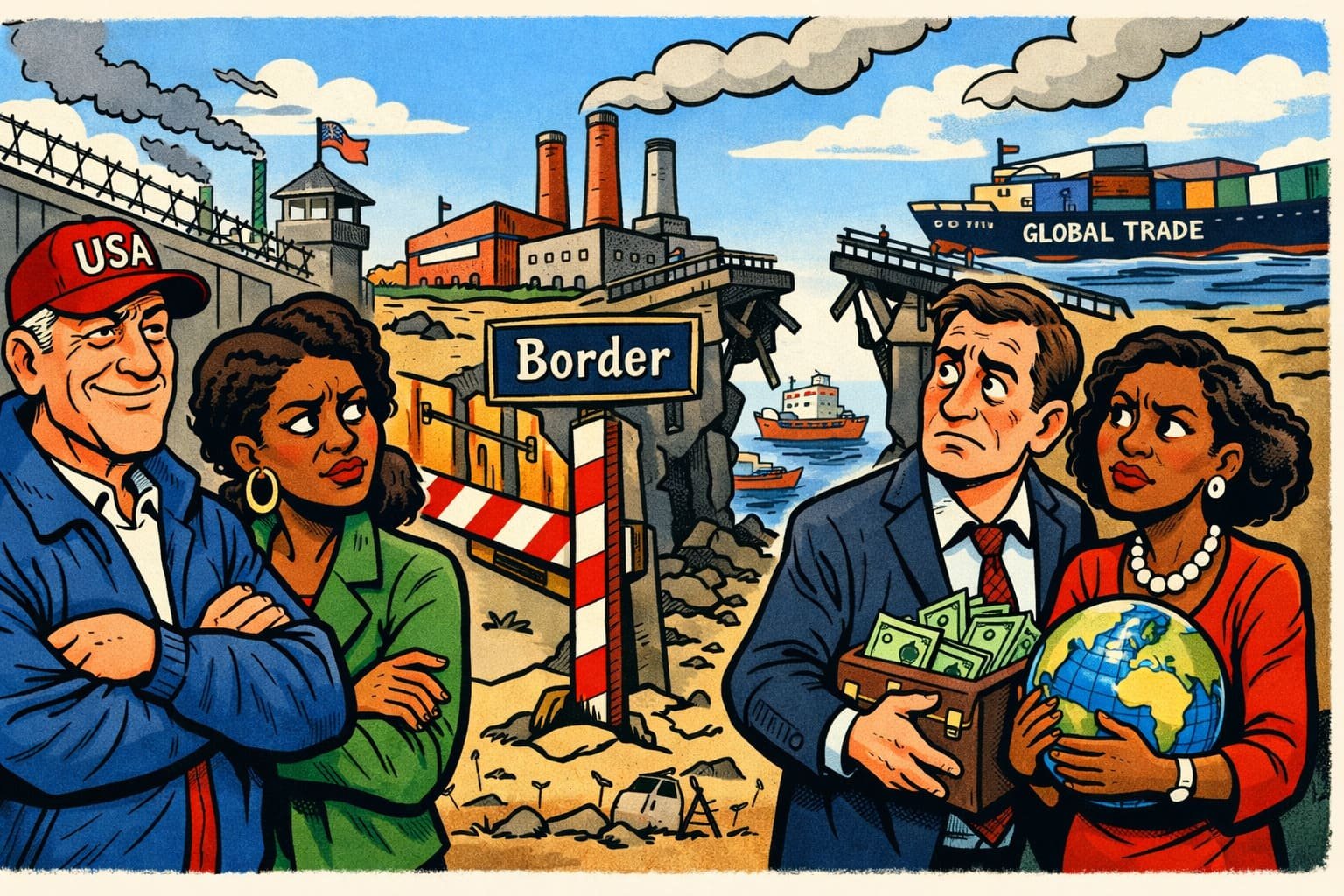
A cargo vessel waits offshore while cranes stand perfectly still, not because machines have failed but because policy has changed. Inside nearby headquarters, executives redraw supply maps that looked permanent only months earlier. Efficiency suddenly has a rival. Governments increasingly value resilience, domestic production, and strategic independence alongside economic growth, transforming international trade from a straightforward calculation of cost into a complicated balance between security, employment, investment, and national competitiveness.
For decades, globalization rewarded businesses that built long supply chains across multiple countries to minimize production costs. Economic nationalism challenges that model by encouraging local manufacturing, strategic industries, and domestic investment through tariffs, subsidies, procurement policies, and industrial incentives. These measures rarely eliminate international trade altogether. Instead, they reshape incentives. Companies must now evaluate whether maximum efficiency still outweighs political stability, regulatory certainty, and reduced dependence on distant suppliers vulnerable to geopolitical disruption.
Taiwan Semiconductor Manufacturing Company illustrates this changing landscape. Growing concerns over semiconductor security encouraged significant investment in manufacturing facilities beyond Taiwan, including the United States and Japan. A smaller manufacturer led by Grace experienced similar pressures after importing specialized industrial components became increasingly uncertain. Rather than relying on one overseas supplier, she developed partnerships with regional producers despite modestly higher prices. Customers accepted slightly higher costs because dependable delivery proved more valuable than occasional bargain pricing.
Classical economics argues that comparative advantage allows nations to specialize, increasing overall prosperity through trade. Modern policymakers increasingly balance that principle against strategic vulnerability. Medical equipment shortages during recent global disruptions reminded governments that efficiency sometimes carries hidden risks. Companies adopting diversified supply networks often accept higher operating expenses in exchange for greater resilience. Financial analysis now measures not only production costs but also interruption risks, inventory flexibility, and long-term continuity during unpredictable geopolitical events.
Another story unfolded inside Omar’s electronics assembly business. Imported components had always arrived with remarkable consistency until new trade restrictions extended delivery schedules unpredictably. Production deadlines slipped, frustrating loyal customers. Omar invested in redesigning products around locally available parts while strengthening relationships with domestic suppliers. Margins narrowed briefly, yet reliability improved substantially. Competitors waiting for previous trade conditions to return gradually lost customers who valued dependable service over slightly lower prices and uncertain delivery promises.
Night settles across a border crossing where trucks continue moving, though no longer with yesterday’s assumptions guiding every journey. Economic nationalism does not signal the end of globalization. It marks the beginning of a different commercial era where resilience stands beside efficiency as an equal strategic priority. Businesses prepared to balance both will navigate uncertainty with greater confidence than those chasing cost alone. Tomorrow belongs to organizations that understand strength is measured by adaptability as much as efficiency.
