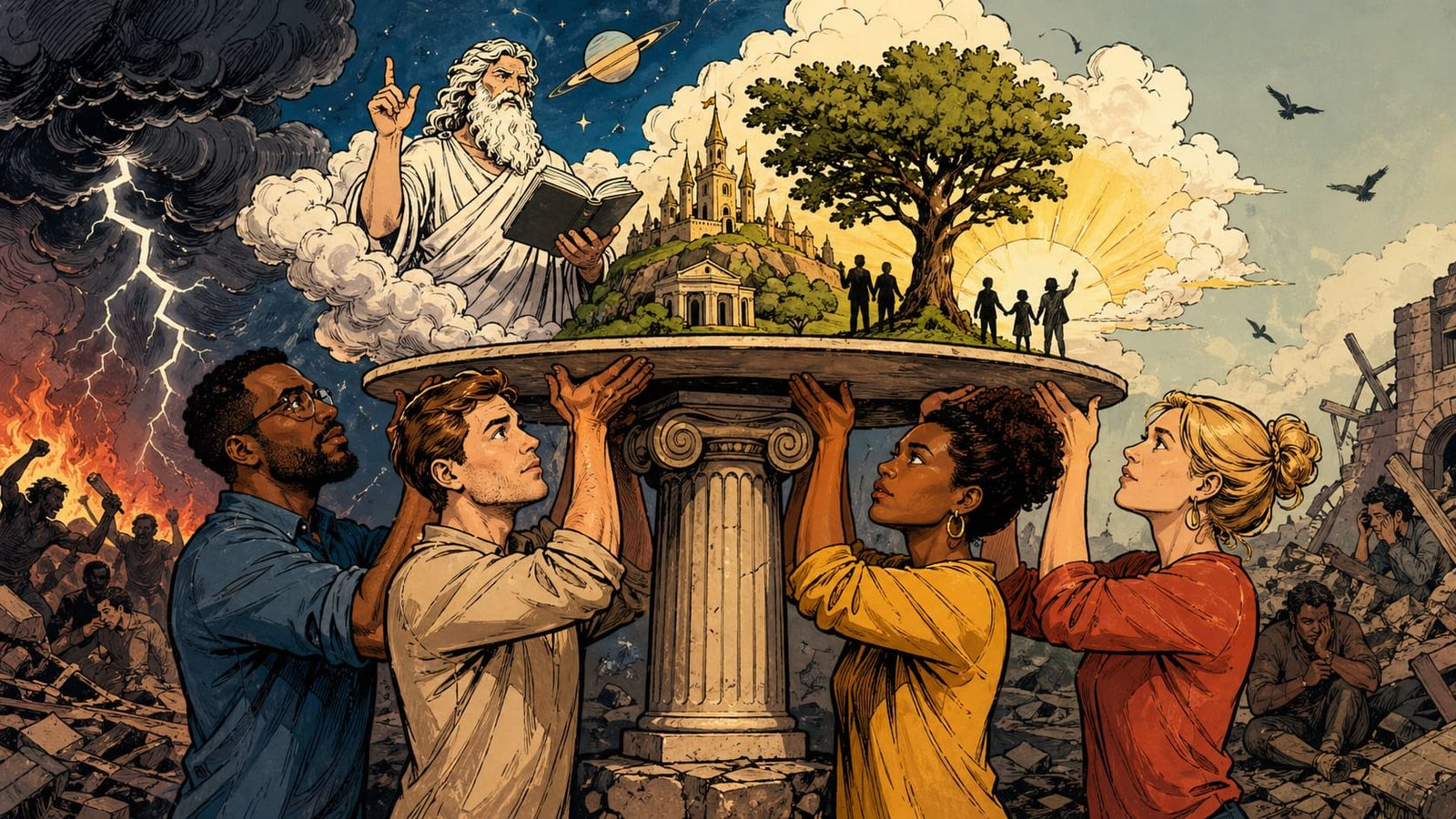
A courtroom falls silent before a verdict, the kind of silence that feels heavier than law books stacked against polished wood. The arguments have been made, the evidence laid out with precision, yet what lingers in the room is not just logic. It is a tension that feels older than the legal system itself, something closer to a shared instinct about fairness, about what should happen next. Modern society prides itself on rational frameworks, on systems designed to be objective and impartial. Still, beneath those structures, something less visible continues to operate. Myth. Not in the sense of falsehood, but as a narrative force that shapes how people understand right and wrong, justice and consequence, meaning and order.
The belief that morality can exist purely on logic sounds appealing. It promises clarity, consistency, a clean separation from the ambiguities of tradition. Yet logic alone struggles to generate motivation. It can explain why an action is beneficial or harmful, but it rarely inspires people to act beyond self-interest. Myth fills that gap by embedding moral ideas within stories that resonate emotionally. These stories create a sense of significance, a feeling that choices matter beyond immediate outcomes. A public defender named Andre once described how juries often responded less to technical arguments and more to the narrative framing of a case. The facts were essential, but the story gave them weight.
Societies rely on shared narratives to maintain cohesion. These narratives do not always appear as formal myths. They can take the form of cultural values, national identities, or widely accepted ideas about progress and success. They provide a framework for interpreting behavior, for deciding what is acceptable and what is not. Without them, rules become abstract, disconnected from lived experience. A community leader named Hana worked in a neighborhood facing rising conflict. She noticed that attempts to enforce rules without addressing the underlying narratives often failed. When people began to share stories about what the community stood for, about the kind of place they wanted to live in, behavior started to shift. The narrative created alignment that rules alone could not achieve.
The influence of myth becomes even more apparent in how people respond to moral dilemmas. When faced with complex decisions, individuals rarely rely on pure calculation. They draw on internalized stories about identity, responsibility, and consequence. These stories guide intuition, shaping choices in ways that are not always consciously recognized. A physician named Luis once faced a difficult decision about allocating limited resources. The guidelines provided a framework, but they did not resolve the tension. What ultimately guided him was a deeply held narrative about care and dignity, one that had been shaped long before his professional training.
Pop culture continues to reinforce the role of myth in shaping morality. Films, series, and literature often explore ethical questions through narrative rather than abstract argument. Characters face challenges that require them to choose between competing values, revealing the complexity of moral decision-making. These stories resonate because they mirror real-life situations, where choices are rarely clear-cut. They provide a space for audiences to engage with moral questions in a way that feels tangible and immediate. The popularity of such narratives suggests that people seek more than logical frameworks. They seek meaning that can be experienced, not just understood.
There is also a tension between the desire for objectivity and the need for narrative. Modern systems aim to minimize bias, to create fairness through standardized processes. This is a necessary goal, yet it does not eliminate the influence of underlying stories. These stories shape how rules are interpreted, how decisions are justified, how outcomes are perceived. A policy analyst named Sofia once reflected on how different stakeholders viewed the same regulation. Each interpretation was influenced by a broader narrative about what the policy represented. The text remained constant, the meaning shifted.
The persistence of myth does not mean that logic is irrelevant. It plays a crucial role in refining ideas, in testing assumptions, in creating systems that function effectively. The relationship between logic and myth is not a competition. It is a collaboration. Logic provides structure, myth provides meaning. Together, they create a framework that is both functional and resonant. Remove one, and the system becomes unbalanced. Too much reliance on logic can lead to detachment. Too much reliance on myth can lead to rigidity. The balance between the two is what allows societies to adapt while maintaining coherence.
At the edge of that courtroom, a figure watches as the verdict is delivered, the words echoing with a finality that feels both precise and incomplete. The decision follows the rules, aligns with the evidence, yet it also reflects something less tangible, a shared sense of what feels right. Outside, the world continues to refine its systems, to pursue fairness through logic and design. Inside, a quieter truth lingers. Morality does not live in rules alone. It breathes through the stories people carry, the narratives that give those rules meaning. And in that unseen layer, society finds a kind of order that logic by itself could never fully sustain.
