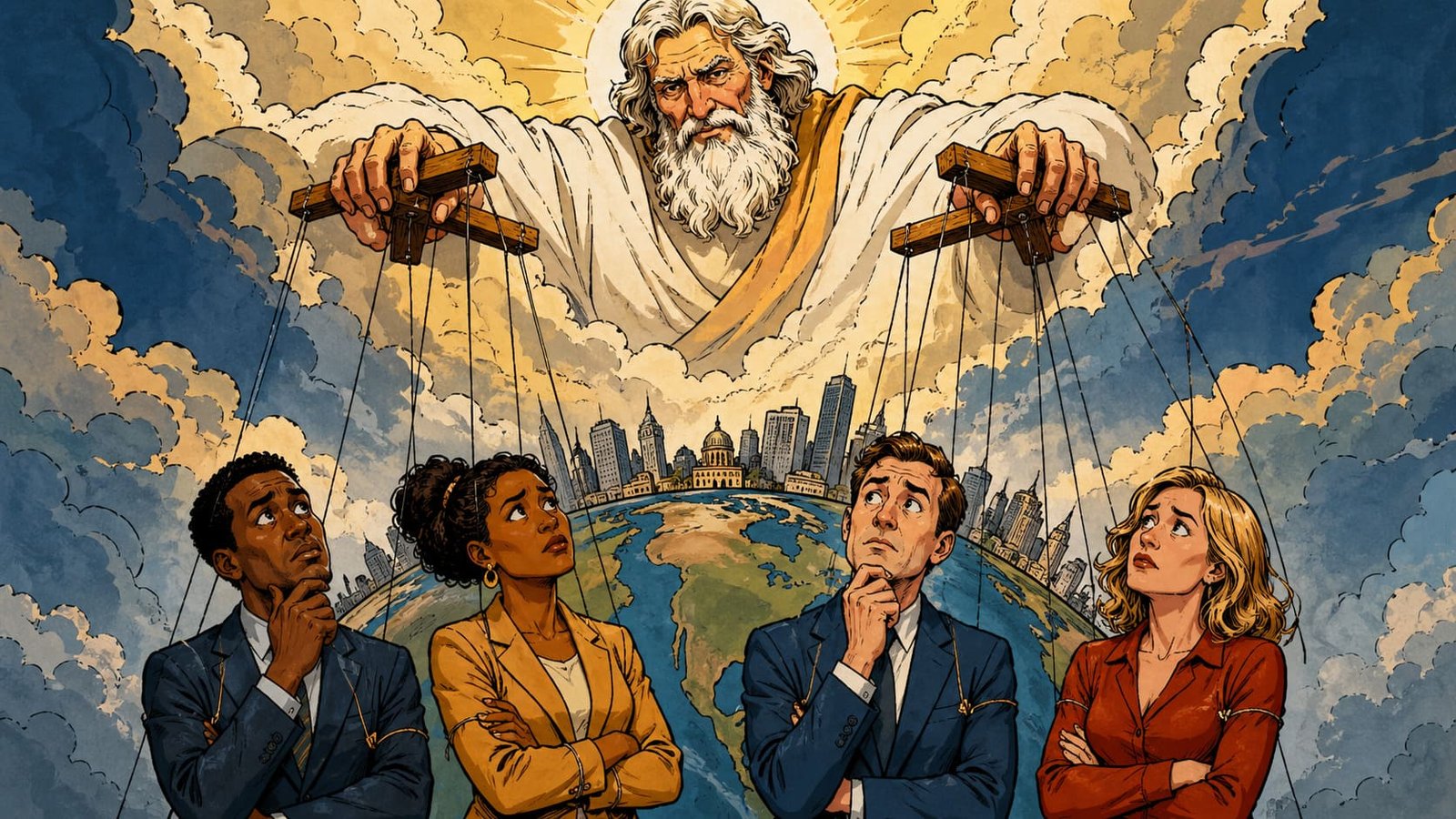
A glass tower rises above a city that prides itself on neutrality. Inside, executives debate policy with the language of compliance, governance, and global standards. Screens glow with charts that promise control, as if human behavior can be mapped like weather. No scripture is quoted, no prayer is spoken, yet something ancient hums beneath the polished floor. Decisions carry a moral weight that spreadsheets cannot explain. The room insists it is secular, objective, modern. Still, the choices echo with judgments about right and wrong, sacrifice and reward, virtue and consequence. The vocabulary has changed. The gravity has not.
Power rarely announces its true foundations. It prefers to appear rational, procedural, detached from belief. Yet every system that governs people rests on a set of assumptions about what matters. Law encodes morality. Markets reward certain behaviors while punishing others. Even innovation carries an implicit belief that progress is desirable. These are not neutral positions. They are convictions, often inherited, rarely questioned. A policy advisor named Selin once spent months refining a regulatory framework meant to balance growth and fairness. Late one evening, she admitted that the hardest part was not the data. It was deciding what counted as fair. That decision did not come from a model. It came from a deeper sense of what the world ought to be.
Religion, in its traditional form, may appear to have retreated from public life in many places. Institutions lose influence, rituals fade from daily routines, and public discourse leans toward secular language. Yet the underlying structure of belief remains embedded in how societies operate. Concepts like justice, dignity, and human rights carry a lineage that stretches far beyond modern frameworks. They are shaped by centuries of moral reflection, much of it rooted in religious thought. Remove that foundation, and the language still stands, but its depth begins to thin. The words remain, the weight behind them starts to shift.
The influence becomes clearer when observing how people respond to power itself. Authority is rarely accepted without a narrative that justifies it. Governments, corporations, and leaders all rely on stories that explain why their power is legitimate. These stories often borrow from older traditions, even when they avoid explicit references. A startup founder named Ibrahim built a company around the idea of ethical technology. His pitch decks were filled with terms like transparency and responsibility. Investors were drawn not only to the business model but to the moral vision it implied. What he offered was not just a product. It was a framework for believing that technology could be guided by something beyond profit.
Crisis reveals the hidden architecture of belief more than stability ever could. When systems fail, people do not turn to data alone. They search for meaning, for explanations that go beyond immediate cause and effect. During a sudden market downturn, a trader named Elena watched years of strategy unravel in hours. The models she trusted offered no comfort. What steadied her was a quiet conviction about resilience, about enduring beyond the moment. That conviction did not emerge from her training. It came from a deeper place, one shaped by values that had been present long before her career began. In that moment, the distinction between secular and sacred blurred.
Pop culture mirrors this dynamic in subtle ways. Stories about power, whether in films, series, or literature, often draw on themes that resemble religious narratives. The struggle between good and evil, the fall and redemption, the idea of destiny, these patterns repeat because they resonate with something fundamental. Even in worlds filled with advanced technology and futuristic settings, the underlying conflicts remain moral at their core. The audience may not label them as religious, but the structure feels familiar. It speaks to a shared understanding that power without purpose becomes unstable.
There is also a quiet contradiction in how modern society approaches belief. Public spaces often discourage overt expressions of faith, framing them as private matters. At the same time, collective decisions continue to reflect deeply held values that resemble those found in religious traditions. This creates a tension that is rarely addressed directly. A legal scholar named Tomas once described it as a kind of selective amnesia. Society forgets where its moral language comes from, yet continues to rely on it. The result is a system that appears secular on the surface but remains shaped by deeper currents.
The persistence of religion’s influence does not mean that it controls every aspect of life in an obvious way. Its power is more subtle, woven into the assumptions that guide behavior. It shapes what people consider meaningful, what they are willing to sacrifice, and how they interpret success. These influences operate quietly, often unnoticed, yet they carry significant weight. They remind us that governance is not only about rules and systems. It is also about the values that give those rules legitimacy.
On the edge of that glass tower, a figure stands looking out over the city, where lights stretch into the distance like a constellation built by human hands. Each light represents a decision, a life, a belief about what matters. The skyline feels modern, almost detached from the past. Yet beneath its surface, older currents continue to flow. They guide choices in ways that rarely appear in reports or presentations. They whisper through institutions, shaping outcomes that logic alone cannot fully explain. And in that quiet persistence, a realization takes hold. The world may speak the language of secularism, but its heart still beats with questions that feel older than any system designed to answer them.
