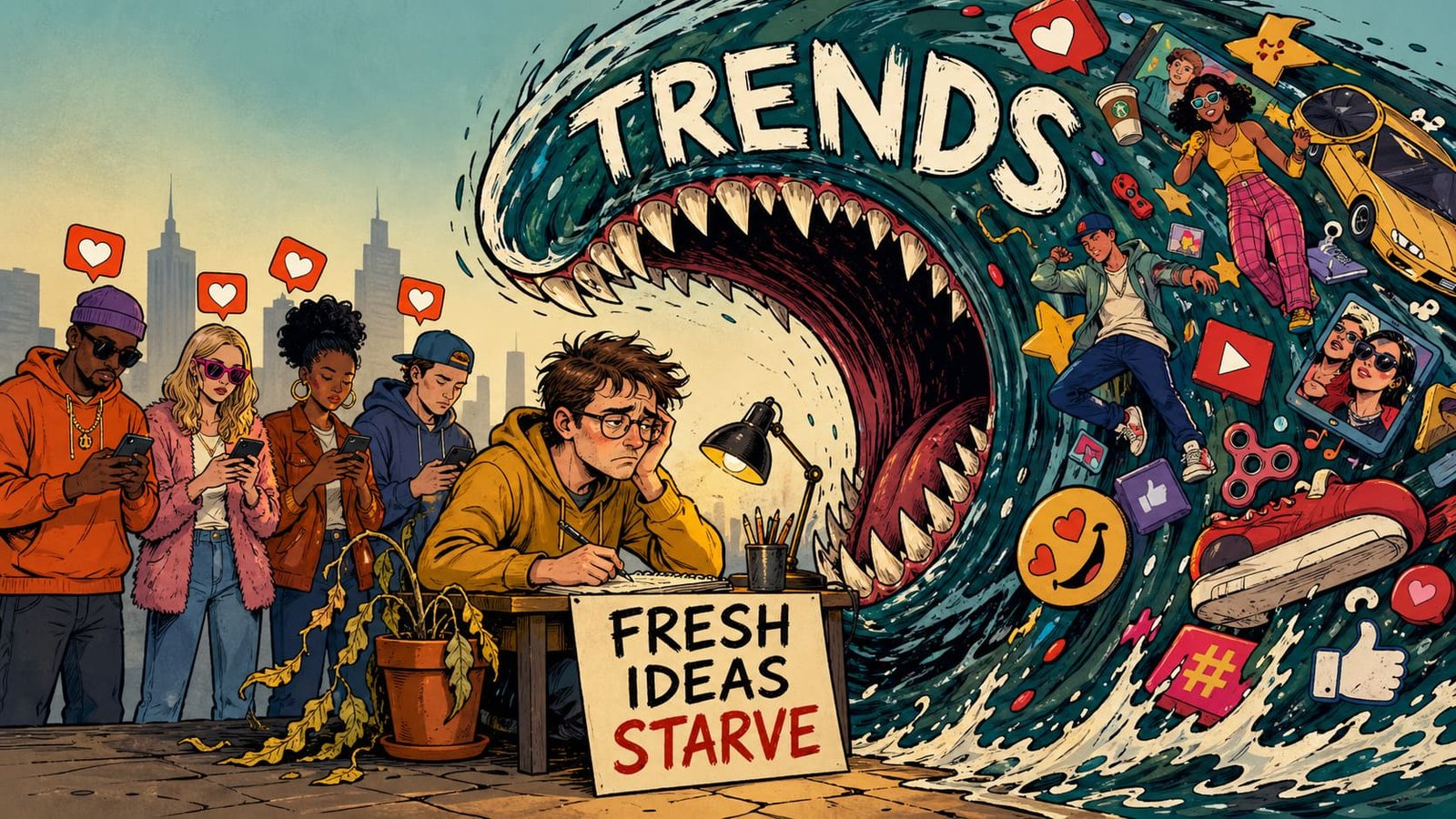
A studio sits half-lit, sketches scattered across a desk that looks like it has been arguing with itself all night. The concept is new, strange, slightly uncomfortable. It refuses to resemble anything that has worked before. Across town, another office glows with certainty, screens filled with variations of something already proven. Meetings there feel smoother. Decisions arrive faster. The difference is not talent. It is appetite. One space is trying to invent. The other is trying to repeat what already fed the system.
Original ideas have always faced resistance, but the current environment accelerates that resistance into something sharper. Trends act like filters, not just highlighting what is popular but quietly starving what does not align. The system rewards familiarity because familiarity travels easily. It is understood quickly, shared effortlessly, and monetized without friction. Freshness, by contrast, asks for patience. It requires interpretation. It carries risk. In a culture that moves at speed, risk becomes expensive.
There was a product lead named Kavish who spent months developing a tool that approached a common problem from a completely different angle. Early testers were intrigued but confused. Feedback was slow, scattered, sometimes contradictory. Meanwhile, competitors released simplified versions of existing tools with minor tweaks. Their adoption surged. Kavish’s team faced pressure to pivot, to align with what was already gaining traction. The decision was not framed as abandoning originality. It was framed as being pragmatic.
Trends create a gravitational pull that shapes behavior across industries. They signal what is safe to pursue. When something gains momentum, it becomes a reference point. Others follow, not necessarily because they lack ideas, but because they recognize the efficiency of alignment. This leads to a clustering effect, where multiple players converge on similar solutions, aesthetics, or narratives. The result is abundance without diversity.
A filmmaker named Soraya experienced this firsthand. Her script challenged conventional storytelling, refusing clear resolution and predictable pacing. Studios hesitated. Around the same time, a specific genre began to dominate box offices, driven by familiar arcs and recognizable characters. Soraya was encouraged to adapt her work to fit the trend. She resisted for a while, then adjusted certain elements to secure funding. The film was released, received well, yet she admitted in a quiet interview that it felt like a compromise that the audience could not see but she could not unfeel.
The tension between originality and adoption is not new, but it is intensified by the speed of feedback loops. Metrics arrive instantly. Engagement is measured in real time. This creates a constant pressure to optimize for what works now. Ideas that require time to mature often appear weak in early stages. They are abandoned before they have the chance to evolve. The system does not wait long enough for depth to reveal itself.
A startup founder named Elias once described his early product as “too early for its own category.” Users did not know how to interact with it because it did not resemble anything they had used before. Adoption was slow. Investors grew impatient. Meanwhile, simpler products that mirrored existing patterns gained traction quickly. Elias eventually refined his concept, introducing familiar elements to ease entry. Growth followed, but the original ambition had been partially diluted.
This pattern extends into creative fields as well. Music, fashion, digital content, each space shows signs of repetition driven by trend alignment. A sound becomes popular, then replicated across countless tracks. A visual style dominates feeds, then appears in every campaign. The cycle is efficient but limiting. It produces volume without necessarily producing meaning.
A content creator named Anika built her early following by experimenting with unconventional formats that did not fit platform norms. Growth was slow, sometimes discouraging. When she briefly adopted trending formats, her visibility spiked. The contrast was immediate. She faced a choice between continuing her original approach or leaning into what the system rewarded. She chose a hybrid path, maintaining elements of her style while incorporating recognizable structures. It worked, but she often spoke about the constant negotiation between authenticity and reach.
The economic logic behind this is clear. Trends reduce uncertainty. They provide a template that has already demonstrated viability. For businesses operating under pressure, this is attractive. It allows for quicker decisions, faster execution, more predictable outcomes. Original ideas, by definition, lack this safety. They require belief before evidence, a difficult proposition in environments driven by short-term results.
There is also a cultural dimension to this dynamic. Audiences, conditioned by repeated exposure to certain patterns, develop expectations. Content that aligns with those expectations feels comfortable. Content that deviates can feel jarring, even when it is more innovative. This creates a feedback loop where creators adjust to audience preferences, and audience preferences are shaped by what is most visible.
Yet, despite this environment, originality does not disappear. It retreats, adapts, finds alternative paths. Some creators choose to operate outside mainstream channels, building smaller but more engaged communities. Others persist within the system, gradually introducing new ideas in ways that feel accessible. These approaches require patience and resilience. They rarely produce immediate recognition, but they can create lasting impact.
A small design studio led by Matteo focused on projects that did not follow current trends. Their work was initially overlooked by larger clients. Over time, a distinct identity emerged, attracting those seeking something different. Growth was slower, but it was built on differentiation rather than imitation. Matteo often described their strategy as “playing a longer game that the system does not reward immediately.”
The broader culture continues to oscillate between novelty and familiarity. Trends dominate the surface, shaping what is seen and shared. Beneath that surface, quieter efforts push against the current, exploring possibilities that have not yet been validated. The tension between these layers defines the creative landscape.
The studio remains half-lit, sketches still scattered, ideas still unresolved. Across town, the screens continue to glow with variations of what is already known. Both spaces are active, both producing, both contributing to the same ecosystem in different ways. One feeds the present. The other attempts to shape the future.
Sit with that contrast for a moment and consider: are you building something that fits the moment, or something that might outlive it?
