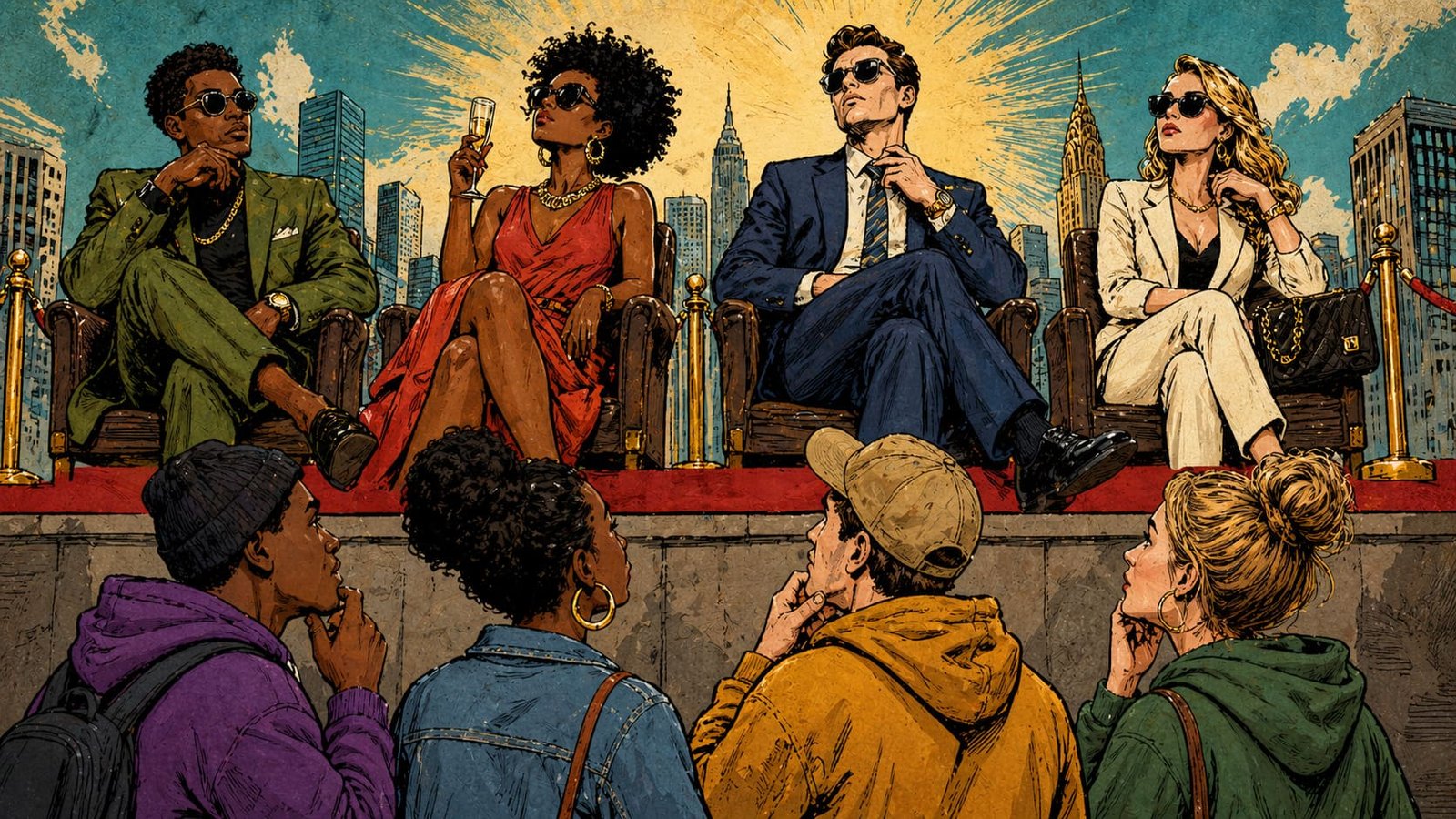
A private lounge hums with low conversation, where nothing is said directly yet everything is communicated. Fabric choices speak louder than voices. Watches flicker under soft light like coded signals. Shoes carry histories that only a trained eye can read. No one announces hierarchy. It reveals itself in glances, in pauses, in who gets approached and who gets observed. Style here is not decoration. It is language sharpened into a ranking system.
Taste has always carried social meaning, but it now operates with a precision that feels almost engineered. What used to be personal preference has been elevated into a form of cultural currency. The right combination of aesthetics signals belonging to a certain tier. The wrong combination quietly closes doors before they even open. It is not about wealth alone. It is about fluency in a code that shifts constantly and punishes hesitation.
There was a consultant named Darien who moved from a technical role into high-level advisory work. His expertise was unquestionable, his insights sharp. Yet early meetings felt strained. Clients listened politely but rarely leaned in. A colleague suggested a subtle shift, different tailoring, restrained color palettes, a watch that suggested taste without shouting expense. Within weeks, the dynamic changed. Conversations extended. Invitations followed. Darien realized something unsettling. His ideas had not changed. Their reception had.
Style functions as a shortcut for judgment. It compresses complex information into immediate impressions. In environments where time is limited, these impressions carry weight. A venture capitalist once admitted during a private discussion that first meetings often hinge on “signal recognition.” Founders who understand the visual language of the room are perceived as more aligned, more trustworthy. It is not a conscious bias. It feels intuitive, which makes it harder to challenge.
This creates a tension between authenticity and adaptation. On one hand, style offers a way to express individuality. On the other, it demands conformity to certain standards to unlock opportunity. A designer named Leandro built his brand around unconventional silhouettes that challenged traditional norms. Early reception was mixed. Some praised the originality. Others dismissed it as impractical. Over time, as similar aesthetics began to appear in mainstream collections, Leandro’s work was reinterpreted as visionary. The shift was not in the designs. It was in the collective readiness to accept them.
The speed at which style evolves intensifies this dynamic. Trends move quickly, but status signals move even faster. What felt exclusive last season becomes accessible the next. This forces constant recalibration. Individuals who rely on visible markers of taste must update continuously to maintain their position. It creates a cycle where stability is difficult to achieve. The pursuit of distinction becomes a moving target.
A retail buyer named Sienna once described this as “controlled instability.” She curated collections that balanced familiarity with just enough novelty to signal awareness. Customers did not always articulate why they were drawn to certain pieces. They felt it. The items aligned with an unspoken standard that suggested relevance. Sienna understood that her role was not simply to select products, but to interpret the shifting language of status.
Style also intersects with access. Certain signals are easier to acquire with resources, but others require cultural literacy. Knowing when to simplify, when to exaggerate, when to step back, these are learned behaviors. They are not always taught explicitly. They are absorbed through observation, through proximity to environments where these codes are practiced. This creates a subtle barrier. Those outside the system may possess talent and insight, yet struggle to translate them into recognized signals.
Pop culture amplifies these patterns by turning style into spectacle. Red carpets, social feeds, and curated campaigns broadcast visual hierarchies to a global audience. What was once confined to specific circles becomes widely visible, yet not equally accessible. A stylist named Amara worked behind the scenes for emerging artists, crafting looks that balanced aspiration with relatability. She noticed how quickly audiences responded to visual cues, often forming opinions before engaging with the work itself. Image became the entry point, sometimes the only point.
There is also a psychological layer that shapes how individuals interact with style. It offers a sense of control in uncertain environments. Choosing what to wear, how to present, becomes a way to navigate spaces where other variables are unpredictable. This can be empowering. It can also become restrictive if the focus shifts from expression to performance. The line between the two is often thin.
A small creative collective led by Mateo explored this boundary by deliberately removing visible status markers during their gatherings. No branded items, no overt signals of hierarchy. The result was initially disorienting. Conversations felt slower, more deliberate. Over time, interactions deepened. Without the usual cues, participants engaged with each other more directly. It revealed how much of social navigation relies on visual shorthand.
The broader culture continues to reward those who master these signals. Opportunities often flow toward individuals who can align their presentation with the expectations of influential spaces. This does not negate the importance of substance, but it highlights the role of perception in determining access. The challenge lies in balancing awareness of these dynamics without becoming entirely shaped by them.
There are individuals who manage to navigate this with a certain quiet confidence. They understand the codes but are not fully defined by them. Their style feels intentional rather than reactive. It evolves, but not at the pace dictated by external pressure. This approach does not guarantee immediate recognition. It builds something more durable over time, a sense of identity that does not depend on constant validation.
The lounge remains filled with subtle exchanges, each gesture carrying meaning that does not need to be spoken. The hierarchy persists, fluid yet consistent, shaped by countless small decisions that accumulate into perception. It feels natural, almost inevitable. Yet beneath that surface, there is space for a different approach, one that treats style as a tool rather than a verdict.
Step into that space for a moment and consider: is your style expressing who you are, or quietly negotiating where you are allowed to stand?
