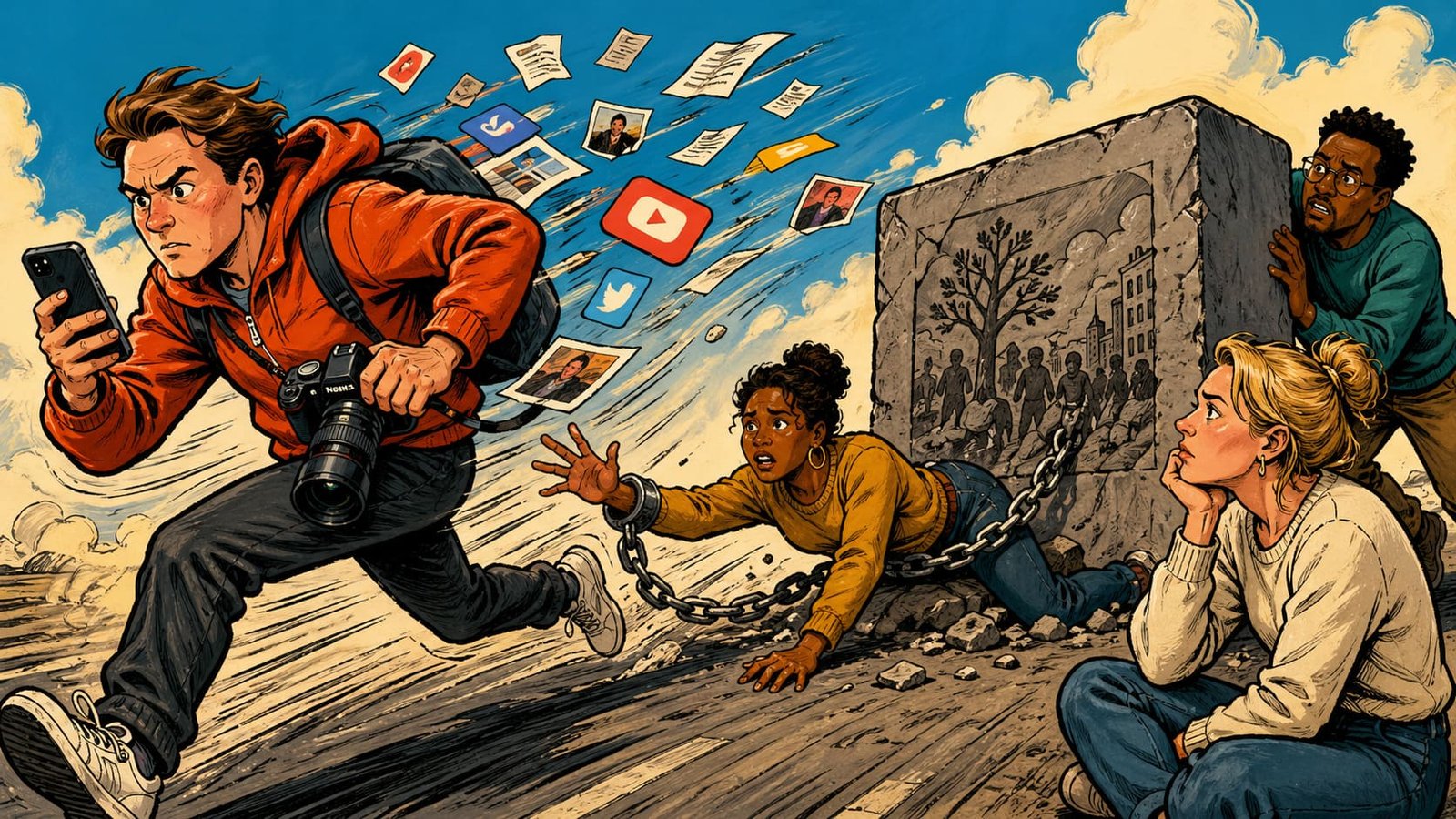
A red banner flashes across a screen in a control room that never really sleeps, and a producer leans forward as if urgency itself were a substance that could spill. Words are pushed out before they have time to settle. A headline appears, then updates, then updates again, each version shaving off doubt in favor of certainty. Somewhere between the first alert and the third revision, the story begins to harden, not because it is complete, but because it is already moving.
Speed has become the hidden currency of modern news. It rewards immediacy, punishes hesitation, and quietly erodes the space where context once lived. The media scholar Marshall McLuhan argued that the medium shapes the message. In a landscape built for rapid transmission, messages shrink to fit the pace. Depth feels like friction. Nuance feels like delay. The faster the cycle, the thinner the story becomes.
That thinning rarely feels dramatic. It shows up in small distortions that accumulate. A logistics manager named Tariq once followed a developing story about a supply chain disruption while waiting for a delayed flight. The first report suggested a systemic collapse. Minutes later, updates softened the claim, then clarified it further. By the time the full picture emerged, the initial panic had already spread through markets and conversations. Tariq noticed something unsettling. The correction never traveled as far as the first impression. Speed had amplified the error and buried the repair.
Inside newsrooms, the pressure is constant and strangely intimate. A digital editor named Elise described it during a quiet moment after a long shift, the glow of multiple monitors reflecting in her tired eyes. She spoke about the tension between being right and being first. The system rarely rewards the former if it arrives too late. Competitors publish, audiences move on, relevance fades. Accuracy still matters, but it competes with a clock that never stops. Over time, the instinct to verify begins to share space with the instinct to release.
The consequences ripple outward into how events are understood. Complex situations demand time. They require layers, perspectives, contradictions. Speed compresses all of that into fragments. Consider how crises unfold in real time. Early reports often rely on partial information, yet they shape the narrative frame that persists long after details change. When Anderson Cooper reports from a scene, the immediacy brings viewers closer, but it also carries the weight of incomplete knowledge. The audience experiences the event as it is being interpreted, not as it fully is.
A regional newsroom in São Paulo once experimented with delaying publication on certain stories to allow for deeper reporting. The editor, Rafael, believed that context could be a competitive advantage rather than a liability. The initial results were promising in terms of quality, but traffic told a different story. Readers gravitated toward faster outlets, even when those outlets offered less clarity. Rafael faced a difficult realization. The audience had been trained to value immediacy, often at the expense of understanding. The experiment revealed not just a production problem, but a cultural one.
Pop culture mirrors this acceleration in subtle ways. Live reactions, real-time commentary, and instant reviews create a feedback loop where opinions form before experiences settle. A film releases, and within hours, it is labeled a success or a failure. The conversation moves on before the work has time to breathe. The same pattern applies to news. Events are judged in their earliest moments, then rarely revisited with the same intensity once more information emerges. The first version becomes the lasting one.
The deeper cost is not only misinformation. It is the erosion of patience. The mind adapts to speed, becoming less comfortable with ambiguity, less willing to wait for clarity. A policy researcher named Noor noticed this during a workshop where participants were asked to analyze a developing issue without immediate conclusions. The room grew restless. People reached for quick interpretations, filling gaps with assumptions. Waiting felt unnatural. The habit of instant judgment had taken root.
Somewhere within this fast-moving landscape, a quieter impulse begins to surface. It resists the rush, not by rejecting information, but by slowing its intake. It asks different questions. What is missing? What has not yet been confirmed? What might change with time? This impulse does not align easily with the dominant rhythm. It feels out of step, almost inconvenient. Yet it carries a different kind of strength, one that values understanding over immediacy.
In a small apartment overlooking a city that never quite dims, a researcher sits with a story that has already cycled through headlines. The room smells faintly of paper and old coffee, the kind that lingers after long hours of reading. Notes are spread across a desk, each one adding a layer that never made it into the initial reports. The fuller picture emerges slowly, quietly, without urgency. It does not trend. It does not flash. It simply clarifies.
As the next breaking alert begins to pulse across screens, a question remains, steady and difficult to ignore: when speed becomes the measure of relevance, how much of reality is left behind in the race to be first, and who notices what never had time to be understood?
