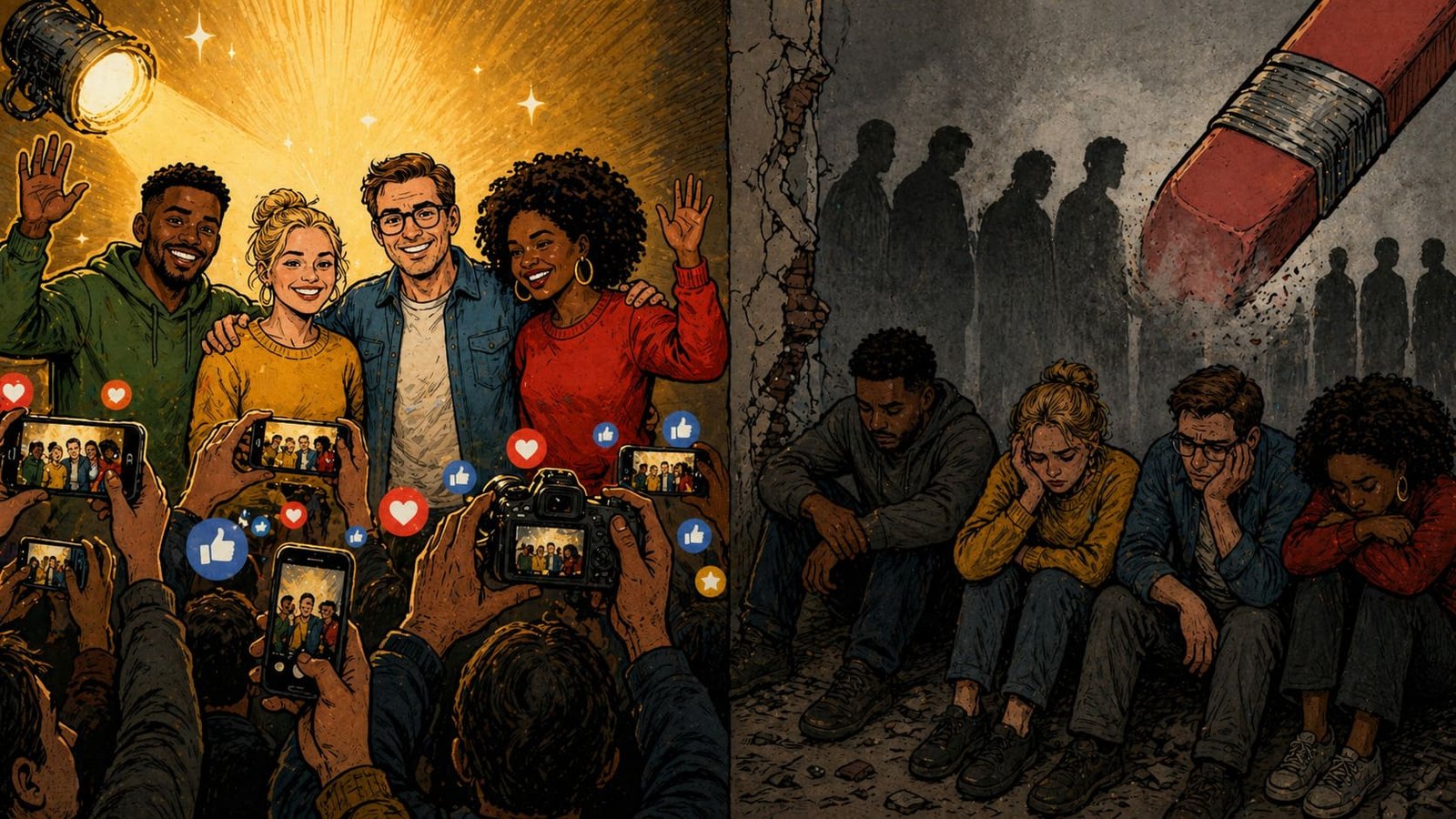
A dim corridor stretches across the digital landscape, lined with doors that open only when light touches them. Some glow constantly, bathed in attention, their names repeated until they feel inevitable. Others remain closed, not because they lack substance, but because no beam ever reaches them. It is not absence that defines them. It is invisibility. And in this quiet architecture, existence itself begins to feel conditional, negotiated through exposure rather than truth.
Visibility does not simply reflect value. It manufactures it. The sociologist Pierre Bourdieu spoke of symbolic capital, the kind that accumulates through recognition rather than material proof. In the modern media ecosystem, that capital flows through attention. What is seen gains legitimacy. What is ignored fades, regardless of merit. The hierarchy feels natural only because it is repeated so often that it stops looking constructed.
The shift becomes personal in small, almost forgettable moments. A founder named Laila once launched a thoughtful product designed to simplify remote collaboration. It solved real problems, earned genuine praise from early users, and then quietly stalled. Not because it failed, but because it never reached the right screens. Months later, a similar product appeared, louder, more visible, wrapped in narratives that made it feel groundbreaking. Laila watched as attention gathered around the second entrant like gravity. The difference was not quality. It was exposure. The market did not reward the best idea. It rewarded the most visible one.
This pattern repeats across industries, from entertainment to politics to everyday careers. A strategist named Mikkel once described it during a late evening brainstorming session, the room carrying the faint smell of overheated laptops and stale air. He noted that visibility operates like oxygen. It does not guarantee success, but without it, survival becomes unlikely. Campaigns that dominate attention cycles shape perception before competitors have a chance to speak. The audience does not compare options. It recognizes what it has already seen.
There is a quiet brutality in this system. Silence does not feel neutral. It feels like erasure. Entire communities, ideas, and perspectives can exist in depth and richness, yet remain absent from mainstream consciousness simply because they are not amplified. Consider how certain global issues receive sustained coverage while others remain peripheral. The disparity is not always about importance. It is about narrative momentum. Once a story gains traction, it attracts more coverage, more discussion, more visibility. The cycle reinforces itself.
A media collective in Accra once tried to disrupt this pattern by focusing exclusively on overlooked stories. The founder, Kojo, believed that consistent exposure could shift public awareness. For a time, it worked. Readers engaged deeply with narratives that had previously been invisible. Yet scaling the effort proved difficult. Algorithms favored content that already performed well. Advertisers leaned toward safer, more familiar topics. Kojo found himself in a paradox. To make the invisible visible, he needed the very system that thrived on visibility hierarchies. The effort revealed how deeply the economy of attention is embedded in the structure itself.
Pop culture amplifies this dynamic with almost theatrical clarity. Viral moments elevate individuals overnight, turning unknown creators into household names. The process feels spontaneous, even democratic, yet it follows patterns. Content that aligns with existing trends spreads faster. Personalities who fit recognizable archetypes gain traction more easily. The system rewards familiarity dressed as novelty. Those who fall outside these patterns often struggle to break through, not because they lack talent, but because they do not fit the mold that visibility prefers.
The deeper consequence extends beyond recognition. It shapes identity. When visibility becomes a measure of worth, absence begins to feel like failure. A young artist named Sofie once confessed during a quiet gallery opening that she questioned her own work not because of its quality, but because it did not circulate widely. The room carried the soft scent of paint and varnish, her pieces arranged with care, each one holding a story that felt personal and deliberate. Yet the lack of attention made them feel incomplete. Visibility had become a mirror, reflecting not just presence, but perceived value.
This creates a subtle distortion in how people navigate the world. Decisions begin to prioritize exposure over substance. Efforts shift toward what can be seen rather than what can be built quietly. The tension grows between depth and display. A startup advisor named Henrik once observed that founders increasingly design products with shareability in mind, sometimes at the expense of durability. The logic is simple. If it does not circulate, it does not exist. The product becomes secondary to the narrative around it.
Somewhere beneath this system, a quieter understanding begins to form. It does not reject visibility outright. It questions its authority as the primary measure of value. It recognizes that attention is uneven, often arbitrary, shaped by forces that extend beyond merit. This awareness does not eliminate the need for exposure. It reframes it. Visibility becomes a tool, not a verdict.
In a small, dimly lit studio tucked between narrow streets, a writer sits surrounded by drafts that have never been published. The air carries a faint trace of ink and paper, the quiet weight of ideas waiting without urgency. Outside, louder stories move quickly, gathering attention, shaping discourse. Inside, something slower persists. The absence of visibility does not erase the work. It simply delays its recognition.
As the city hums with the constant exchange of attention, a question lingers, steady and unsettling, refusing to dissolve into the noise: if existence in the modern world depends so heavily on being seen, what truths remain hidden simply because no one has learned how to look?
