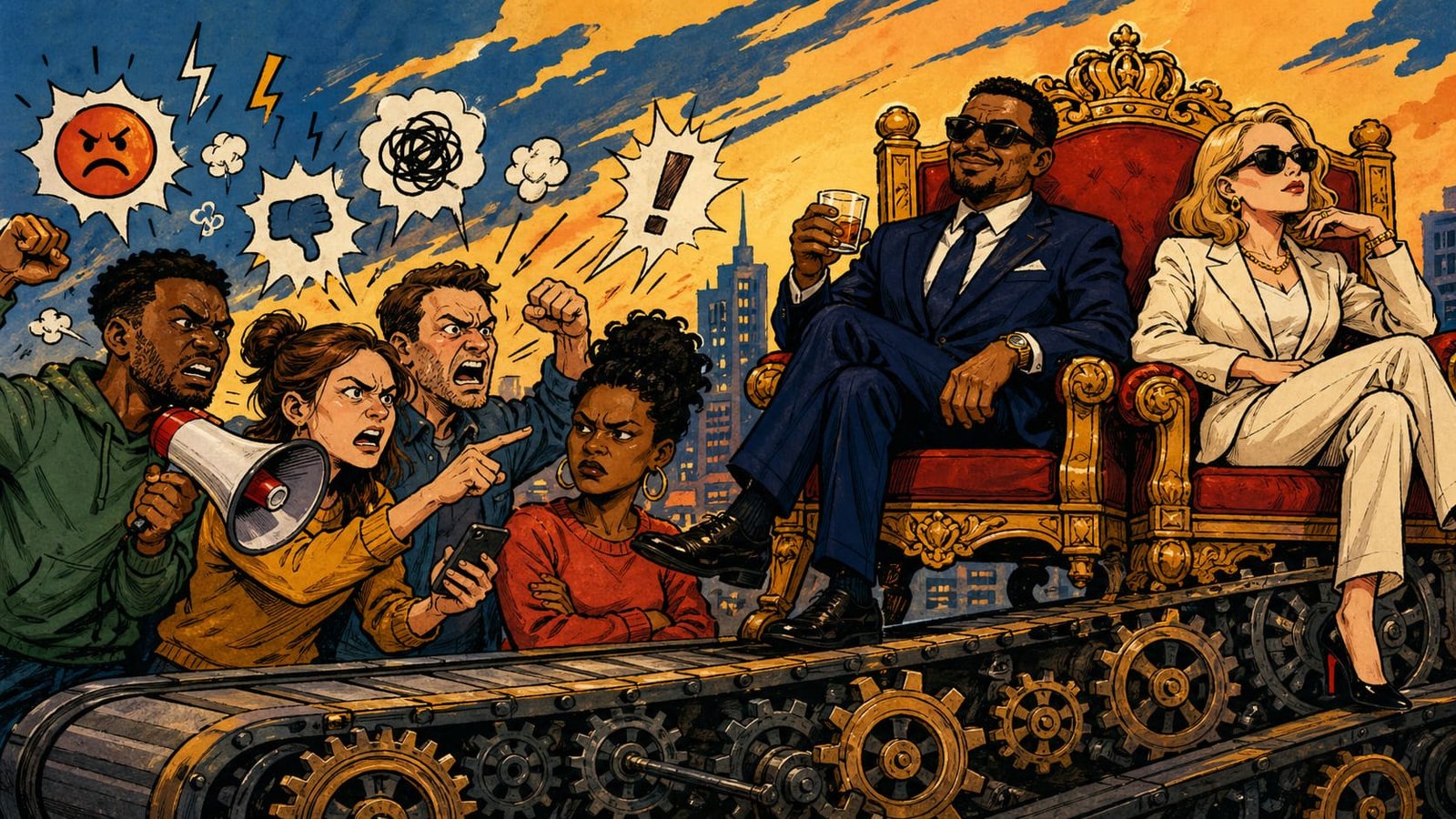
The headline burns hot for a moment, bright enough to pull every eye toward it. Feeds refresh, voices rise, statements sharpen into something that feels like collective conviction. There is a rhythm to it now, almost predictable. Outrage surges, spreads, peaks, and then, just as quickly, begins to cool. The story fades, replaced by another, then another. What remains is not silence, but a subtle shift, as if the energy that once demanded change has been quietly absorbed into the system it sought to challenge.
Moral outrage has become a defining feature of modern discourse. It signals awareness, aligns individuals with values, and creates a sense of shared urgency. At its best, it can expose injustice, mobilize action, and push institutions to respond. The problem is not the presence of outrage, but its volatility. It rises quickly, often without depth, and dissipates before it can translate into sustained change. Power, by contrast, moves differently. It is patient, structured, and less dependent on momentary attention. It does not need to trend. It endures.
A journalist named Thabo experienced this cycle while covering a series of corporate controversies that captured public attention. Each story followed a similar arc. Initial reports sparked widespread reaction, companies issued statements, discussions filled timelines and comment sections. For a brief period, it felt as though something significant might shift. Then the focus moved on. The companies adjusted their messaging, made incremental changes, and continued operating largely as before. Thabo noticed that while outrage created visibility, it rarely altered the underlying structures that allowed the issues to emerge in the first place.
The speed of modern communication amplifies this pattern. Information spreads instantly, reactions follow just as quickly, and the window for sustained attention narrows. This creates an environment where issues are acknowledged but not fully processed. The emotional intensity of outrage can give the impression of engagement, yet without continuity, it often lacks the depth needed to drive lasting impact. The system absorbs the reaction, adapts, and continues.
There was a public relations executive named Mirela who worked on crisis management for large organizations. Her role involved responding to moments of intense scrutiny, crafting messages that addressed concerns while protecting the company’s position. She understood the rhythm of outrage intimately. The goal was not to dismiss it, but to navigate it, to allow it to pass without causing irreversible damage. Over time, Mirela observed that most crises followed a predictable trajectory. With the right response, the intensity would subside, attention would shift, and operations would resume. The strategy did not rely on resolving every issue. It relied on the temporary nature of public focus.
This dynamic creates a tension between moral expression and structural change. Expressing outrage can feel meaningful, and in many cases, it is. It signals values, builds awareness, and can contribute to broader conversations. Yet without mechanisms to sustain that energy, to translate it into action that persists beyond the initial moment, its impact remains limited. Power structures, which operate on longer timelines, are often better equipped to withstand these cycles.
A policy advocate named Jonas encountered this tension while working on regulatory reforms that required long-term commitment and coordination. Public attention would spike around certain issues, creating a window of opportunity. During those moments, progress was possible, conversations opened, and proposals gained traction. As attention faded, so did the urgency. The work continued, but with less visibility and fewer resources. Jonas realized that meaningful change depended not only on moments of outrage, but on sustained effort that could outlast them.
Pop culture reflects this cycle in subtle ways. Narratives of scandal and redemption often mirror the rise and fall of public attention. Characters face intense scrutiny, navigate the immediate consequences, and eventually move forward as the focus shifts elsewhere. The pattern reinforces the idea that outrage is temporary, that time, combined with strategic response, can mitigate even significant challenges. It is not always accurate, but it is frequently observed.
The deeper issue lies in how morality is expressed and maintained within a fast-moving environment. When values are communicated primarily through reaction, they risk becoming tied to the moment rather than to consistent practice. This does not diminish their importance, but it does affect their durability. Without structures that support ongoing engagement, values can appear to fluctuate, aligning with what is visible rather than what is sustained.
A community organizer named Amina approached this differently. Instead of relying on moments of heightened attention, she focused on building networks that operated continuously, regardless of whether an issue was trending. The work was slower, less visible, and often less immediately rewarding. It involved organizing meetings, maintaining relationships, and addressing problems that did not attract widespread attention. Over time, the impact became evident, not through dramatic shifts, but through gradual changes that held. Amina’s approach did not reject outrage, but it did not depend on it. It treated attention as a catalyst, not as the foundation.
This contrast highlights the distinction between visibility and influence. Visibility can be achieved quickly, amplified through networks, and directed toward specific issues. Influence, particularly at a structural level, requires persistence, coordination, and often a willingness to operate outside the spotlight. The two are not mutually exclusive, but they function on different timelines and through different mechanisms.
In a quiet office where decisions are made without public scrutiny, a group reviews data, adjusts strategies, and plans for the next quarter. The conversation is measured, focused, insulated from the fluctuations of public attention. Outside, discussions continue, voices rise and fall, new topics emerge. The two worlds intersect occasionally, but they do not move at the same pace.
In that separation, a question begins to take shape, steady and unsettling: if outrage fades and power remains, what does it take to make morality endure beyond the moment it is noticed?
