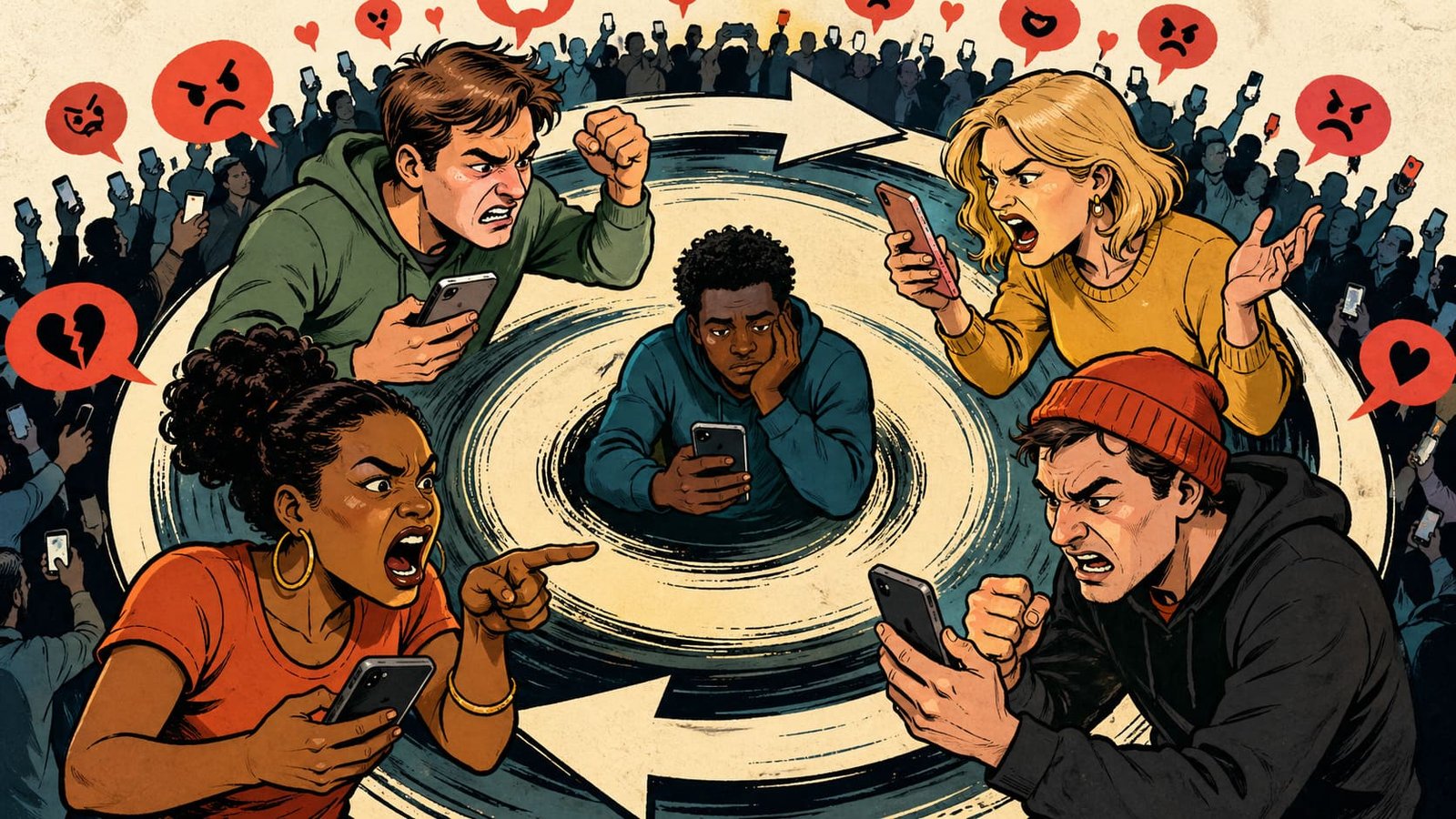
A headline flashes across a crowded feed, sharp enough to stop a thumb mid-scroll. The outrage arrives almost instantly, a wave of reactions building before the full story is even understood. Comments stack, voices rise, judgments form with a speed that feels both impressive and unsettling. Then, just as quickly, the moment fades. Another headline replaces it. Another wave begins. The previous storm dissolves without resolution, as if it never fully happened.
The cycle feels familiar because it is constant. Outrage has become a rhythm, not an exception. It thrives on immediacy, on the rush of reacting before reflecting. Social platforms amplify this rhythm, rewarding content that provokes strong emotional responses. Anger spreads quickly. So does moral certainty. Together, they create an environment where each new issue feels urgent, even as the last one slips quietly out of focus.
A communications consultant named Farah noticed this pattern while managing a brand crisis for a retail company. A controversial incident sparked intense backlash online. The team worked through the night, preparing statements, addressing concerns, monitoring sentiment. The pressure felt overwhelming. Then, within days, attention shifted to a completely different story. The outrage moved on, leaving behind a trail of unresolved questions. Farah realized something unsettling. The intensity of the reaction did not guarantee its longevity.
This dynamic shapes not only public discourse but also personal perception. A university lecturer named David observed how his students engaged with current events. They were informed, passionate, quick to respond. Yet when asked to revisit issues from weeks earlier, many struggled to recall details. The constant influx of new controversies made it difficult to sustain attention on any single topic. Awareness became broad but shallow, reactive rather than reflective.
The media landscape reinforces this pattern. News outlets compete for attention in a crowded digital space. Stories that generate strong reactions often receive more visibility, encouraging a focus on immediacy over depth. This does not mean that journalists lack integrity. It reflects the pressures of an environment where engagement metrics influence editorial decisions. The result is a steady stream of high-intensity stories that rarely linger long enough for deeper understanding to take root.
A social media manager named Lucas experienced this from the inside. His role involved tracking trending topics and aligning content with what people were already discussing. He noticed how quickly narratives shifted. A story that dominated conversation in the morning could be nearly invisible by evening. The strategy was simple. Stay current. Move fast. Do not dwell. It kept engagement high, but it also created a sense of constant urgency that felt difficult to escape.
Pop culture mirrors this cycle in subtle ways. Public figures often find themselves at the center of intense scrutiny, only for attention to shift just as quickly. A celebrity controversy might dominate headlines for a brief period, sparking debates and strong opinions. Then a new story emerges, redirecting focus. The previous issue fades, not because it was resolved, but because something else captured attention more effectively. The pattern repeats, reinforcing the idea that outrage is temporary, even when the underlying issues are not.
There is a psychological comfort in this constant movement. Each new wave of outrage offers a sense of participation, a feeling of being engaged with important issues. It creates a shared experience, a collective reaction that feels meaningful in the moment. Yet it can also lead to fatigue. The repetition of intense emotional responses without sustained resolution can leave people feeling overwhelmed, even disconnected.
A journalist named Amina once described the experience as “chasing echoes.” She covered multiple breaking stories in quick succession, each demanding immediate attention. By the time she began to understand one issue in depth, another had already taken its place. The work felt important, but also fragmented. The constant shift made it difficult to follow through, to see how stories evolved beyond their initial impact.
The deeper tension lies in how this cycle shapes collective memory. When attention moves quickly, memory becomes short. Issues that require sustained focus risk being overshadowed by those that generate immediate reaction. This does not diminish their importance, but it does affect how they are perceived and addressed. The pace of outrage can outstrip the pace of meaningful change.
Somewhere in a crowded café, a young professional named Kevin scrolls through his feed, reacting to one story after another. Each moment feels significant, each response justified. Yet by the end of the day, the details blur. The emotions linger, but the specifics fade. It becomes harder to distinguish between what mattered deeply and what simply moved quickly.
In a world where attention is constantly redirected, outrage continues to loop, feeding on its own momentum. It creates a sense of urgency that rarely resolves, a cycle that feels both engaging and exhausting. The pattern persists because it aligns with how platforms are designed and how people respond within them.
And within that endless loop, a quiet realization begins to form. The ability to move on quickly can feel like resilience, but it can also mean forgetting what deserved to be remembered.
You react, you move on, you react again, and somewhere in that repetition, you must decide whether outrage is driving change or simply keeping you in motion.
