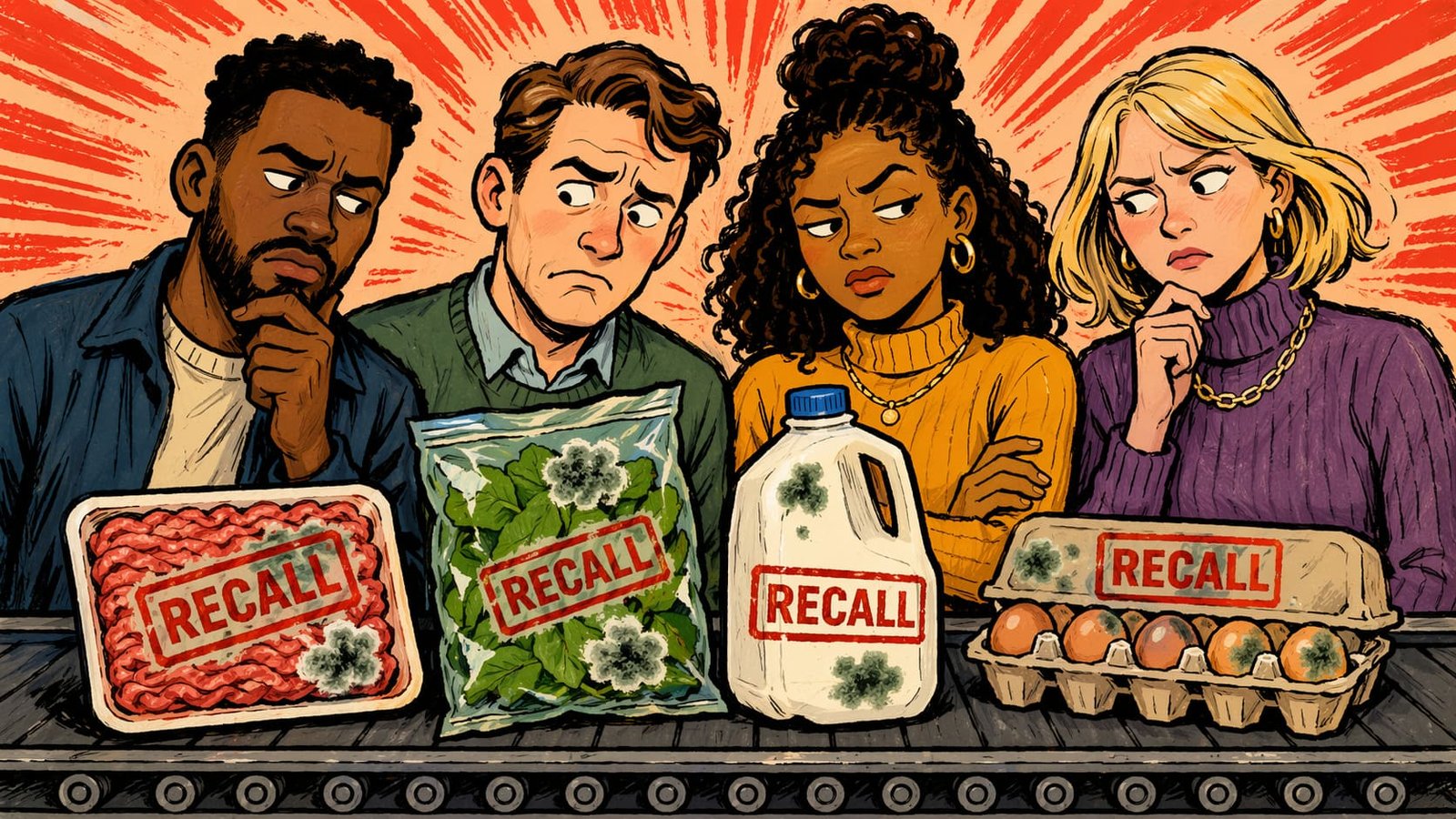
A warehouse hums under fluorescent light, pallets stacked in geometric confidence, labels clean, dates precise, systems aligned. Somewhere inside that order, a single batch slips through unnoticed, a minor deviation, a microscopic presence that will travel farther than intention. Days later, a notification appears on a phone screen, a quiet alert that interrupts routine: a product has been recalled. The message feels small, almost administrative. The implication is not.
Modern food systems are built on scale, and scale carries both efficiency and fragility. You walk through a supermarket and see abundance arranged with reassuring symmetry. Every shelf suggests control. Yet behind that surface lies a network stretched across regions, climates, and regulations. When something goes wrong, it does not stay contained. It moves, quietly at first, then all at once. Organizations like U.S. Food and Drug Administration and Centers for Disease Control and Prevention monitor these events, tracing patterns, issuing advisories, attempting to contain what has already begun to spread.
There is a particular unease in the way recalls arrive. They rarely announce themselves with drama. A headline here, a notice there, a list of products identified by codes that most people never check. You might discover it by chance, scrolling, or hear it mentioned in passing. The gap between exposure and awareness creates a subtle tension. You have already consumed before you are informed. The timeline moves faster than your attention.
A supply chain analyst named Victor once described the system as “precise until it isn’t.” He spent years optimizing distribution routes, reducing delays, increasing efficiency. One incident shifted his perspective. A contamination issue in a processing facility led to a recall that spanned multiple states. Victor watched as the system he admired for its coordination became a pathway for rapid spread. “The same design that makes it work also makes it vulnerable,” he said, almost to himself.
This vulnerability is not new, but it feels more visible now. As food travels further, passes through more hands, and integrates into more complex systems, the points of potential failure multiply. A single oversight can ripple outward. The scale amplifies both success and error. What once might have been a local issue becomes a national concern.
A restaurant owner named Amara felt this shift in a deeply personal way. She built her business on trust, sourcing ingredients carefully, maintaining strict standards. One afternoon, she received a notice about a recalled ingredient that had already been used in several dishes. The response was immediate. She closed for the day, contacted customers, discarded inventory. The financial impact was significant, but what stayed with her was something else. “People look at you differently after that,” she said. “Even when it isn’t your fault.”
Trust, once questioned, does not return instantly. It rebuilds slowly, through consistent action, through transparency, through time. In the context of food, trust is intimate. It enters the body. It becomes part of you. When that trust is disrupted, even briefly, it leaves a residue that is difficult to name but easy to feel.
Consumers respond in varied ways. Some become more cautious, checking labels, following updates, adjusting habits. Others feel a sense of resignation, accepting that risk is part of modern life. The supermarket remains full, the routines continue. Yet beneath that continuity, awareness shifts slightly. A quiet calculation begins to accompany choice.
A mother named Elena described a moment that captures this shift. She stood in a grocery aisle, reading a recall notice on her phone while holding the same product in her hand. She hesitated, then placed it back. It was a small decision, almost invisible to anyone around her. Yet it marked a change in perception. “I never used to think twice,” she said later. “Now I do.”
The industry has responded with increased monitoring, improved tracing systems, more transparent communication. Technology plays a role, allowing faster identification of issues, quicker dissemination of information. These developments matter. They reduce harm, limit spread, restore confidence. Yet they also highlight the complexity of the system. The need for constant vigilance becomes part of the narrative.
A food safety consultant named Rajiv once explained the paradox to a group of executives. “We are better at detecting problems now,” he said. “So it may feel like there are more of them.” His point was clear. Visibility can create the impression of increased risk, even as systems improve. The challenge lies in balancing awareness with perspective, caution with trust.
There are also broader cultural implications. Food has always carried meaning beyond sustenance. It represents care, tradition, connection. When recalls become more visible, they intersect with these meanings. A meal is no longer just a moment of nourishment. It carries a layer of consideration, a quiet awareness of the system behind it.
A small scene brings this into focus. A group of friends gathers for dinner, laughter filling the room, plates shared, stories exchanged. At one point, someone mentions a recent recall. The conversation pauses briefly, then moves on. The moment is fleeting, yet it leaves a trace. The awareness lingers, even as the meal continues.
In professional kitchens, the response is often more immediate. Chefs adjust sourcing, verify suppliers, implement stricter checks. The work becomes more meticulous, more attentive. A chef named Luca described it as “cooking with one eye on the plate and one eye on the process.” The craft expands to include not just flavor, but assurance.
The economic dimension cannot be ignored. Recalls carry costs, both direct and indirect. Products are removed, reputations affected, systems reviewed. Companies invest in prevention, in communication, in rebuilding trust. The cycle continues, shaped by both necessity and expectation.
Yet despite these complexities, people continue to eat, to gather, to share meals. The act of eating remains deeply human, resistant to reduction. The system evolves, adapts, responds. The tension between scale and safety persists, not as a flaw to be eliminated entirely, but as a reality to be managed.
In a quiet kitchen late at night, a refrigerator hums softly, shelves holding ingredients chosen with care. The labels are read more closely now, the sources considered more deliberately. The ritual of preparation carries a slightly different weight, not heavier, but more conscious.
A plate is set, a meal begins, and the familiar comfort returns, layered with a new kind of awareness. The question does not interrupt the experience, but it sits nearby, patient, unresolved, part of the background now.
And in that space between trust and caution, a thought settles with quiet persistence, almost like a flavor that lingers longer than expected:
When the system that feeds you becomes too large to see, how do you decide what still deserves your trust?
