A fire burns low beneath a suspended cut of meat, its edges darkening, releasing a scent that feels older than language. Around it, figures gather without speaking, drawn by something instinctive. Hunger, yes, but not only hunger. There is ritual here, a gravity that turns eating into something closer to ceremony. The scene feels ancient and modern at once, as if the appetite itself has traveled intact across centuries, carrying with it more than taste.
Beef, in particular, has always occupied a strange position in that story. It is not just food. It is signal. It suggests abundance, power, control over land and resources. Across cultures, the presence of beef often marks a shift from survival to dominance. Where cattle thrive, systems of ownership emerge. Where ownership expands, hierarchies follow. The plate becomes a quiet reflection of something much larger.
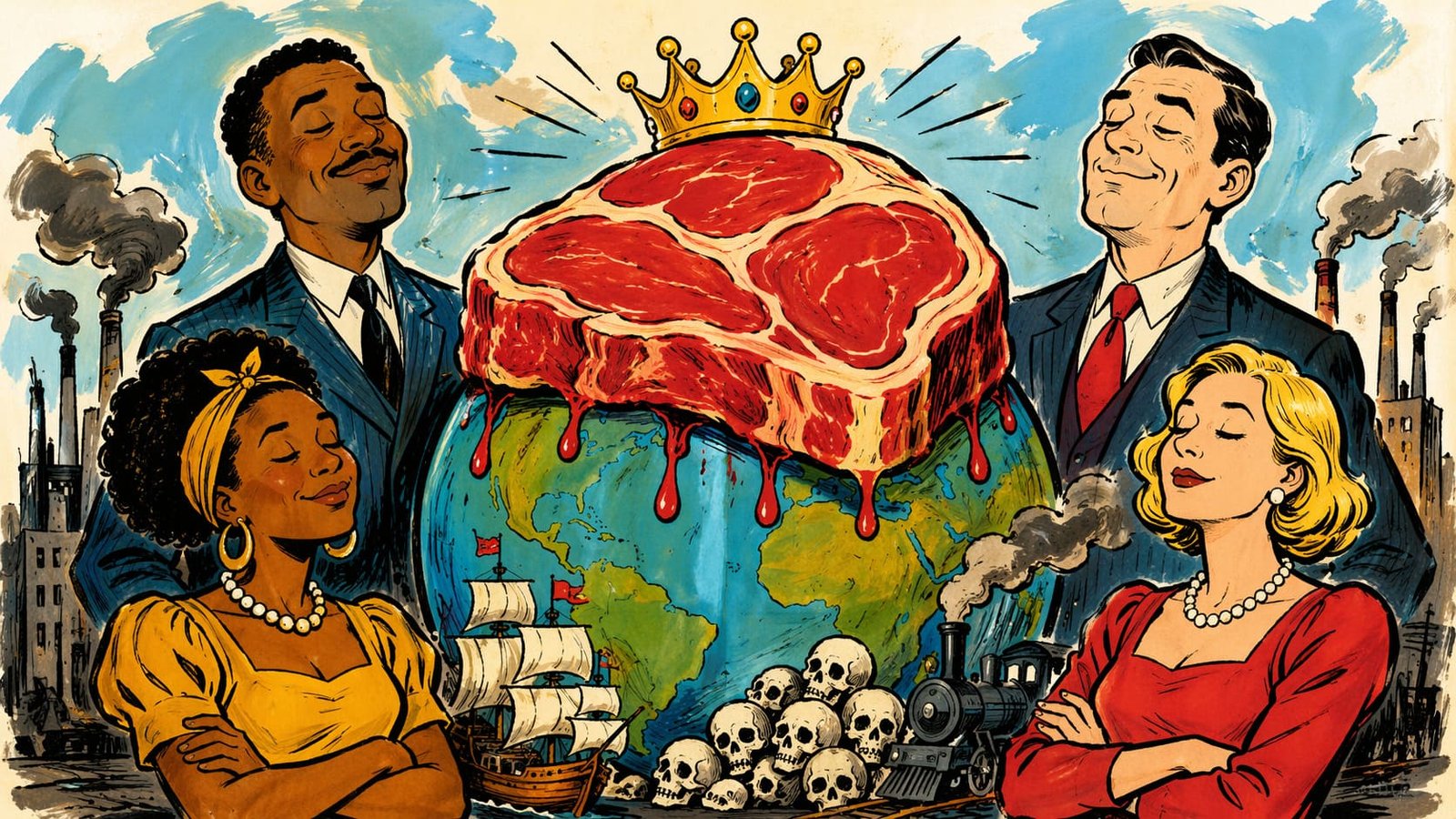
The rise of beef consumption is deeply tied to the expansion of empires. In regions where cattle could be raised at scale, land became more than territory. It became infrastructure. Fields were cleared, ecosystems reshaped, and labor organized around the production of a single resource. The appetite for beef did not simply respond to these changes. It drove them. Demand created pressure. Pressure reshaped landscapes.
Consider Javier, a rancher whose family land stretches across a dry plain that once held dense vegetation. Stories passed down through generations describe a different environment, one filled with diversity and unpredictability. Over time, that complexity was replaced with uniformity. Grasslands optimized for grazing. Systems designed for efficiency. Javier speaks of pride in sustaining a legacy, but also of a quiet awareness that something was traded in the process. The land feeds, but it also remembers.
The global spread of beef is also a story of cultural influence. Diets do not travel alone. They carry values, aspirations, and identities. As Western eating habits expanded through trade, colonization, and media, beef became associated with progress. It symbolized a certain kind of modern life, one defined by access and choice. In many places, adopting that diet felt like stepping into a new world. Yet the cost of that transition often remained hidden, absorbed into distant supply chains.
A food historian named Dr. Sidney Mintz once noted that what people eat reveals how societies organize themselves. Beef, in this sense, is a lens. It exposes the relationship between consumption and control. It shows how preferences are shaped not only by taste, but by systems of production that operate far from the table. The steak appears simple. The network behind it is anything but.
There is also an economic dimension that cannot be ignored. Entire industries have formed around the production, processing, and distribution of beef. Jobs, infrastructure, and national policies are tied to its success. In countries where cattle farming dominates, the industry becomes a pillar of stability. Challenging it feels less like a dietary choice and more like a structural shift. This is why conversations around meat consumption often carry a weight that extends beyond nutrition.
A young entrepreneur named Leila once attempted to introduce alternative protein products into a market deeply rooted in beef culture. Her approach was thoughtful, her messaging careful. Initial curiosity gave way to resistance. Customers did not reject the product because of taste alone. They resisted what it represented. A departure from tradition. A questioning of identity. Leila realized that changing what people eat requires engaging with what that food means to them, not just how it tastes.
The environmental impact of beef production has become a central part of modern discourse. Conversations around land use, water consumption, and emissions have placed the industry under scrutiny. Yet these discussions often struggle to translate into widespread behavioral change. Information alone rarely shifts habits that are deeply embedded in culture. The tension between awareness and action remains unresolved, creating a space where contradictions thrive.
There is a certain irony in how beef is both celebrated and questioned in the same breath. It appears in moments of indulgence, in celebrations, in symbols of achievement. At the same time, it is scrutinized for its broader implications. This duality reflects a deeper conflict between desire and responsibility. People are drawn to what feels satisfying, even when they understand the complexity behind it.
In a bustling urban kitchen, a chef carefully plates a dish centered around a perfectly cooked cut of beef. The presentation is precise, almost reverent. Diners admire it, photograph it, share it. For a moment, the experience feels complete. Yet beyond the walls of that restaurant, the chain of production continues, stretching across fields, facilities, and systems that remain largely unseen. The beauty of the plate contrasts with the scale of the process that made it possible.
The story of beef is not simply about food. It is about how appetite shapes the world. It reveals how individual choices connect to collective outcomes, often in ways that are difficult to trace. It challenges the idea that consumption is a neutral act. Every preference carries weight. Every habit leaves an imprint.
As the fire burns lower and the gathering begins to disperse, the remnants of the meal linger. The satisfaction is real, immediate, undeniable. Yet so is the quiet awareness that something larger has been touched, something that extends far beyond the moment itself.
In that lingering silence, a question remains, steady and uncomfortably clear: when appetite builds empires, what does it ask in return from the world that feeds it?
