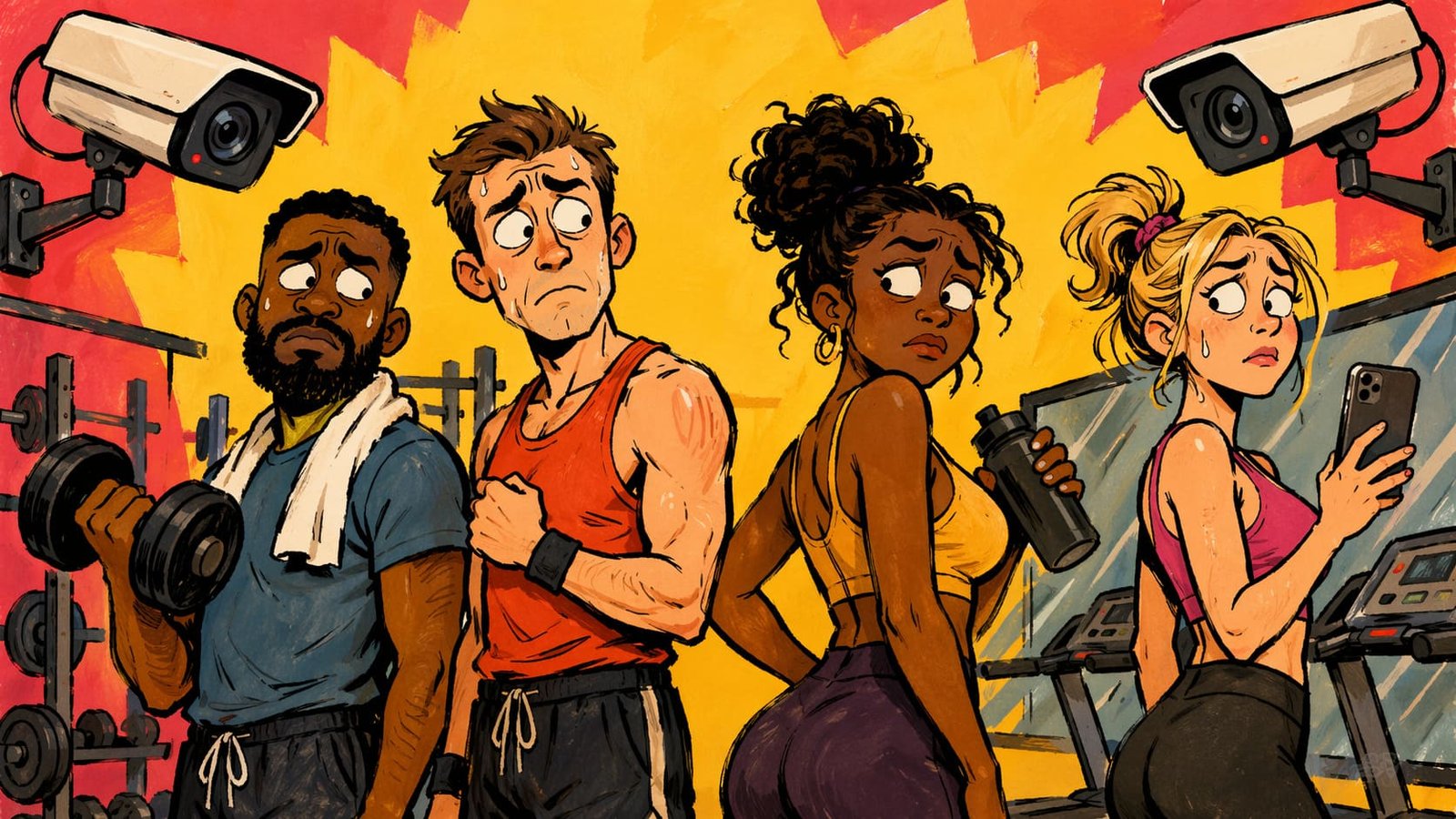
The mirrors used to be enough. Long walls of reflection, slightly warped, catching movement from angles no one fully trusted. Now the mirrors share space with lenses, tiny, patient, everywhere. A phone rests against a water bottle, tilted just right. A tripod unfolds like a quiet declaration. Someone steps into frame, adjusts posture, checks lighting, begins again. The gym hums with effort, yet something else pulses underneath it, a thin current of awareness that never quite switches off. Every repetition carries a second question: how does this look?
Fitness once promised privacy inside exposure. You were seen, but not recorded. You sweated, strained, failed a lift, recovered, all within a fleeting audience that dissolved as quickly as it formed. That temporary visibility made room for awkwardness, for growth that did not need to be documented. Now the boundary has shifted. Platforms like TikTok and Instagram have turned physical effort into shareable content. The gym is no longer just a place to train. It is a place to produce.
The shift sounds harmless at first. Recording progress, sharing routines, building community. These are real benefits. Yet the presence of cameras alters behavior in ways that are difficult to fully notice. Movement becomes slightly more deliberate. Expressions tighten, then soften, then reset. Rest periods stretch just long enough to review footage. The body is no longer just a body. It becomes an image in motion, something to be shaped not only for strength, but for perception.
Arjun, a finance analyst in Mumbai, started filming his workouts to track progress. It felt practical, even disciplined. Over time, he noticed a subtle change. He began choosing exercises that looked impressive rather than those that felt effective. His sessions grew longer, not because of intensity, but because of retakes. One evening, after a particularly polished clip, he realized he had spent more time framing the lift than actually lifting. The realization lingered longer than the workout itself.
There is a psychological loop at play, one that feeds on visibility. When effort is observed, it gains a different kind of weight. Validation arrives through views, likes, comments, small signals that something has been recognized. That recognition can motivate, but it also redirects attention. The goal shifts from internal progress to external approval. The mirror reflects the body. The camera reflects the audience.
This dynamic does not affect everyone in the same way, but it creates a shared atmosphere. Even those who do not record feel the presence of those who do. A young woman pauses mid-set, noticing a phone angled nearby, unsure if she is in the frame. A beginner hesitates before trying a new movement, aware that mistakes might be captured. The gym, once a space for imperfect effort, becomes subtly charged with the possibility of exposure.
Pop culture has leaned into this transformation with surprising speed. Fitness influencers build entire identities around their routines, blending discipline with performance in ways that feel both inspiring and intimidating. Figures like Kayla Itsines have shaped how millions approach exercise, turning workouts into narratives that can be followed, replicated, shared. The line between guidance and spectacle grows thinner with each scroll.
There is also a quieter, more intimate cost. When attention turns outward, the connection to the body itself can weaken. Instead of feeling a movement, people begin to watch themselves perform it. The focus shifts from sensation to appearance, from strength to symmetry, from effort to outcome. This creates a kind of distance that is difficult to articulate but easy to feel. The body becomes something to manage rather than inhabit.
Lina, a physiotherapist in Stockholm, noticed this change among her clients. Injuries that once came from overexertion now often stemmed from imitation, people attempting movements they had seen online without fully understanding them. She described sessions where clients spoke more about how an exercise looked than how it felt. The language had shifted. Form was discussed in visual terms, not physical ones.
The economics of attention reinforce this pattern. Content that is visually striking travels further. Complex, subtle, less photogenic work struggles to compete. This creates an incentive structure where performance is rewarded more than process. The danger is not just superficiality. It is misalignment. What gets attention is not always what builds strength, resilience, or long-term health.
Yet the story is not entirely bleak. Some spaces are beginning to push back, creating environments where recording is limited or discouraged. In these rooms, the atmosphere changes almost immediately. Movements loosen. Conversations feel less guarded. Mistakes are made more freely, and learning accelerates in a quieter, less visible way. The absence of cameras does not reduce effort. It deepens it.
There is also a growing awareness among individuals who choose to film, a recognition that intention matters. Some use cameras as tools rather than stages, focusing on technique, education, or personal tracking without slipping into constant performance. The difference is subtle but significant. It lies in whether the camera serves the workout or the workout serves the camera.
The tension remains unresolved, suspended between two impulses. One pulls toward visibility, connection, shared experience. The other pulls toward privacy, presence, internal focus. Both have value. The challenge is not choosing one over the other, but navigating the space between them without losing something essential.
Somewhere, in a corner of a brightly lit gym, someone finishes a set without recording it, breathing heavy, attention fully anchored in the body. Nearby, another person adjusts a phone, capturing the same movement from a better angle. The sounds overlap, metal, breath, music, a rhythm that belongs to both realities at once.
And within that overlap, a quieter question begins to press forward, one that does not resolve easily: when every effort is shaped for an audience, who is the body actually working for?
