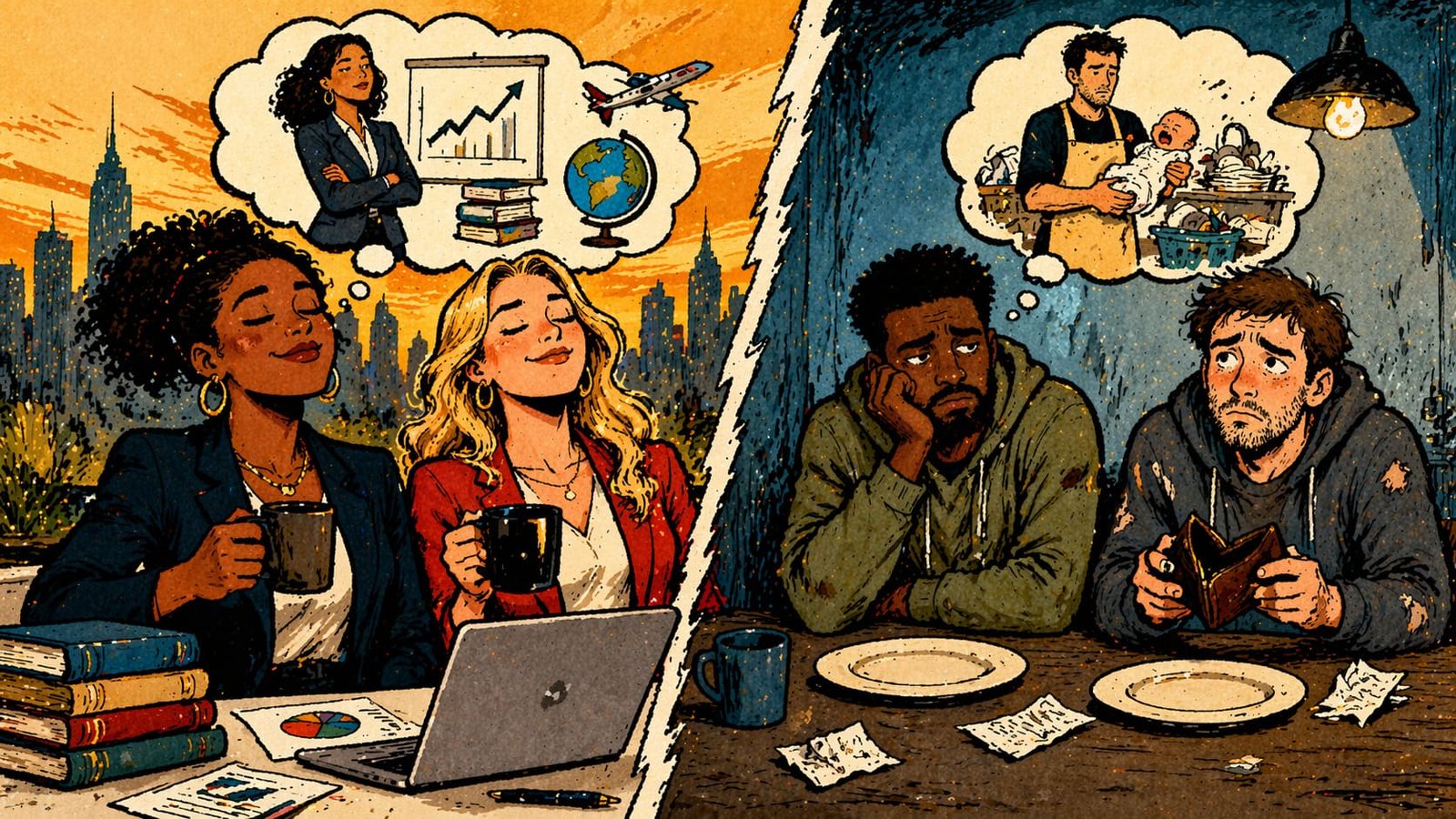
The room is quiet, but not peaceful. It carries the weight of something unspoken, like a sentence that began decades ago and was never finished. A man sits at the edge of a routine that once promised direction. Work, provide, protect. The structure was clear, almost comforting in its simplicity. Now it flickers, unstable, like a signal losing strength. The instructions remain, but the world that made them useful has changed.
For generations, masculinity came with a script that required little interpretation. Value was tied to output, identity to responsibility, respect to provision. The system rewarded consistency. Men who followed the path found recognition, even if it came at a cost. The cost was rarely discussed. It was absorbed, normalized, passed down.
Then the ground shifted. Economic structures evolved, industries transformed, and the nature of work itself became less predictable. The provider model, once central, no longer guarantees stability or status. Roles that felt permanent began to dissolve. The script did not disappear, but it stopped aligning with reality.
This misalignment creates a specific kind of tension. Expectations remain high, but the pathways to meet them are less clear. A man is still expected to succeed, but success itself has become harder to define. The metrics have changed without a clear announcement. The result is a quiet confusion that often goes unspoken.
Cultural narratives amplify this tension. Traditional archetypes persist in subtle ways, even as they lose relevance. Films like Fight Club captured an early version of this disorientation, portraying men grappling with a loss of purpose in a consumer-driven world. What once felt exaggerated now reads like a familiar undercurrent.
You can see the effects in everyday life. Men working longer hours without the same sense of progression. Careers that feel temporary rather than foundational. Relationships that no longer rely on traditional roles, requiring a different kind of contribution that is less clearly defined. The old markers of success do not carry the same weight.
David, a mid-level manager in a logistics company, once described a moment that unsettled him. He had followed the expected path. Stable job, steady income, predictable growth. Yet he found himself feeling replaceable, not just in his role, but in the broader sense of identity. The work paid the bills, but it did not anchor him. He realized he had built a life around a structure that no longer guaranteed meaning.
This is where the concept of “hunger” emerges, not as a lack of resources, but as a lack of direction. A sense that something essential is missing, even when external conditions appear stable. It is a hunger for relevance, for clarity, for a role that feels earned rather than inherited.
The shift in gender dynamics adds another layer. As women gain independence and redefine their own roles, the traditional expectations placed on men lose their automatic significance. Relationships become more balanced, but also more complex. Contribution is no longer assumed. It must be negotiated.
A startup founder once observed this change within his team. Male employees who excelled technically struggled with aspects of collaboration that required emotional awareness. The skills that once guaranteed advancement were no longer sufficient. The company adapted its leadership training, emphasizing communication and adaptability. Some thrived. Others resisted, clinging to familiar patterns.
This transition is not purely external. It requires an internal recalibration that many are still navigating. The shift from defined roles to self-directed identity is not straightforward. It demands reflection, experimentation, and a willingness to confront uncertainty without a clear roadmap.
Pop culture continues to explore this theme. Figures like Dwayne Johnson present a version of masculinity that blends strength with openness, suggesting an evolution rather than a rejection of traditional traits. The appeal lies in balance, not dominance.
Yet the broader conversation often lacks nuance. Discussions about masculinity can become polarized, reducing complex experiences to simplified narratives. This leaves many men without a clear framework to understand their own position. The absence of guidance can lead to frustration or withdrawal.
A small community initiative focused on mentorship offers a glimpse of a different approach. Older professionals meet regularly with younger men, not to impose a specific path, but to share experiences and explore possibilities. The conversations are informal, sometimes awkward, often revealing. Over time, patterns emerge. The need for purpose, for connection, for a sense of contribution that goes beyond traditional metrics.
This suggests that the failure is not of men themselves, but of the structures that once defined their roles. When those structures weaken, the responsibility shifts inward. Identity becomes something to build rather than inherit. This can be empowering, but it also requires effort that was previously unnecessary.
The economic landscape reinforces this shift. Gig work, remote roles, and evolving industries create opportunities but also instability. The idea of a single, lifelong career becomes less common. Adaptability becomes essential. The challenge is maintaining a sense of continuity within constant change.
There are moments where the old script still surfaces. Family expectations, cultural norms, internalized beliefs. They appear in subtle ways, shaping decisions and perceptions. Letting go of these patterns is not immediate. It requires conscious effort, often repeated over time.
A quiet evening in a modest apartment reveals this tension. A man sits reviewing his day, not just in terms of tasks completed, but in terms of meaning derived. The metrics are different now. They include relationships, personal growth, moments of clarity. The shift feels unfamiliar, but necessary.
This is where a new narrative begins to take shape. One that does not rely solely on provision or protection, but incorporates a broader range of contributions. Emotional presence, adaptability, continuous learning. The definition of value expands.
The hunger does not disappear. It transforms. It becomes a drive to define purpose on one’s own terms, to build a life that aligns with both internal and external realities. This is not a simple process. It involves trial, error, and a willingness to accept ambiguity.
Somewhere, in the quiet after another day shaped by shifting expectations, a realization settles. The script was never meant to be permanent. It was a starting point, not a destination.
And in that space, uncertain but open, the possibility emerges to write something new, not inherited, but chosen, not fixed, but evolving.
