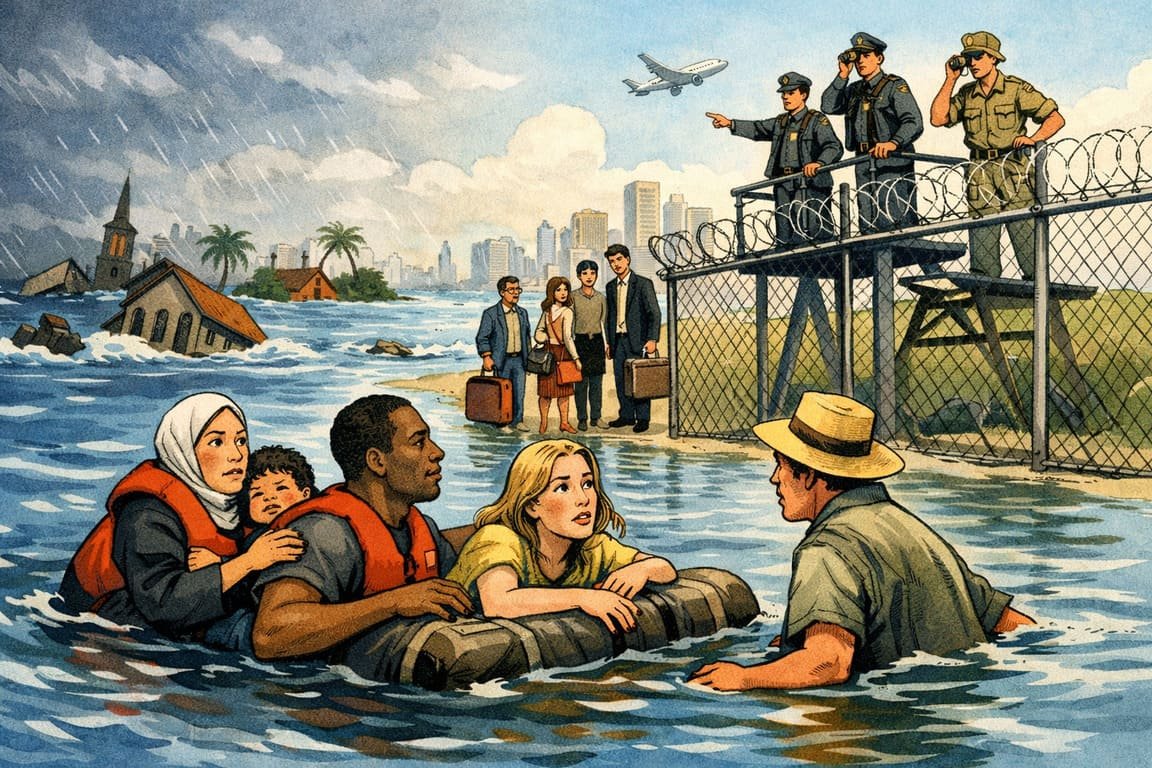
The water does not rush in dramatically. It arrives patiently. Streets flood one season earlier than expected. Wells taste wrong. Crops fail quietly. By the time evacuation becomes a headline, the decision to leave has already been made a thousand times in private. Climate displacement does not announce itself like war. It erodes life until staying feels reckless. Entire nations are discovering that borders mean little when the land itself begins to move.
For years, migration debates focused on conflict, poverty, or ideology. Climate change stayed framed as future risk, a slow burn for later generations. That framing collapsed as coastlines retreated, droughts deepened, and storms rewrote maps faster than policy could respond. Movement stopped being optional. Families left not because they wanted opportunity elsewhere, but because survival demanded it.
What makes climate refugees different is the absence of an enemy to negotiate with. There is no regime to overthrow, no ceasefire to sign. The forces pushing people from their homes respond only to physics. Rising seas do not pause for elections. Heat does not respect sovereignty. This reality breaks legal frameworks built around blame and persecution. People are displaced without fitting existing categories, leaving them exposed and invisible.
Host nations struggle to process this shift honestly. Politicians search for language that avoids responsibility. Climate arrivals are often folded into broader migration narratives, stripped of context. Fear fills the gap where clarity should live. Infrastructure strains become political weapons. The conversation hardens before empathy has a chance to surface.
A fictional island administrator once described watching relocation ships depart at dawn. No protests. No speeches. Just families carrying documents sealed in plastic, unsure whether return was possible. The quietness unsettled observers more than chaos ever could. Climate displacement lacks spectacle, which makes it easier to ignore and harder to explain.
Culturally, these movements reshape societies in subtle ways. Languages blend in classrooms. Food traditions travel inland. Memories of lost coastlines become bedtime stories. Receiving communities gain richness, yet also face identity anxiety. When change arrives without warning, people search for stability in familiar lines. Belonging becomes a contested space.
Policy responses remain fragmented. International law lags behind reality. Temporary visas and humanitarian exceptions offer short term relief, not long term security. Wealthier nations debate thresholds while neighboring regions absorb disproportionate impact. The imbalance exposes uncomfortable truths about responsibility and fairness in a warming world.
Philosophically, climate refugees challenge the idea of permanence itself. Civilization assumed stable geography. Cities grew where rivers behaved. Borders hardened around landscapes that cooperated. That assumption no longer holds. Movement becomes a structural feature of the future, not an anomaly. Adaptation replaces containment as the central political challenge.
There are glimpses of a different approach. Some regions plan relocation early, moving communities together rather than scattering individuals. Cultural continuity is treated as infrastructure. Dignity becomes a design principle. These efforts require foresight, funding, and humility. They succeed quietly, without spectacle, which is why they are rarely discussed.
Denial remains powerful. Some leaders promise walls against rising seas. Others speak of restoration without acknowledging loss. This refusal delays preparation and deepens trauma. Climate change does not negotiate. Every year spent denying reality narrows the range of humane options.
Media framing plays a decisive role. Climate displacement is often presented as future crisis rather than present condition. That delay distorts urgency. By the time numbers force attention, responses turn reactive and harsh. Early visibility invites planning. Late recognition invites panic.
Children adapt faster than adults. They learn new accents, new schools, new routines with unsettling ease. Elders carry landscapes in memory that may never exist again in familiar form. Between those generations sits grief and resolve in equal measure. Movement reshapes identity long after relocation ends.
As night settles over resettled neighborhoods far from the coasts that once defined them, conversations drift between loss and persistence. Borders still exist on maps, but reality redraws them daily. Climate refugees are not an exception waiting to be solved. They are the first signal of a world adjusting to limits it can no longer deny. And as nations confront this rising tide of humanity, one question presses forward with quiet insistence: when the planet itself forces people to move, will compassion arrive before fear decides who belongs where?
