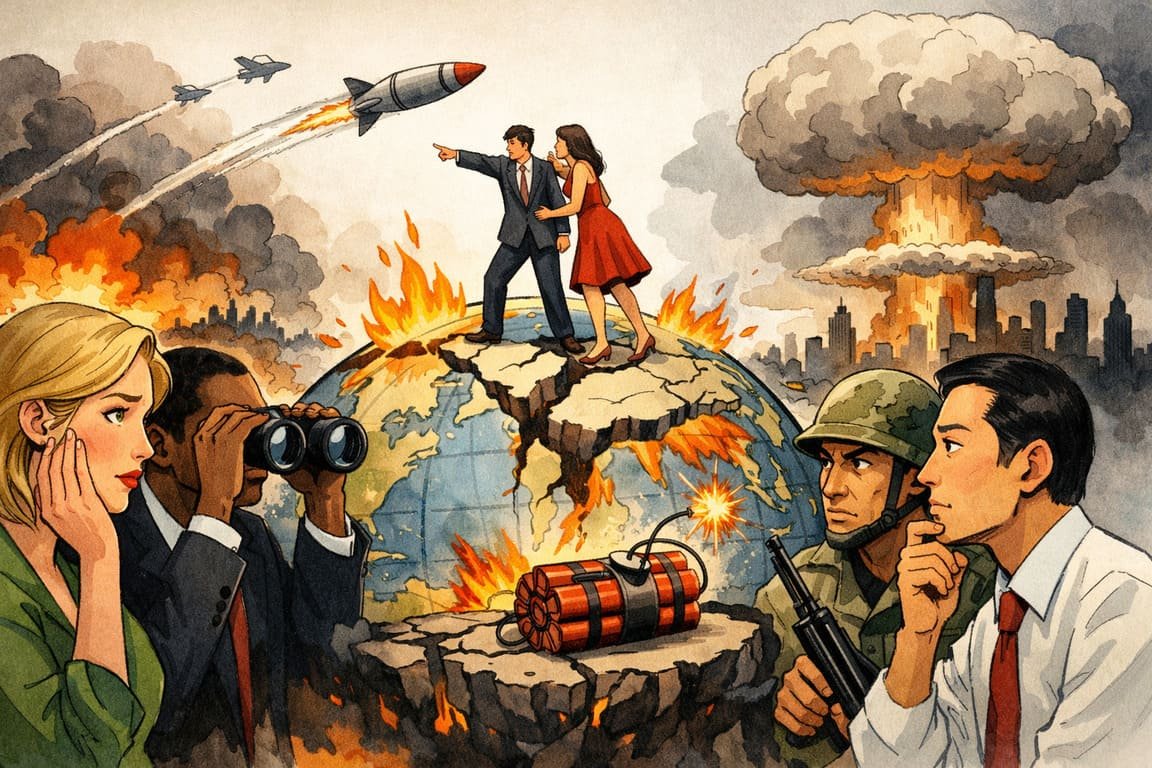
The world looks steady on the surface. Markets open on time. Flights depart. Cafés hum with ordinary conversation. Nothing appears urgent enough to justify panic. Yet beneath this calm, pressure accumulates quietly, like a fault line absorbing strain without sound. War no longer announces itself with speeches or mobilization. It grows inside assumptions, buried within routines that treat escalation as manageable until it suddenly is not.
Modern conflict rarely declares its intentions. It tests them. Cyber intrusions probe defenses. Sanctions tighten slowly. Drones hover without crossing lines. Each move is framed as limited, reversible, controlled. The danger lies in that language. When aggression wears the mask of caution, restraint weakens. War no longer feels like a leap. It feels like a series of reasonable steps.
Great power rivalry has returned without the guardrails that once contained it. Earlier standoffs operated under shared fears and understood red lines. Today, those lines blur under ambiguity. Influence campaigns, proxy conflicts, and economic coercion overlap constantly. Each side assumes the other understands the rules. History shows that assumption collapses precisely when confidence peaks.
Regional conflicts add weight to the system. Local wars rarely remain local for long. Alliances entangle gradually. Advisors arrive quietly. Weapons flow discreetly. Interests overlap until withdrawal feels costly. Escalation accumulates without a single decisive moment. When conflict spreads, leaders struggle to identify when the point of no return was crossed.
Technology accelerates risk in ways that feel invisible. Autonomous systems compress decision time. Artificial intelligence speeds threat assessment while narrowing reflection. When alerts arrive faster than deliberation, hesitation becomes weakness. Speed gets rewarded. Caution looks obsolete. The margin for human judgment shrinks with every upgrade.
Economic interdependence once promised restraint. War would hurt everyone, so everyone would avoid it. That logic erodes as decoupling gains popularity. Supply chains get redesigned for resilience rather than efficiency. Pain becomes distributed. When economic cost feels survivable, deterrence weakens. Conflict appears affordable again.
Public discourse intensifies volatility. Outrage travels faster than evidence. Strength gets rewarded. Nuance struggles for oxygen. Leaders face pressure to respond instantly, not wisely. A single incident can dominate attention, demanding action before facts settle. Politics becomes reactive. War thrives on reaction.
Psychology shapes decisions more than strategy admits. Fear distorts perception. Pride resists compromise. Humiliation demands response. These emotions operate behind closed doors where language turns sharp and patience thins. A negotiator once described talks collapsing not over substance, but over tone. Tone shifts history more often than policy does.
Institutions designed to prevent war strain under acceleration. International bodies rely on consensus while crises demand speed. Veto power paralyzes response. Trust erodes. When systems stall, unilateral action feels justified. That justification spreads. Norms weaken without announcement.
Despite this, war remains deeply unpopular. Societies remember cost, even if memory fades at the edges. Veterans carry weight statistics cannot capture. Families absorb loss long after headlines move on. This collective memory still restrains leaders, even as rhetoric hardens. Peace persists not because it is easy, but because pain is remembered.
Warning signs hide in plain sight. Expanding military budgets. Normalized threats. Exercises framed as defense but read as rehearsal. Each step feels rational in isolation. Together, they tighten the spiral. The most dangerous moments in history rarely felt dramatic at the time. They felt manageable.
The unsettling truth is that war rarely begins with intent. It begins with confidence. Confidence that escalation can be controlled. Confidence that the other side will blink. Confidence that systems will hold. They fail when everyone shares that belief simultaneously.
Somewhere, a control room glows softly, operators watching signals that might mean nothing or everything. The world balances between routine and rupture. What determines the future is not weaponry alone, but restraint, humility, and the willingness to slow down when speed feels tempting, because the wars that devastate civilizations often start not with hatred, but with the calm assurance that nothing will go wrong.
