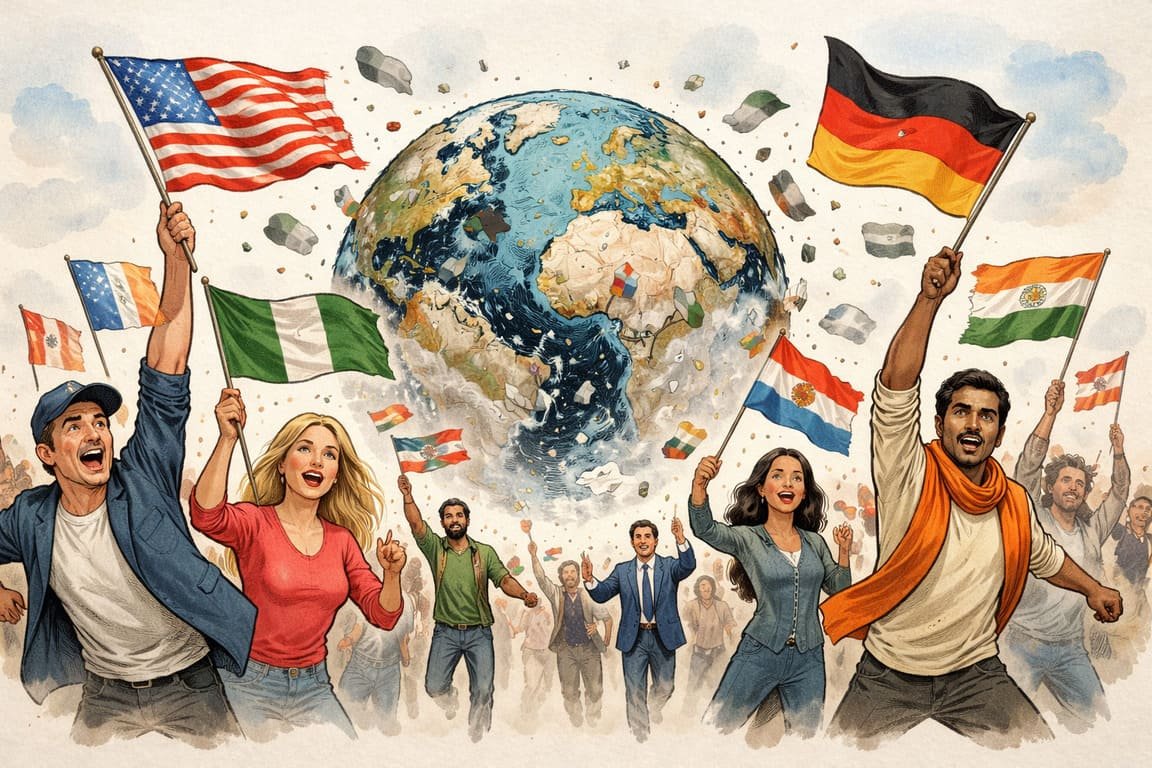
The terminal looks identical to a hundred others, polished floors, muted lighting, announcements spoken in careful neutrality. It is designed to feel nowhere and everywhere at once. Yet beyond the sliding doors, the mood has shifted. Flags appear more frequently. Speeches sound sharper. The language of borders, belonging, and protection has returned with urgency. The borderless dream promised ease and prosperity. Instead, many feel unmoored, and they are reaching for something that feels solid again.
Globalism once carried the weight of inevitability. Markets would integrate. Trade would soften conflict. Cultural exchange would flatten old prejudices. For a time, the story held. Goods moved cheaply. Capital flowed freely. Growth charts climbed. Yet beneath the aggregate success, fractures spread unevenly. Some regions flourished while others hollowed out. The gains felt distant. The losses felt personal.
Communities that lost factories to global efficiency did not experience globalism as progress. They experienced it as disappearance. Jobs vanished faster than retraining programs arrived. Skills passed down through generations lost value overnight. Promises of future opportunity sounded thin against present bills. Resentment grew quietly, then publicly. National pride surged not as nostalgia, but as protest against being overlooked.
Political leaders sensed the shift quickly. Campaign language changed. Abstract global cooperation gave way to grounded imagery. Borders were reframed as care rather than exclusion. Sovereignty became protection. This rhetoric resonated because it mirrored lived experience. When systems feel distant and unresponsive, people seek decision-making closer to home. The nation offered a familiar anchor.
Global institutions struggled to adapt. Built for consensus, they moved slowly as skepticism accelerated. Trade bodies defended efficiency while voters demanded fairness. Multilateral agreements felt abstract against local decline. The gap between governance and identity widened. Trust eroded. Withdrawal stopped sounding reckless and started sounding reasonable.
A small business owner once described competing against imports priced lower than local raw materials. The math never worked. Pride in craft turned into frustration. Calls for open markets felt detached from reality. Protectionism was not about isolation. It was about survival. That distinction often vanished in ideological debate.
Cultural anxiety amplified economic strain. Migration, accelerated by conflict and climate, tested social cohesion. Diversity enriched cities while overwhelming services elsewhere. Political narratives collapsed nuance into slogans. Globalism became a convenient villain for changes far more complex. National pride filled the emotional vacuum, offering clarity where reality felt chaotic.
Critics warn that retreating from globalism risks repeating history’s darker chapters. They are right to caution. Nationalism can harden into exclusion. Pride can curdle into fear. Yet dismissing the resurgence outright ignores its roots. People crave agency. They want to matter within systems that affect them. Identity cannot be outsourced to markets alone.
Economic strategy reflects the recalibration. Supply chains shorten. Resilience competes with efficiency. Governments rethink dependence on distant production. These shifts carry cost, but also memory. Disruptions exposed fragility brutally. National responses filled gaps global systems could not. The lesson lingered longer than slogans.
Philosophically, the moment raises questions of scale. How large can a system grow before individuals feel irrelevant within it. Globalism excelled at connecting markets. It struggled to cultivate meaning. National identity, for all its flaws, speaks to story, memory, and shared obligation. That narrative power matters more than spreadsheets admit.
Media coverage often frames the trend as regression, a step backward from enlightenment. History rarely moves cleanly forward. It oscillates, correcting excesses. The global era leaned heavily toward integration without cushioning disruption. The backlash signals imbalance, not ignorance. Ignoring it risks deepening polarization.
Technology complicates the picture. Digital life remains global even as politics turn inward. People consume international culture while voting local interest. This contradiction feels unstable but real. Identity no longer aligns neatly with economics. Pride and pragmatism coexist uneasily within the same individual.
Some leaders attempt synthesis, blending national priorities with selective cooperation. They argue for rooted openness, borders with bridges. Success varies. Extremes attract louder applause. Balance requires trust, and trust remains scarce. Still, these attempts hint at a path beyond false binaries.
As evening settles in a town far from financial hubs, people gather around familiar rituals, language, food, shared memory. These moments carry weight no trade agreement can replicate. The return of national pride is not merely political. It is emotional, corrective, deeply human. Whether it becomes renewal or retreat depends on guidance rather than impulse. And the quiet question lingers, persistent and unresolved: when the world feels too vast to listen, how close must power move before people believe it hears them at all?
