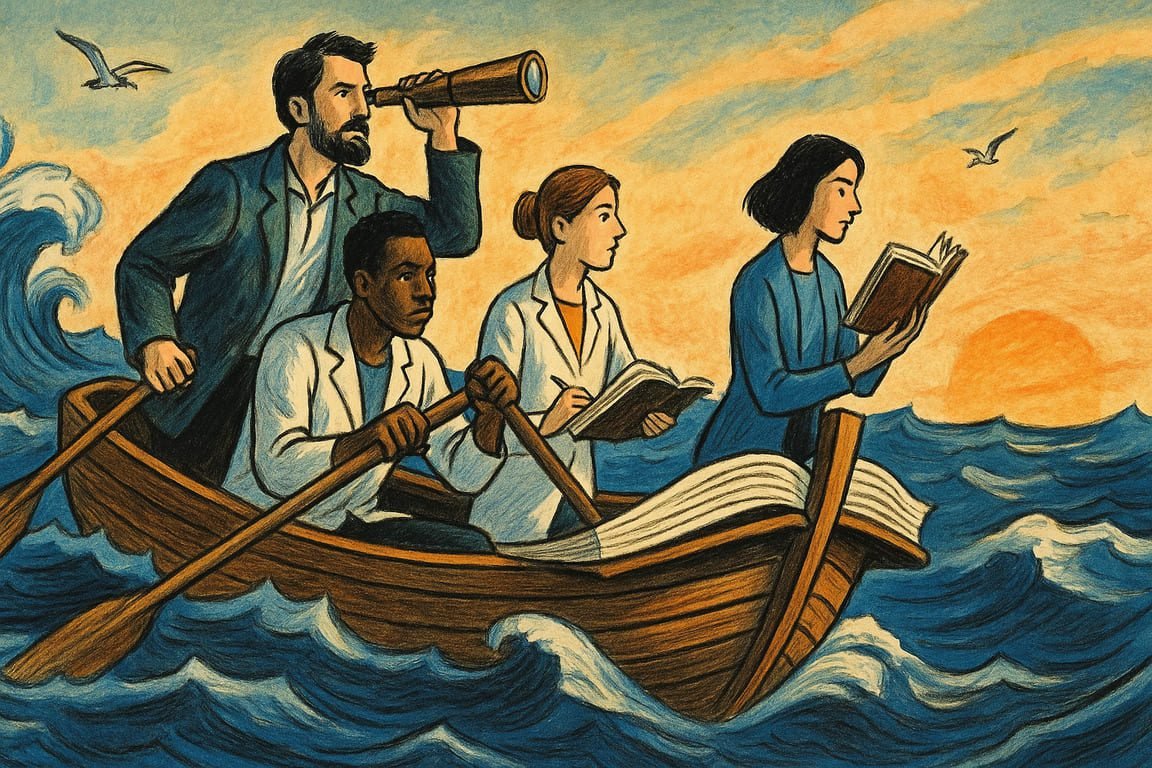
Floodlights sweep across a cavernous maritime museum as rain rattles the roof and echoes off ancient ship hulls. The night guard lingers at the threshold, eyes darting between ghostly figureheads and the glow of a solitary laptop where a postgraduate student maps the next leg of her research. The world outside feels untamed, yet this room—lined with maps, riddled with half-forgotten names—offers a different kind of voyage. Every researcher, from the grizzled professor to the nervous undergrad, becomes a sailor here, steering by uncertain stars through storms of doubt and surprise. The only constant is movement, the persistent urge to seek new lands no matter how many shipwrecks litter the charts.
The odyssey always starts with longing. Maybe it’s a stray statistic, a rumor in the staff lounge, or the nagging sense that something big is missing from accepted knowledge. For Chloe Tan, that spark came while volunteering at a rural library, where a single broken internet cable left dozens of schoolkids cut off from the world. Her curiosity grew into an obsession, mapping how digital divides ripple through families, businesses, even government. Chloe’s journey wasn’t plotted on any official syllabus. She just followed the current that tugged at her gut.
Research never follows a straight path. You launch from a familiar harbor—some comfortable textbook, a well-worn theory—only to find the winds changing. Data veers off course. Sources dry up or explode in relevance. Every turn forces you to question your methods, your motives, even your own endurance. Yet this chaos is the price of adventure. Real discovery rarely shows up on Google Maps. It happens in the shoals, the blind spots, the overlooked wrecks.
What makes the odyssey worth it? The thrill isn’t just in finding new answers, but in learning to ask better questions. When you start, you want clear skies and simple conclusions. As you travel, you learn to savor the fog, the ambiguity, the beautiful complexity that refuses to fit inside neat boundaries. The best researchers aren’t always the boldest. They’re the ones most willing to stay lost a little longer.
Every voyage needs a crew. Whether you’re chasing ancient trade routes or debugging software, the greatest journeys are team efforts. You’ll meet doubters, rivals, mentors, and the occasional stowaway with a radical idea. Once, Chloe nearly scrapped her whole project after a skeptical librarian challenged her assumptions. That encounter forced her to rethink everything—and made the final findings twice as sharp. A true odyssey doesn’t just test your intellect. It tests your humility.
Modern research is crowded with sirens. Social media brims with half-true findings. Grant applications tempt you to take shortcuts. Old guard institutions warn against heresy. Each voice tries to pull you off course. Staying focused means learning when to listen and when to plug your ears. The lesson hits hardest when you realize that certainty is usually an illusion, and only curiosity keeps the ship afloat.
Sometimes, the journey stings. Funding evaporates. Experiments fail. Trusted maps turn out to be fakes. For every celebrated breakthrough, there are a dozen lonely nights spent doubting your direction. Chloe still remembers the night her laptop crashed just before submitting her final analysis—a minor tragedy, but one that tested her resolve. She rebuilt, word by word, not because of the deadline but because she believed in the voyage itself.
The odyssey doesn’t end with the first discovery. One finding opens a dozen new questions, each more unruly than the last. That’s why seasoned researchers call their career a series of expeditions. What you learn from the first trip—resilience, creativity, the courage to pivot—becomes the compass for every new departure.
Pop culture loves the quick fix, the single hero who cracks the code and sails into the sunset. The truth is quieter and far more thrilling. Knowledge is an ocean without edges. Each journey adds to the map, but nobody ever sails it all. The researcher who accepts this paradox finds a peculiar kind of freedom: the right to keep searching without ever needing to “arrive.”
Collaboration changes everything. When Chloe shared her findings with a group of urban planners, they invited her to co-design a broadband rollout for marginalized communities. What started as a solitary project became a city-wide experiment in digital equity. Research, like all great journeys, grows bigger as more hands join the work.
You are the captain of your own odyssey, whether you’re untangling history, predicting market trends, or decoding ancient scripts. What matters most isn’t your expertise or pedigree, but your willingness to launch, get lost, and keep paddling. Some days you’ll chart new waters. Other days, you’ll bail water by the cupful and hope the leaks hold. Both are necessary.
Each odyssey brings its own monsters—doubt, distraction, institutional inertia. But it also brings allies, miracles, and the occasional tailwind that makes impossible distances vanish overnight. The sea of knowledge never stands still. What was once taboo becomes gospel, and yesterday’s heresy becomes today’s headline. Your job is to keep moving.
Somewhere near dawn, in the museum’s shadowy backroom, the postgraduate student finally steps outside, squinting at a sky bruised with the promise of new discoveries. The rain has stopped. Every puddle on the pavement reflects the city’s lights—unsteady, infinite, inviting. Across the water, a lighthouse sweeps its beam through the fog, daring the lost and the restless to set sail again.
Knowledge isn’t a harbor. It’s a horizon. All that matters is how far you’re willing to go—and whether, in the silence between waves, you hear the call to journey on.
