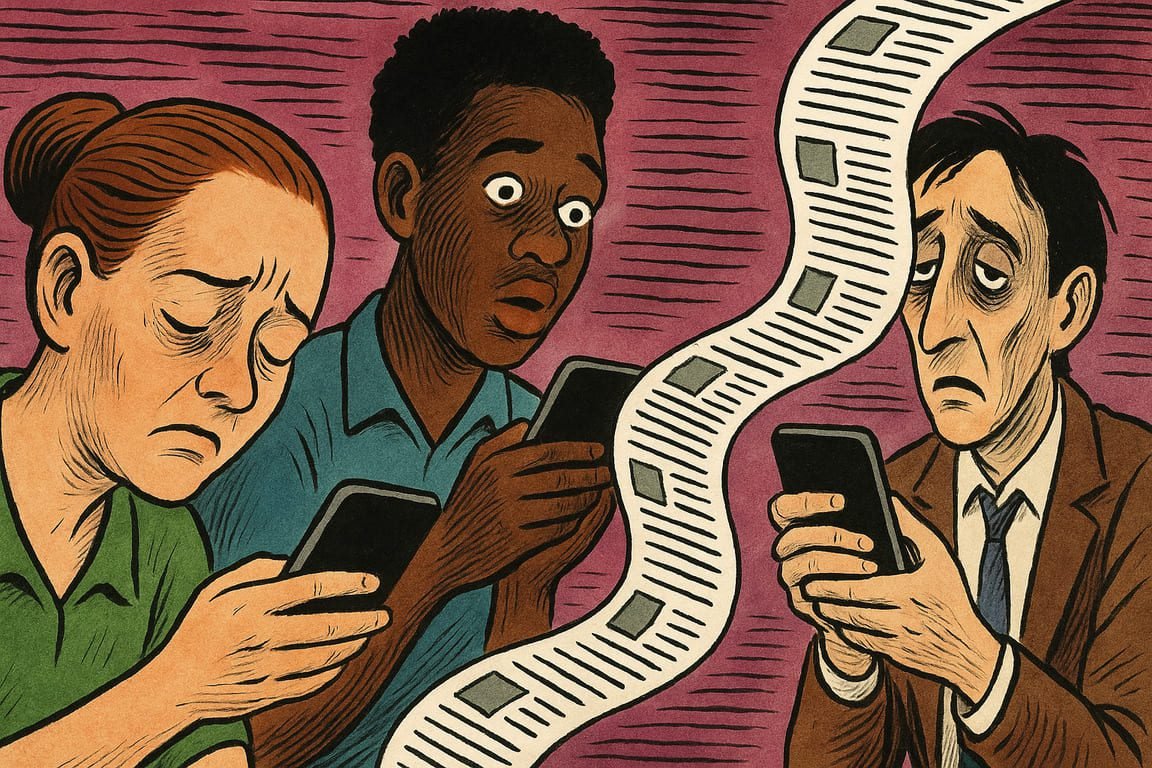
A tired student in Buenos Aires flicks her thumb across a glowing screen, chasing a laugh, a meme, or a brief sense of connection. In the next room, her father loses track of time reading news, arguments, and clickbait headlines that never seem to run out. Neon signs outside blink “Open 24/7,” but nobody leaves their couch. Somewhere, an app engineer perfects a loading animation designed to lure you deeper, to keep you from leaving. Outside, the city breathes. Inside, everyone is lost in the scroll.
Every morning, millions wake to a river of content that never pauses, never asks permission, and never truly satisfies. The old rituals of reading the paper, sipping coffee, and letting silence linger have faded, replaced by a jittery compulsion to refresh, tap, swipe, and repeat. The sun rises, but the glow that greets you comes from a screen, not a window.
The day blurs into evening. What started as a search for news turns into a tumble down rabbit holes—recipe videos, influencer gossip, rage threads. Nobody can remember what they came for. The scroll is always hungry, always ready. It takes without asking and leaves nothing but a hazy sense of time lost.
This is not just distraction. It’s quiet theft, and it’s everywhere.
Quick Notes
- The Endless Loop: Infinite scroll designs keep you engaged by removing stopping points, turning every moment into a potential trap.
- Hijacked Attention: Algorithms serve up viral content and controversy, fueling addiction, anxiety, and wasted hours.
- Stolen Time: The minutes and hours spent scrolling erode real-life relationships, creativity, and health.
- Cultural Reflection: Films, series, and viral moments reveal society’s growing unease with screens that never sleep.
- Finding the Exit: People and organizations are waking up, setting boundaries, and designing tools to reclaim time and meaning.
The Endless Loop: Trapped by Design
Infinite scroll isn’t an accident. It’s the work of tech designers like Aza Raskin, who once admitted he “unleashed a monster” by removing the end from online feeds. Now, social media giants rely on endless content to boost ad views, turning every scroll into profit. Each swipe is a bet that you’ll stay just a little longer.
Ella, a freelance graphic designer, remembers when Facebook had a “back to top” button. Now, she loses hours to Instagram reels that never stop. She laughs, “Sometimes I forget what I came for—I just get pulled in.”
Companies know exactly how to engineer the loop. Netflix autoplays the next episode. TikTok launches videos before you decide. “There’s never a natural stopping point,” says Dr. Cal Newport, a digital minimalism expert. “It’s always easier to keep going than to quit.”
Pop culture mocks and mourns the trap. The movie “The Social Dilemma” dramatizes engineers struggling with guilt as their creations become compulsions. Cartoons riff on the meme, “Just one more scroll,” showing people growing old in the glow.
This is how habits form: not by choice, but by design. The scroll is a maze with no exit.
Hijacked Attention: Algorithms That Feed the Beast
Every moment you spend online is measured, predicted, and monetized. Algorithms analyze what makes you pause—anger, laughter, outrage—and serve up more of it. Virality isn’t an accident; it’s a science.
Ravi, a college student in Bangalore, confesses he planned to watch one video and ended up arguing politics with strangers at 3 a.m. “The feed knows what makes me mad,” he says, “and it’s really good at showing more.”
News cycles never end. Outrage trends hourly. Even productivity apps now sneak ads and push notifications into your quiet time. Platforms like YouTube experiment with “up next” to keep your eyes glued to the page.
Satirical comics show people scrolling while the world burns around them, too busy fighting online battles to notice. “South Park” spoofed the cycle, showing characters trapped in a loop of notifications and FOMO.
Every tap, swipe, and pause is a signal. The more you react, the more you’re fed. The scroll is not neutral; it’s engineered to be irresistible.
Stolen Time: Life Fades as the Feed Grows
The price of endless scrolling isn’t just a few wasted minutes. It’s friendships left unread, art projects abandoned, and health quietly eroded by sleepless nights.
In Milan, Paolo used to play guitar after work. Now, he barely picks it up. “I open TikTok to unwind and next thing I know, it’s midnight.” He laughs, but his partner isn’t amused. Their dinner conversations shrink as phones fill the silence.
A New York startup found employees spent twice as long “researching trends” on Twitter than finishing client projects. The CEO implemented “no scroll” afternoons—productivity jumped, but so did withdrawal symptoms.
Health professionals warn of “digital hangover”: anxiety, brain fog, and blue-light insomnia. Relationships suffer when everyone’s attention is fragmented by competing feeds.
Pop culture has noticed. The film “Her” paints a lonely future where digital companions replace human touch. In reality, mental health clinics now offer “scroll detox” therapy.
The scroll takes more than time. It chips away at joy, presence, and connection.
Cultural Reflection: Our Uneasy Love Affair with the Feed
Society’s obsession with infinite content isn’t just a personal struggle—it’s a cultural crisis. Memes about “scrolling until your soul leaves your body” are everywhere. Comedians riff on the absurdity of social media addiction. Even late-night hosts mock their own scrolling habits.
“Black Mirror” offers warnings wrapped in fiction, showing characters lost in loops they can’t break. In “Bandersnatch,” viewers literally can’t stop choosing, mimicking the infinite scroll in narrative form.
Viral moments reveal discomfort. When Instagram crashes, panic and relief blend as people rediscover time. Influencers who log off for a week spark headlines: “What did they do with all that freedom?”
Brands cash in, selling “screen time reducers” and “digital detox” challenges. Some cities host “No Scroll Sundays,” with parks and cafes offering discounts for phone-free patrons.
Culture sees the problem. The joke, the fear, the longing for something real—they all point to the same truth: everyone is hungry for an exit.
Finding the Exit: Reclaiming Time, One Swipe at a Time
The fightback has begun. People are setting limits, deleting apps, and turning to technology to fix what technology broke. Features like “You’ve scrolled too long” nudge users to take breaks. Screen time reports, though easily dismissed, plant seeds of awareness.
A teacher in Cape Town launched a “digital sabbath” program for her school—one day a week, students must leave devices at home. The first week brought protests. By the third, kids played soccer and shared stories in person.
Companies like Apple and Google now build “focus” modes to help people escape the loop. Digital minimalists champion the power of boredom—letting the mind wander without the comfort of endless content.
In Tokyo, a café bans phones and offers journals. It’s always full. Customers say it feels like “time expands again.”
Reclaiming time is a movement. It’s small, personal, and sometimes lonely, but it’s growing.
Beyond the Scroll: The Day You Remembered to Live
In a quiet room, a student sets down her phone and watches sunlight creep across her desk. Her mind wanders, untethered for the first time in days. Somewhere, a musician picks up his guitar, the notes filling the silence left behind by notifications.
Time, once stolen, starts to return—not all at once, but in stolen moments, slow mornings, unhurried laughter. The scroll loses its grip, and life, tentative and bright, begins to breathe again. You can choose to step out of the spiral. All it takes is one pause—one moment to remember what it feels like to be truly here.