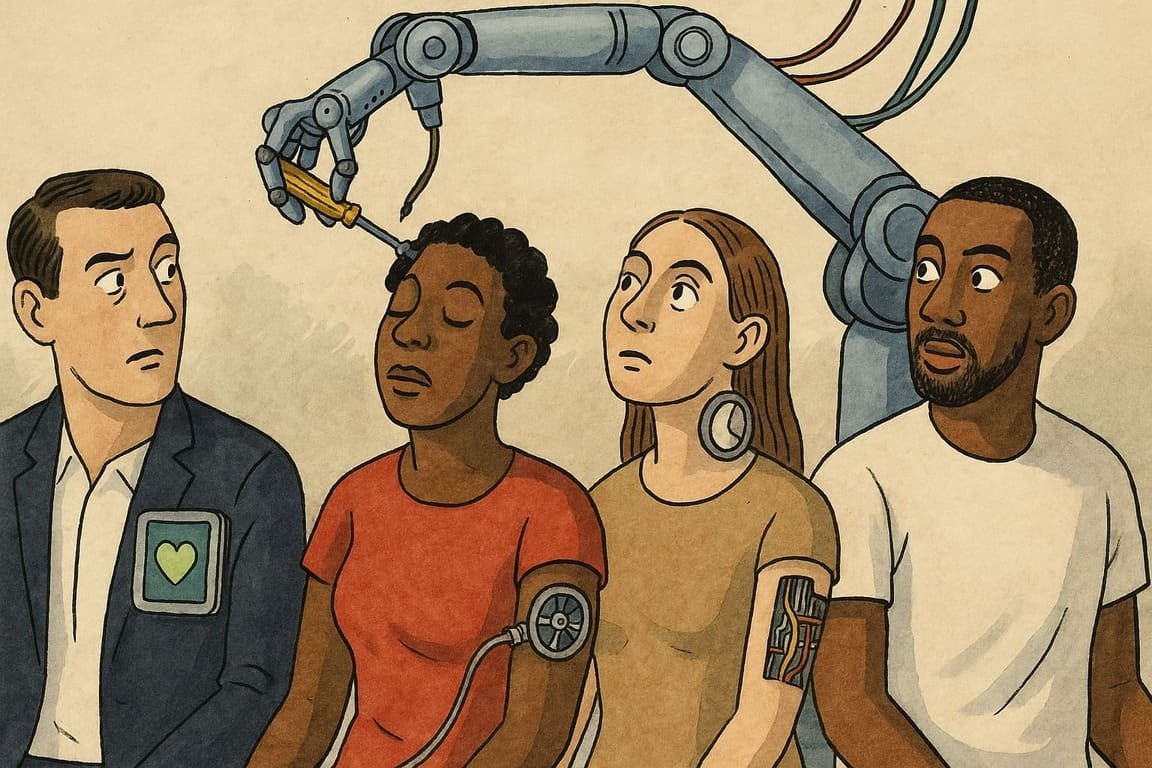
Spotlights burned in the sterile quiet of a research facility, far from the chaos of city streets. Technicians in crisp coats glided through glass corridors, their reflections merging with screens that pulsed with data—sleep cycles, mood swings, hopes, fears. Beneath each polished surface, the promise of reinvention flickered: biology rewritten by silicon, imperfection re-engineered by code. On a bench, a patient named Helena closed her eyes as soft sensors traced the tremor of her breath, mapping her neural rhythms in real time.
No alarms blared, no dramatic pronouncements shattered the calm. Instead, the work unfolded in whispers: a new implant here, a gene tweak there, an algorithmic correction for every emotional glitch. Outside, commuters scrolled past headlines promising a future where every flaw could be tweaked, every struggle smoothed. Inside, the lines blurred between therapy and upgrade, health and ambition, humanity and the logic of machines.
One researcher, arms folded at the observation window, watched Helena’s silhouette dissolve into a wash of numbers. Her story was just one among thousands—each a quiet gamble that what made us fragile could be optimized, upgraded, erased. In the dawn’s first light, a question lingered over the lab’s threshold: If technology can fix anything, what do we risk when it fixes too much?
Quick Notes
- Engineering Humanity: Today’s technology promises not just cures, but upgrades—remaking everything from mood to memory, ambition to empathy.
- Blurred Boundaries: The line between healing and enhancement grows thin, as medical fixes spill into the quest for perfectibility.
- New Ethics, New Risks: Real stories show how tech interventions bring hope, but also loss—of unpredictability, identity, even joy.
- Power Shift: The rise of “fix-it” culture lets corporations and coders shape not just our bodies, but our minds and values.
- The Challenge: As we embrace relentless improvement, we face a choice: surrender to the dream of perfection, or reclaim what makes us stubbornly, beautifully human.
Curing the Uncurable, Upgrading the Average
Across the world, clinics hum with the business of rewiring human limits. At MindSpring Neuro, a startup in Stockholm, doctors use neural stimulators to ease depression and boost memory. Sofia, a marketing manager who struggled for years with sleepless nights and foggy days, describes her first session: “It felt like waking up from underwater—suddenly, I could remember every name, every idea.” Her story is just one of many.
Tech giants are racing to commercialize genetic and cognitive upgrades. At GeneEdge, engineers offer tailored gene edits to reduce disease risk—and, for those who can afford it, to increase intelligence or stamina. Critics worry about inequality, but clients like Arjun, a marathon runner from Dubai, celebrate new records set with CRISPR tweaks. “Why settle for average?” he laughs, flexing for his followers.
This pursuit isn’t confined to the rich. In classrooms from Seoul to San Francisco, wearable devices nudge students to pay attention, warning teachers when focus flags. A high schooler, Maya, recalls feeling “caught between wanting to try harder and wanting to unplug.” Her principal calls it “personalized education.” The cafeteria talk, though, is about surveillance.
The theoretical framework is old—transhumanism’s dream of transcending biology. But now, it’s lived experience. A factory team in Shenzhen tracks fatigue with smart helmets; their manager claims workplace accidents have dropped, but workers whisper about losing the right to be tired. The numbers tell one story, the people another.
Stories multiply: a novelist who uses memory aids to write faster, a musician whose AI-powered hearing implant restores lost notes, a retiree whose tremors fade thanks to neural feedback. Each case blurs the line between treatment and transformation, raising questions machines can’t answer.
From Healing to Enhancement
Once, technology’s goal was to heal the broken. Now, it aims to upgrade the functional. At OptiMood, a wellness app popular among young professionals, users log their emotions and get AI-crafted suggestions: meditate, exercise, connect with friends. Olivia, a junior lawyer, finds herself following the app’s nudges without question. “It’s like having a tiny therapist in my pocket,” she says. “But sometimes I wonder if I’m just living by numbers.”
Corporate wellness programs embrace the trend. Employees at FutureDesk, a leading co-working firm, wear wristbands that monitor heart rates and suggest “micro-breaks” to avoid burnout. Their HR director, Mark, swears by the results: “Productivity is up, sick days are down.” Yet, in private, workers trade hacks to trick the trackers for a few moments of privacy.
At the heart of this movement is the pursuit of control. If an algorithm can predict panic attacks or bad moods, why not prevent them entirely? A college freshman, Samir, uses an emotion-predicting app that texts his roommate when anxiety spikes. “It helps, I guess,” he shrugs, “but sometimes I miss being left alone with my feelings.”
Futurists argue that self-optimization is liberation, but therapists warn of new anxieties. “Perfectionism is going digital,” says Dr. Nguyen, a psychologist who counsels app-addicted teens. “We’re raising kids to fear ordinary emotions.” Stories of burnout, self-doubt, and tech fatigue now echo across dinner tables.
At a recent hackathon, a team unveiled a patch that boosts creativity with mild electrical pulses. Investors cheered; artists grimaced. The new gold rush isn’t for cures—it’s for upgrades, and everyone wants a piece.
The Cost of Constant Correction
Fixing flaws isn’t free. As upgrades multiply, so do side effects, sacrifices, and second thoughts. A programmer in Mumbai, Raj, received a brain-computer interface to treat migraines, only to discover his sense of taste changed. “Food is just… bland now,” he told friends. The headaches were gone, but so was his favorite spice.
At a biotech summit, a renowned ethicist recounted the story of a couple who used fertility tech to select for “resilience.” Their son excelled in sports, but confessed to feeling disconnected, unsure whether his victories belonged to him or the algorithm. “I’m grateful, but am I me?” he asked quietly, after the applause faded.
Corporations face a different struggle. A financial services firm installed emotion-sensing cameras to spot fraud by analyzing facial cues. The unintended consequence: employees learned to mask their emotions so well that trust within teams began to erode. Their manager, Lena, tried to rebuild morale with old-fashioned retreats. “We need a break from being upgraded,” she joked, only half-serious.
Sometimes, the cost is invisible. At Aurora Health, a clinic specializing in memory enhancement, staff noticed that patients with perfect recall became less forgiving of others’ forgetfulness. The pursuit of flawlessness bred new kinds of impatience, even cruelty.
These stories reveal a paradox: every fix creates a new variable, every correction opens a fresh wound. The dream of total optimization risks trading chaos for sterility, connection for control. The machine solves problems—then writes new ones, in code only humans can decode.
Who Decides What Needs Fixing?
Behind every upgrade is a decision: what counts as “broken”? At CivicGen, a startup in Nairobi, coders debate whether social shyness is a problem to be solved or a difference to be respected. Their lead designer, Amina, insists, “Not every quirk needs a cure.” Her stance sparks debate at weekly meetings, but customers keep requesting fixes for ordinary struggles.
Power shifts subtly in this landscape. When Google’s algorithm quietly redefines “healthy” search results, or when a fitness tracker penalizes “unproductive” sleep, someone—often unseen—has decided what “better” means. A young mother in Toronto discovered her smart speaker’s advice changed after a software update: bedtime routines became stricter, story time shorter. She wondered who got to rewrite her family’s rituals.
Theories of “algorithmic governance” warn of subtle coercion, even as users cheer each new breakthrough. For every skeptic, a dozen enthusiasts line up for the latest mood chip, productivity booster, or social skills tutor. The promise is seductive: a life with less pain, more success.
But the trade-off is real. When a software patch removed “negative” emotion cues from a popular mindfulness app, users reported feeling numb, cut off from the emotional range that once anchored their days. The company, pressured by investors, restored the feature—after months of confused customers.
These debates shape the future as much as any invention. The question remains: do we trust the fixers, or learn to love what isn’t broken?
Reclaiming the Right to Be Human
Not everyone is ready to surrender to the upgrade parade. At the annual Humanist Tech Forum, speakers champion “intentional imperfection”—a movement to preserve the mess, wonder, and vulnerability of unedited life. Their leader, Dr. Felix, tells the story of his sister, a jazz pianist who refused a tempo-correcting implant. “She wanted to miss a beat, to feel the music’s risk.” The crowd erupts.
In workplaces and homes, people experiment with “tech sabbaticals,” setting aside wearables, apps, even basic analytics to remember what unoptimized days feel like. A restaurateur in Rome, Lucia, banned phones and smartwatches from her dining room, trading data for conversation. Her business boomed, a sign that imperfection has fans.
Still, resistance is a privilege not everyone can afford. For those with chronic illness, trauma, or deep-seated challenges, tech fixes remain a lifeline. At OpenHope, a nonprofit in Mumbai, volunteers balance cutting-edge tools with old-fashioned empathy, reminding clients that healing and upgrading aren’t always the same.
The real revolution may lie in making room for both: choosing when to optimize, when to accept, and when to rebel. The “right to be human” is not a nostalgic slogan—it’s the next frontier of freedom.
As technology advances, the battle lines shift. The question is not whether we can be fixed, but who decides what’s worth fixing, and what must be left gloriously, heartbreakingly whole.
The Last Experiment: What Remains After the Upgrade
In a quiet corner of the lab, Helena’s monitor went dark, her pulse steady and unremarkable. The researchers filed their notes, the algorithms spun into new rounds of correction. For a moment, the room was still. Then, beyond the sterile glass, the sun slipped through, painting the walls with gold, indifferent to optimization.
Somewhere outside, a jazz song wandered offbeat, laughter spilled out of a coffee shop, and a child lost his balance chasing pigeons. The world, unruly and unscripted, thrived on what technology could not catch. You will face the question: what in yourself will you choose not to fix?