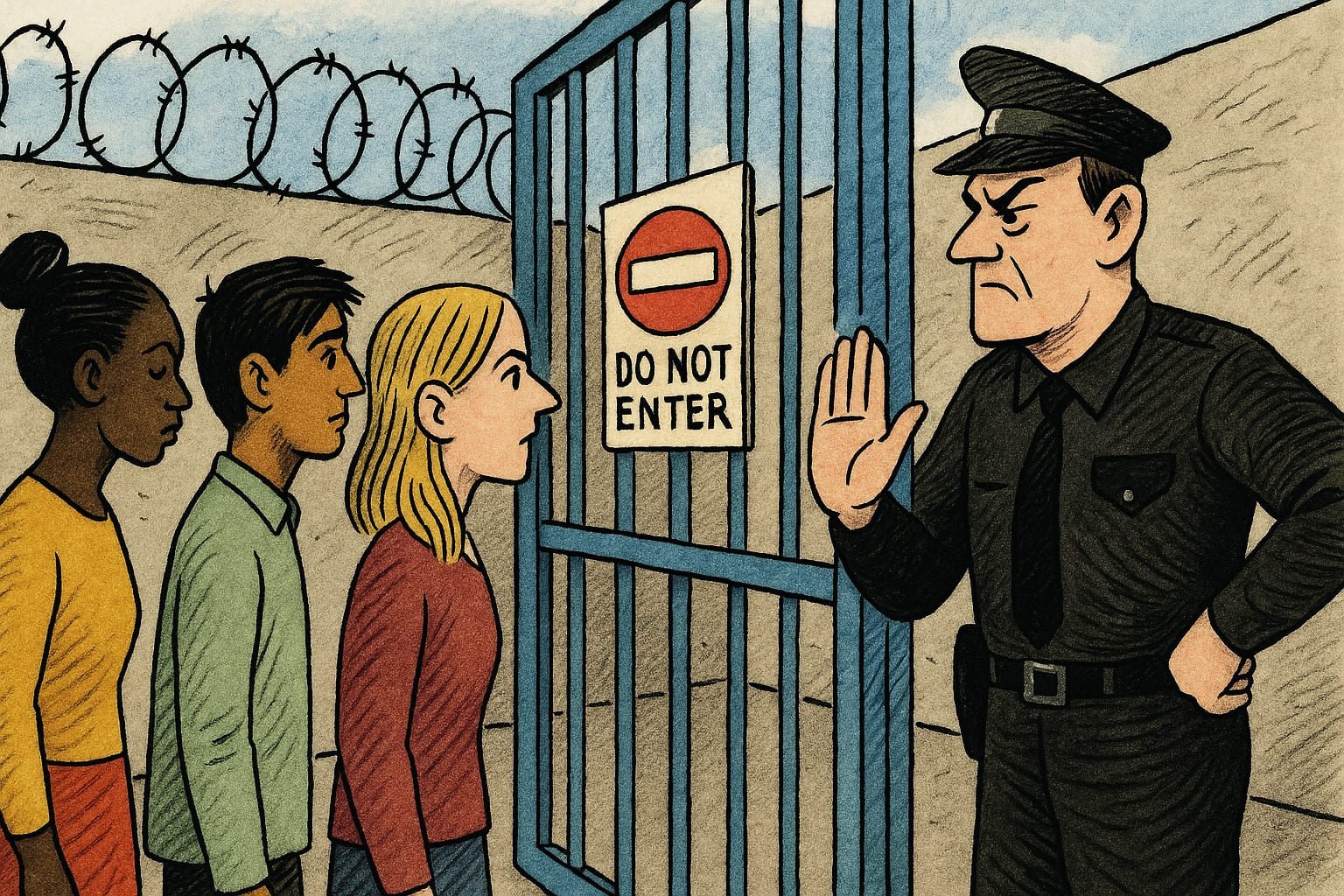
The world is a party let’s not kid ourselves but only a few ever get past the velvet rope. Some carry golden tickets stitched with birthrights, others stand in endless lines, eyes fixed on the bouncer called “Immigration Policy.” Every so often, someone jumps the fence, chased by headlines that frame them as both threat and promise, villain and savior. Few topics slice so close to the bone of national identity as immigration rights, where politics, power, and human dreams collide in a spectacle that’s equal parts Hunger Games and Shakespearean drama. Is it really about security and jobs, or is it about who gets to write the guest list for the world’s future? Get ready with your cup of coffee, because the story of “who’s in” is a mirror for every fear, hope, and hypocrisy we harbor about belonging and it’s about to get messy, emotional, and, if you’re paying attention, deeply transformative.
Quick Notes
- Immigration policy isn’t just paperwork; it’s a high-stakes test of national character, shaping destinies and reimagining borders through political decisions, human stories, and global pressures.
- Behind every heated debate about “who gets in” are the real, raw tales of families separated, economies revived, cultures blended, and identities transformed, challenging our deepest beliefs about fairness and belonging.
- Politicians turn immigration into theater, wielding fear, hope, and identity to stir crowds, while businesses quietly rewrite the rules in pursuit of profit, and activists fight for voices drowned out in the noise.
- Case studies from Silicon Valley to Syrian refugee camps prove that those deemed “outsiders” today often build tomorrow’s prosperity, offering living proof that border walls and welcome mats are both tools of power and symbols of moral choice.
- The politics of immigration is ultimately a question we must answer as individuals and as a society: Who are we if we shut the door and what could we become if we dare to open it wider?
The Gatekeepers’ Game: Who Gets to Decide Belonging?
Nothing divides a room faster than the question, “Who deserves to be here?” especially when “here” means a shot at freedom, safety, or just a decent job. The gatekeepers, often faceless bureaucrats or headline-grabbing politicians, hold the power to turn borders into bridges or barricades. One day, a president stands at a podium promising compassion; the next, razor wire unspools at the border as if fear itself has a physical form. Laws and quotas become a ritual dance, where the music changes with every election cycle and each new crisis, sometimes swaying with empathy, sometimes stomping to the drum of exclusion. Every headline screams for clarity, yet the rules shift, obscured by trade-offs between security and humanity, between economic need and political theater.
Remember Ahmed, a Syrian doctor who risked his life crossing three countries to reunite with his family in Berlin? His journey wasn’t just about escaping bombs; it was about finding a place that would let his skills heal again, not rot in exile. The paperwork was grueling, the interviews dehumanizing, the waiting endless, but when he finally got his residency, his new city gained a healer, a taxpayer, and a bridge between worlds. Ahmed’s story isn’t unique; it’s the rule, not the exception. Every country’s hospital, tech startup, or bakery likely has a story like his simmering quietly in the background.
Turn on the news, and you’ll find talking heads debating what “real citizenship” means. Is it birth? Bloodline? Loyalty? Yet in practice, citizenship is more like a lottery crossed with a reality show, where luck, connections, and political winds matter more than anything written in law. Countries cling to their sovereignty, arguing it’s about protecting “our way of life,” while quietly benefitting from newcomers’ energy and ambition. The irony? Most of the loudest voices against immigration conveniently forget their own ancestors arrived with nothing but hope and a willingness to start over.
On paper, immigration policies read like solemn contracts: points for education, deductions for criminal records, bonuses for rare skills. But these systems often miss the messiest, most human parts; grit, resilience, sheer hunger for a better life. Real power belongs to those who design these invisible filters, balancing national interest with global compassion, while rarely acknowledging the randomness and cruelty that can define a person’s fate. In a world obsessed with fairness, few systems are so perfectly designed to make you question whether fairness is even possible.
As borders harden, the stories keep coming; children torn from parents, asylum seekers languishing in limbo, dreamers walking tightropes over deportation threats. And yet, for every wall built, someone finds a door, a loophole, or a kind stranger who breaks the rules for love, for justice, or just for the hell of it. Gatekeepers may write the rules, but history belongs to those who refuse to accept them as final.
The Power of Story: How Immigrants Redefine Nations
Every statistic about migration hides a heartbeat, a story, and sometimes a revolution. People don’t uproot their lives on a whim; desperation, hope, and ambition drive them to risk everything for a fresh start. These journeys leave scars but also spark new cultures, infusing old neighborhoods with fresh ideas, foods, languages, and dreams. Immigrants aren’t just bodies filling labor shortages; they are living proof that national identity is always under construction; a mosaic, not a monolith.
Ask anyone who’s watched a neighborhood transform as newcomers arrive. In Toronto, Indian and Filipino immigrants turned a sleepy suburb into a culinary and economic powerhouse, where old diners serve curry next to poutine. In Texas, Mexican migrants revived dying towns, opening businesses, schools, and entire ecosystems of possibility. Far from being a “burden,” these communities became the glue that held fraying places together. The lesson is simple: the story of immigration is the story of renewal, survival, and astonishing creativity.
Then come the backlash headlines; “they’re taking our jobs,” “they’re changing our values,” as if culture were a fixed object instead of a living, breathing thing. The truth is, cultural evolution is as natural as breathing. When hip-hop took root in New York’s immigrant neighborhoods, few predicted it would conquer the world, just as no one thought Korean dramas would storm Western screens. Every time cultures meet, something unexpected blooms; sometimes messy, sometimes magical, but always more interesting than a closed door.
Case studies tell a tale numbers never could. Google, Tesla, and countless Silicon Valley icons owe their genesis to immigrant founders or first-generation grit. The late Steve Jobs, son of a Syrian migrant, changed the way humanity communicates and thinks proof that exclusion often means losing tomorrow’s visionaries. On the flip side, every time a country cracks down on refugees, it turns away not just the desperate, but the determined; the ones who might have built the next big thing.
Immigrant voices are often the first to warn when society drifts into intolerance or complacency. They see old prejudices and new opportunities in ways locals can’t, having lived both sides of the border. Their children grow up with hybrid identities; never fully “from here,” never entirely “from there” and become the translators, bridge-builders, and, sometimes, troublemakers who force countries to confront their own blind spots. Immigration is rarely about loss; it’s about the perpetual reinvention of “us.”
Political Theater or Human Rights? The Battle for the Narrative
Every election season, politicians dust off the script of immigration, casting themselves as protectors or liberators, depending on the crowd. It’s a spectacle as old as politics itself: fear sells, hope inspires, and identity wins votes. When borders are front-page news, the conversation shifts from economics to morality, from jobs to values, and from security to the existential question of who we are as a people. The result is often noise, with real lives lost in the shuffle.
Look closer, though, and the motivations are rarely pure. Leaders frame migrants as threats when they need a distraction from failing policies or economic woes, but hail them as heroes when their skills save an industry or score a diplomatic win. The same parliament that debates stricter controls one week welcomes “highly skilled migrants” the next, exposing the double standards baked into policy. In this circus, the loudest voices often drown out the most vulnerable, while corporations quietly lobby for loopholes to fill jobs and fatten profits.
Real human rights battles rage just outside the spotlight. Lawyers fight to reunite families, faith groups shelter the undocumented, and activists stage hunger strikes for asylum seekers at risk of deportation. For every speech about “orderly migration,” there’s a camp full of people waiting, hoping, and wondering whether justice will ever reach their side of the fence. The paradox is clear: immigration law is about as predictable as a weather forecast, but the stakes are nothing less than life or death.
The narrative war goes beyond borders. Social media platforms amplify every outrage, real or manufactured, turning local incidents into global flashpoints. One viral video of a border patrol gone wrong can upend political fortunes, mobilize protests, or deepen divides overnight. The winners of these battles aren’t always the righteous; they’re often the loudest, the most organized, or the ones who know how to pull emotional levers in a twenty-four-hour news cycle.
In the end, the question lingers: is immigration a matter of sovereignty or solidarity? Are borders there to keep people out, or to invite the best the world has to offer? The answer, inconveniently, depends less on law and more on the stories we choose to tell ourselves; about danger, about hope, and about the kind of society we want to build. The narrative isn’t set in stone; it’s rewritten every day, in every country, by the choices we make and the fears we indulge.
Walls, Bridges, and The Big Lie: Economics and the Reality of Inclusion
Talk to a taxi driver in Paris or a nurse in New York, and you’ll hear a truth the headlines miss: immigration isn’t just a political problem; it’s an economic engine with quirks, contradictions, and untapped potential. While politicians wage war over “open borders” versus “closed doors,” businesses quietly adapt, hiring whoever can get the job done and often lobbying for the policies that suit their bottom lines. The results can be surprising, sometimes infuriating, always revealing.
Silicon Valley would not exist without foreign-born coders, scientists, and entrepreneurs, yet those same workers often face labyrinthine visa hurdles that make the lottery look merciful by comparison. Farms in California or Spain rely on migrant hands to harvest crops, while politicians argue about “illegals” and “essential workers” in the same breath. The contradiction is almost poetic: those most needed are often least welcome, at least in the public narrative. Meanwhile, economies quietly depend on the invisible labor force that sustains them.
My friend Lucia’s father arrived in Canada with nothing but a suitcase and a letter of acceptance from a meatpacking plant. Decades later, his children run businesses, pay taxes, and serve on city councils. The “burden” became the backbone; the outsider became the neighbor. Multiply Lucia’s story by millions, and you get a sense of the unacknowledged return on investment that countries reap from those once seen as “costs.”
The big lie is that immigration drains resources, when in reality it replenishes them economically, culturally, and, yes, even spiritually. But that doesn’t mean there are no tensions or real challenges. Housing markets tighten, schools adapt, and communities sometimes strain to integrate the new with the old. Yet every wave of newcomers brings renewal, and the greatest cities are always those that figured out how to turn strangers into stakeholders.
Economics isn’t destiny, though; it’s politics that ultimately sets the terms. Countries can choose to build walls or lay out welcome mats, but the future belongs to those that understand: prosperity is not a pie with fixed slices, but a banquet that grows richer every time another chair is pulled up to the table. The only real scarcity is imagination and political will.
The Future is Fluid: Redrawing the Map of Belonging
Peering into the future, the old rules of migration are crumbling. Climate change, technology, and shifting power balances are rewriting the script faster than any government can legislate. Rising seas, wildfires, and collapsing economies are forcing people to move not out of choice, but necessity; a wave of “climate refugees” already testing the limits of international law and moral imagination. If borders are lines drawn in sand, the tide is coming in.
Smart countries are rethinking what it means to belong, experimenting with “digital nomad” visas, path-to-citizenship reforms, and sanctuary cities that flip the script on exclusion. Estonia’s e-residency lets entrepreneurs operate globally without ever setting foot in Tallinn. New Zealand, battered by climate disasters, prepares to welcome island nations whose homes may vanish beneath the waves. The question is no longer whether to adapt, but how fast and how fairly.
Pop culture isn’t waiting for politicians to catch up. Music, movies, and memes transcend borders in seconds, shaping identities that don’t fit tidy national boxes. Gen Z grew up online, more likely to have friends on other continents than across the street, and less inclined to see “foreigner” as a slur. Their heroes are often immigrants, refugees, or third-culture kids who rewrite the rules and remix traditions into something entirely new. Identity itself is going global.
One telling story: when the COVID-19 pandemic closed borders overnight, countries faced a reckoning. Essential workers; often immigrants kept cities alive, delivering food, caring for the sick, and proving that survival depends on solidarity, not suspicion. When the crisis ebbed, many of these same workers found themselves threatened with deportation, a brutal reminder that gratitude in politics is fickle, and justice unfinished. Yet the lesson lingers: the old boundaries are porous, and the only constant is change.
As the map of belonging redraws itself, the choice is stark: cling to the illusion of purity, or embrace a world where “who’s in” means anyone bold enough to imagine, contribute, and care. The future, like the past, will belong to the risk-takers, the bridge-builders, and the dreamers who refuse to accept that any velvet rope is final. Belonging, in the end, isn’t about permission; it’s about participation.
The Grand Unmasking: Will We Open the Door or Lock Ourselves In?
Every nation’s history is a story of arrival sometimes forced, sometimes welcomed, always transformative. The politics of immigration rights isn’t just a question for lawmakers; it’s a crucible where our best ideals and our worst fears are tested daily. Will we choose the comfort of walls, or the daring of bridges? The answer will define who we are and who we might yet become. If history proves anything, it’s that those willing to invite the world in often find the world, in turn, remakes them for the better.
So ask yourself: Is your society a fortress, a waiting room, or a stage for the next act of human possibility? The party’s still going. The guest list is wide open. Who’s in?
Partnered. Provocative. Worth Your Scroll.
This is a Promoted Post by ESYRITE—yes, it’s paid, but never filtered. Our voice stays raw, real, and razor-sharp. We team up with bold ideas, game-changers, and stories that spark something real. If it’s here, it earned its place—no fluff, just impact. We don’t just promote—we provoke. Stay sharp. Dive deeper.
