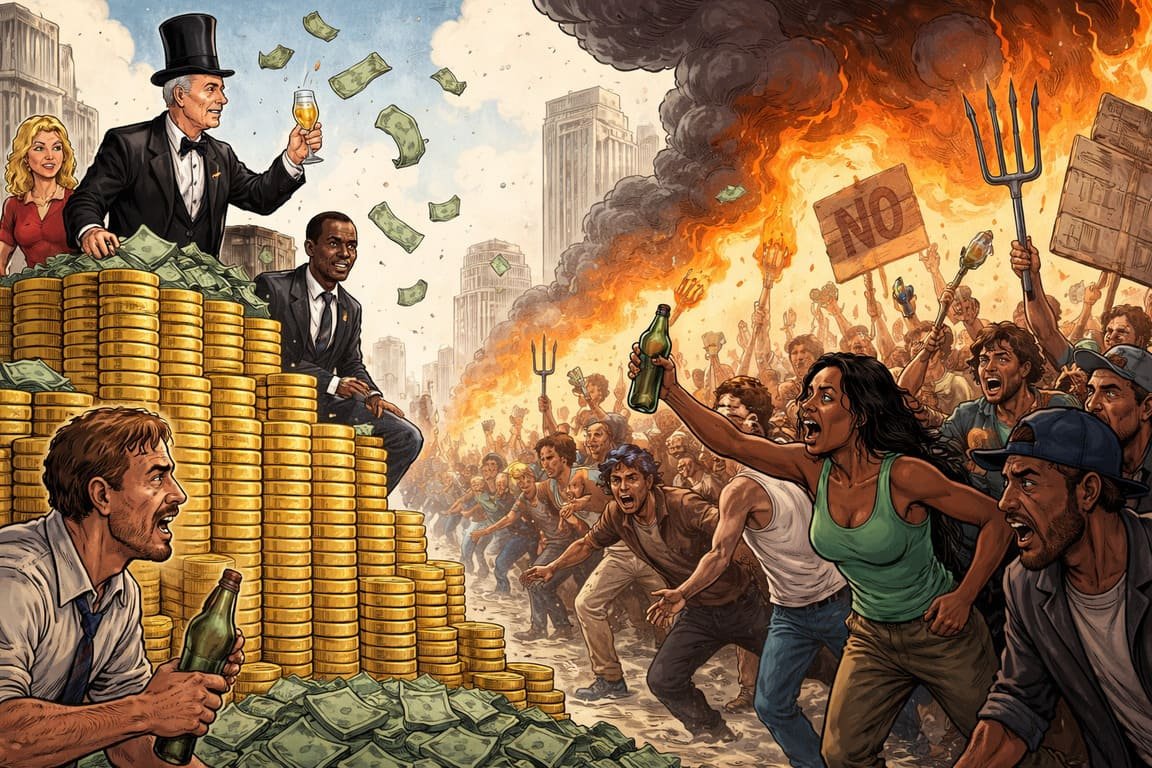
The city still works. Trains arrive. Cafés open. Glass towers reflect the sun like nothing is wrong. Yet something inside the system feels stretched thin, like a wire pulled too tight but not yet snapped. Wealth no longer simply separates lifestyles. It rearranges dignity. The gap between those who glide and those who grind has stopped being theoretical. It presses against sidewalks, classrooms, hospitals, and dinner tables, shaping choices before people realize they have been made.
Money used to signal comfort or ambition. Now it signals safety. Those without it live closer to risk, not dramatic risk, but constant risk. A missed paycheck. A medical bill. A landlord’s email. Meanwhile, those with excess float above consequences, insulated by assets that grow while others tread water. This imbalance creates more than resentment. It produces a moral fracture. When survival and abundance coexist too closely, society stops feeling shared.
History has watched this movie before, though the costumes change. When inequality hardens, unrest follows, not because people crave chaos, but because patience erodes. Revolutions rarely begin with ideology. They begin with comparison. A dockworker once described watching luxury apartments rise on land where his job vanished. He did not rage immediately. He recalibrated his belief in fairness. That recalibration is where unrest starts.
Modern inequality feels sharper because it is visible everywhere. Phones collapse distance. Lifestyles parade endlessly across screens. The problem is not aspiration. It is mockery disguised as motivation. When effort no longer correlates with outcome, hustle turns bitter. People stop asking how to succeed and start asking why the game feels rigged. That question spreads faster than policy debate ever could.
Governments often misread the temperature. Economic indicators improve while trust collapses. Growth looks healthy on paper, yet streets feel restless. A policy advisor once admitted that they celebrated rising GDP while ignoring rising anger. Numbers cannot measure humiliation. They rarely capture precarity. When institutions speak in metrics while people speak in fear, legitimacy leaks.
Corporations play a central role whether they admit it or not. Decisions made in boardrooms ripple outward, closing plants, automating roles, consolidating power. Efficiency wins applause. Communities absorb the cost. A factory shutdown does more than erase jobs. It dissolves identity. Retraining programs promise renewal but rarely replace pride. Work is not just income. It is meaning.
Culture reflects the pressure. Entertainment grows darker. Humor sharpens into satire. Success stories glamorize extremes because moderation feels unreachable. Children learn brand hierarchies before civic values. The wealth gap teaches lessons early, not through lectures, but through lived contrast. Some futures feel wide open. Others feel prewritten.
Philosophers warned that extreme inequality corrodes empathy. When lives diverge too far, imagination fails. The wealthy struggle to picture fragility. The struggling struggle to believe in fairness. Society becomes a collection of parallel realities sharing infrastructure but not experience. Trust cannot survive that distance for long.
Media coverage often accelerates misunderstanding. Protests become spectacles. Property damage becomes the story. The years of erosion vanish behind footage of a single night. Violence gets airtime. Context gets trimmed. The gap benefits from this framing. Noise distracts from cause.
There are paths forward, though none are painless. Societies that stabilize inequality focus on access, not charity. Education aligned with real opportunity. Healthcare that removes fear from illness. Tax systems that reward contribution over extraction. These ideas are not radical. They are preventative. Prevention simply lacks drama.
Responsibility extends beyond policy. Capital signals values. Consumers reward behavior. Employers decide whether profit includes people or excludes them. Small decisions compound. A business choosing stability over short term gain changes belief inside a community. Belief is the true accelerant of unrest, not ideology.
What makes this moment volatile is not poverty alone. It is proximity. The rich and struggling live close enough to see each other clearly. When hope becomes gated, patience drains quietly. Societies do not fracture because some have more. They fracture because too many feel locked out permanently.
Somewhere tonight, a city keeps humming, lights on, systems running, wealth compounding silently. The tension remains invisible until it isn’t. The question hovering over everything is simple and dangerous: whether those with power recognize that stability depends less on growth curves and more on restoring the feeling that the future still belongs to everyone, not just the fortunate few.
